THE UNIVERSITY OF SASKATCHEWAN’S MAIN CAMPUS IS SITUATED ON TREATY 6 TERRITORY AND THE HOMELAND OF THE MÉTIS.


THE UNIVERSITY OF SASKATCHEWAN’S MAIN CAMPUS IS SITUATED ON TREATY 6 TERRITORY AND THE HOMELAND OF THE MÉTIS.

Features

  • By February 19, 2012

    “You are suffering from overhydration,” Dr. Wayne Smith said, running a hand through his greying hair. “You are drinking so much water that it is becoming like a poison in your body.”

    I stared at him in disbelief. Beside me sat my metal water bottle, its flower pattern chipping from overuse. My tongue felt like sandpaper and I wanted nothing more than to take a gulp from it. But, from that moment on, it was no longer an option.

  • The Sheaf’s predictions for the 84th Annual Academy Awards

    By February 18, 2012

    Need some help predicting this year’s Oscar winners? The Sheaf has you covered. Oscar prognosticators Aren Bergstrom and Colin Gibbings both give their picks on who will win at the 84th Academy Awards. So take notes and get ready to win that Oscar pool come Feb. 26.

  • State of the arts: how arts funding affects our communities

    By February 12, 2012

    hen Stephen Harper famously declared that “ordinary people” don’t care about arts funding during the 2008 election campaign, artists and arts groups were quickly forced to prove their worth.

    In 2009, $45 million was cut from the federal arts budget, and not long after, the government of B.C. made serious cuts of its own. Since those serious cuts to arts funding in 2009, many artists and arts groups in B.C. have had to find innovative ways to generate money while struggling to make ends meet.

  • Valentine’s Series

    By February 10, 2012

    Click here to see our series on Valentine’s Day.

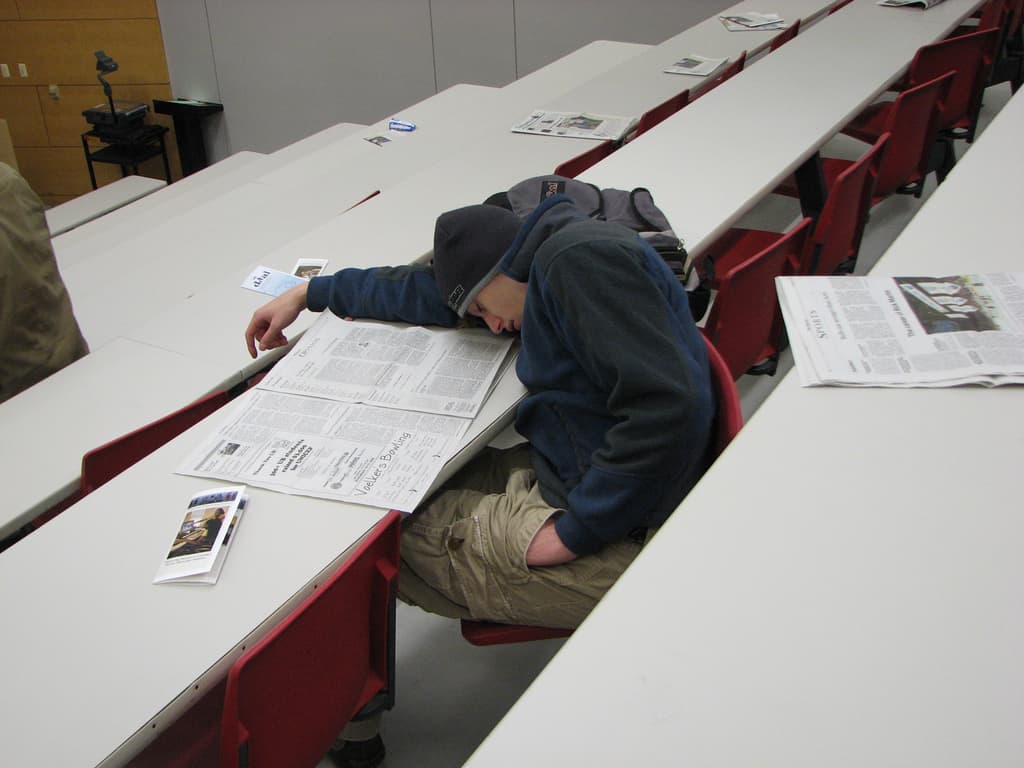
  • Are lectures losing it? Irrelevant and unengaging talks are sapping my productivity.

    By February 6, 2012

    It’s 3 p.m. on a Monday and I’m sitting in my afternoon writing lecture. The professor has been reviewing Powerpoint slides for the past half-hour and my attention has inevitably slipped away from the content of the class. In one open window of my laptop, I’m brewing ideas for the paper due at the end of this week; in another, I’m editing photos for a commercial photo shoot I did over the weekend. In my busy life, this is the perfect opportunity to get some work done. I half-listen to the lecture, perking up when a question is asked.

  • The grad school journey: professors and students offer insight into taking the big jump at the end of your degree

    By February 5, 2012

    The light at the end of the tunnel appears for many undergraduate students in their fourth year of study.

    As the month of April approaches, graduating students dream of donning gowns and tossing caps in the air in before heading off into the proverbial “real world.” For others, receiving an undergraduate degree is just the tip of the iceberg. How do professors and students — those working toward obtaining a graduate degree and those in the midst of the application process — perceive the jump to grad school?

  • The revitalization of Riversdale: artists and young entrepreneurs embrace ‘the hood’

    By November 30, 2011

    During the construction of the Two Twenty, thinking nothing of it, Curtis Olson signed an email to his friend Grant Unrah with, “It’s good in the hood.”

    He had no idea the phrase would take off like it did. Within weeks, residents across Riversdale were wearing buttons with the phrase on them.

  • Tattoos have lost their taboo

    By November 26, 2011

    At the age of 17, Mike Thompson-Hill dropped out of high school and began a career in tattooing. 16 years later he says he has seen the industry relocate from the fringes of society to the mainstream.

    A couple decades ago, tattoos were still largely seen as the domain of sailors, bikers or prisoners. But from the hugely successful Miami Ink (and its spinoffs LA Ink, London Ink and NY Ink) to the recently released “Tattoo Barbie,” tattoos are now undeniably widespread.