
THE UNIVERSITY OF SASKATCHEWAN’S MAIN CAMPUS IS SITUATED ON TREATY 6 TERRITORY AND THE HOMELAND OF THE MÉTIS.
THE UNIVERSITY OF SASKATCHEWAN’S MAIN CAMPUS IS SITUATED ON TREATY 6 TERRITORY AND THE HOMELAND OF THE MÉTIS.
TANNARA YELLAND
Associate News Editor
New buildings are going up all over campus, leaving some to wonder why the old ones weren’t good enough.
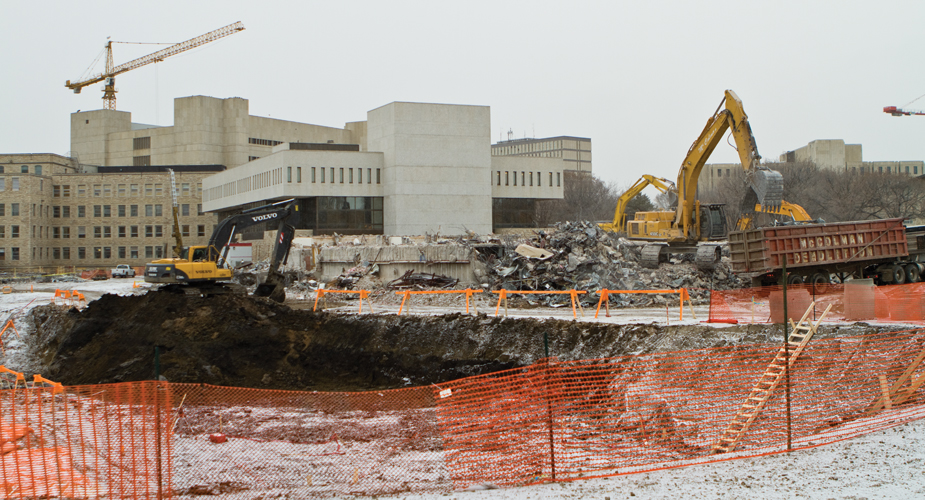
The most recent sacrifice to modernity is the Medical Research Building, formerly located beside the College of Dentistry building. It was deconstructed to make room for the E Wing of the expansive Academic Health Sciences building complex. The Academic Health Sciences project is a multi-building development intended to provide adequate space and facilities for students in the health sciences.
Rather than renovate existing buildings, the university has chosen to remove them and begin anew.
The Medical Research Building was opened only 51 years ago, in May 1958. It was built for $783,000; with an inflation rate of 4.03 per cent per year, that would amount to just under $6 million today, or just over one quarter of the cost of the new building.
Yet the E Wing is expected to cost over $121 million.
The cost of the entire project has not been released as some parts have not yet been tendered and the university might not receive competitive bids if the expected costs are released.
Brett Fairbairn, University of Saskatchewan provost and vice-president academic, called the Medical Research Building “a very old, constrained facility” and added that it had asbestos in it.
The health sciences — nursing, medicine, physical therapy, dentistry, pharmacy and nutrition — are currently revamping their programs to include a more interdisciplinary approach to learning, which the E Wing is designed to accommodate.
The D Wing being constructed opposite the Arts Building will house the research facilities, and the E Wing will have both large and small classrooms and a new library.
“The different things that are in the space reflect the academic design of the programs,” Fairbairn said.
He was also careful to draw a distinction between demolition and deconstruction. Deconstructing a building means that some of it is saved for re-use. Some of the field stone, red granite and tyndall stone from the old building will be used in the construction of the E Wing, and some of the building’s concrete will be broken down and used for road construction on campus.
Fairbairn was excited about the Academic Health Sciences project, saying it will be “the biggest teaching and learning project in the university’s history when you include all the different components of it.”
The E Wing, for which ground was broken on Oct. 13, 2009, is expected to be fully operational for the beginning of the 2013 fall term. Construction should be done by October 2012, but it will take some time to move everything into the classrooms and offices.
Also being taken down during deconstruction is the underground MRI facility that connects to the Royal University Hospital.
– –
photo: Robby Davis

Leave a Reply