
THE UNIVERSITY OF SASKATCHEWAN’S MAIN CAMPUS IS SITUATED ON TREATY 6 TERRITORY AND THE HOMELAND OF THE MÉTIS.
THE UNIVERSITY OF SASKATCHEWAN’S MAIN CAMPUS IS SITUATED ON TREATY 6 TERRITORY AND THE HOMELAND OF THE MÉTIS.
 COLE HOGAN
Arts Writer
“The only absolute knowledge attainable by man is that life is meaningless.”
-Leo Tolstoy
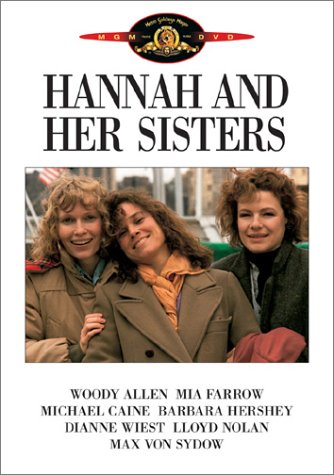
Woody Allen’s Hannah and Her Sisters plays between two Thanksgiving dinners over the course of a year.
At the first dinner we are introduced to various house guests with several problems, the focus of which is Hannah (Mia Farrow) and her sisters. Hannah, now home-maker, then actress, is the lightning rod and the object of adoration for everyone at the dinner table.
The other sisters are Lee (Barbara Hershey) and Holly (Dianne Wiest). Lee is dating a man named Frederick (Max von Sydow) and she quickly receives the secret affection of Hannah’s husband Elliot (Michael Caine). Holly has fleeting life direction, aspiring to act, then write, then who knows, during this process being unacceptably flippant. Beyond the three sisters we follow the story of Mickey (Woody Allen), a hypochondriac television producer and the ex-husband of Hannah.
The conversation in this film is non-stop and fast paced, rarely letting anyone breathe and stands in stark contrast to the backdrop these interactions take place in front of. I don’t think there’s a single bright colour in this film, nothing but pale, muted tones. While most of the conversations are quick and reassuring, the background seems to speak for the characters’ thoughts that go unspoken, or their general demeanour.
In a particular scene in a bookstore for instance, a character struggles to profess his affection for another, fumbling over his words much like the over packed bookstore fumbles over itself. Stacks of books spilling over everywhere, much like the character and his emotions.
The soundtrack for Hannah and Her Sisters is perfect. A manic jazz song flying along as Mickey tries to organize the production of his television show, or heavy piano rattling through the house as we’re introduced to all the guests during the dinner each song perfectly reflects the tone and feeling of its corresponding scene.
The score in Hannah and Her Sisters is the exact opposite of many modern film scores, which beat the viewer over the head with obvious sonic cues. The music moulds with the dialogue and works so well it’s almost unnoticeable. When the score does settle for a moment, it is for an inner monologue with one of the characters who express very common self-doubts, worries and anxieties that many, if not all, can relate to.
The cinematography is simple and this movie calls for it. There are a few impressive long, one-take shots that showcase the talent of the cast which, in this movie, is impressive to say the least. There isn’t one questionable performance or line of dialogue and the performances are among the best of the actors’ careers.
There is a scene in which a Mexican stand-off of emotions and half-truths erupt, no one saying exactly what they would like to while the camera creeps around the characters at the table. You can feel all the stories intertwining and circling themselves. The eccentricities of all the characters are performed in amazing form, especially in the character of Mickey.
The hilarity in this movie comes from watching Mickey struggle with himself, being racked with existential questions. Constantly worried about everything, he carries himself around with an ever present panic, contemplating every possibility and considering every option. Mickey’s nature is further evident in the fact that he literally goes religion shopping in this film. Mickey’s first choice is Catholicism, despite being raised a Jew. He discusses this with his parents which results in a conversation that explains the whole essence of the film.
“If there’s a God why is there so much evil the world, just on a simplistic level, like why were there Nazis?” asks Mickey.
“Tell him Max,” says Mickey’s mother.
“How the hell do I know why there were Nazis; I don’t know how the can opener works,” responds Mickey’s father.
The whole theme of the movie is revealed in this line. You can spend your life worrying about things that are beyond your control, like why there were Nazis, or you can worry about practical things that actually affect your life, like how the can opener works.
– –
Leave a Reply