
THE UNIVERSITY OF SASKATCHEWAN’S MAIN CAMPUS IS SITUATED ON TREATY 6 TERRITORY AND THE HOMELAND OF THE MÉTIS.
THE UNIVERSITY OF SASKATCHEWAN’S MAIN CAMPUS IS SITUATED ON TREATY 6 TERRITORY AND THE HOMELAND OF THE MÉTIS.
IAN REGNIER
News Writer
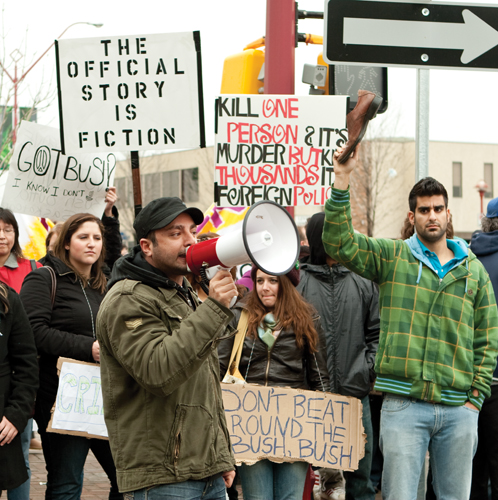
The calm, cool midday sky above downtown Saskatoon on Oct. 21 contrasted starkly with the tense atmosphere on the ground around TCU Place.
Nearly 2,000 attendees waited in line for “A Conversation with George W. Bush” while banner-waving protesters rallied across the street. From the sidewalks to the rooftops, Saskatoon cops teamed up with Secret Service and earnestly patrolled the scene.
Among the attendees there was a general feeling of anticipation to see and hear George W. Bush. Most were there as admirers, some as interested neutral parties and a few as harsh critics. One man in line tried to appeal to the disgruntled protesters by yelling, “I’m on your side!” and saw his access into the building as entering the “belly of the beast.” An all-around consensus was nowhere in sight.
Inside, the TCU event staff did a stand-up job of promptly filing people through the metal detectors and seeing them to their seats. Once the luncheon wrapped up, 650 CKOM’s John Gormley and Bedford Biofuels CEO David McClure gave brief introductions before the man himself hit the stage, greeted by a resounding standing ovation.
Bush commenced speaking in his typical Texan drawl and thanked Canadians for being America’s northern neighbours. He drew in his spectators with a charismatic statesmanship and privy self-deprecation. As a retired commander-in-chief he said life has slowed down for him, but he was here to attest to the decisions made in those “100 miles per hour” days.
Bush claimed that he had no intention of ever being a wartime president but after 9-11 it became crucial for the U.S. to take the offence against violent fundamentalist terrorists.
He also remains an adamant believer in free markets, anti-protectionism and resource exploration. His most illuminating remarks in the initial address were about the moral pressure he faced when ordering the torture of Al-Qaeda henchman Khalid Sheikh Mohammed. Bush asked his White House lawyers “what range of methods were legal to obtain critical information?” He stated that he did not have the luxury of sitting back and being a “philosopher” and emphasized that water boarding had only been conducted on three prime suspects.
In the second half, Bush sat down for a conversation with University of Saskatchewan graduate W. Brett Wilson, a prominent Canadian entrepreneur. Right off the bat, Wilson asked about no weapons of mass destruction being found in Iraq. Bush defended his 2003 invasion by stating that Saddam Hussein had previously used weapons against his own people and that overthrowing Hussein was a major step for nuclear deterrence in the Middle East. Bush also a received applause when announcing that Iraqis no longer had to live under a brutal dictatorship.
Next, Wilson asked Bush how governments run by “left-wing lunatics” like Venezuela’s Hugo Chavez and Libya’s Muammar al-Gaddafi could be undermined. In the case of Chavez, Bush remarked that democracies should be encouraged in surrounding countries like Colombia and Panama to discredit the authoritarian regime.
Bringing attention back to the Middle East, Bush outlined his aspirations for seeing future peace in the region. He wants to “drain the swamp of hopelessness” that creates suicide bombers and believes the most progressive forces are the women’s democracy movements.
Bush said he rejects being labelled a “hopeless idealist” and cited the example of the previously strained U.S.”“Japan relationship being transformed into its present-day alliance. He views this as major precedent to inspire reform in today’s Middle East. Bush also spoke on his initiatives to prevent AIDS in Africa and enhance children’s education in America.
Overall Wilson did not drill Bush in a Frost / Nixon manner and more controversial questions could have been asked, such as: What was your family’s relationship with the bin Ladens? What was your reaction to Abu Ghraib? Why the humanitarian relief delay in New Orleans after Katrina? These topics must not have been “pre-approved.”
The hour and a half time constraint put a major limit on in-depth discussion but it allowed the people who paid the $100-plus ticket price to walk away with their own assessment on the legacy of America’s 43rd president.
Leave a Reply