
Facebook Twitter RSS
Home » Opinions
14 October 2009

Random breathalyzer tests a threat to our rights

Roadside testing undermines presumed innocence

ALEX MACPHERSON
Opinions Writer

If the Canadian constitution were as concrete as its American counterpart, proposed legislation concerning the application of random roadside breathalyzer tests would be killed long before it reached the House of Commons.

As it stands, however, the eighth section of the Charter of Rights and Freedoms, which assures Canadians protection from unreasonable search and seizure, is not nearly as monolithic as the Fourth Amendment. That a bill advocating unwarranted searches could conceivably become law is indicative of the weakness of our charter rights.

“To subject every passing driver to an invasive breath test is, unequivocally, an unwarranted search.”

Currently, any search carried out by the police must be accompanied by reasonable suspicion of a crime. In the case of drunk driving, this usually amounts to the smell of alcohol, slurred speech and general incoherence. In Canada, roadside checkstops are common: they allow the police to keep drunks off the road without compelling anyone to search without grounds.

Checkstops, which have been struck down as unconstitutional in the United States on several occasions, have become an acceptable nuisance. However, the indifference of drivers toward roadside sobriety checks could be changed with the addition of a mandatory breathalyzer test.

Although it is impossible to disagree in principle with the institution of preventative measures intended to increase the safety of every citizen, the protection of fundamental rights must also be considered. To subject every passing driver to an invasive breath test is, unequivocally, an unwarranted search; that is, the legal result of roadside breathalyzer tests is the extirpation of reasonable suspicion and probable cause. And without legally justifiable grounds on which to conduct a search, a breathalyzer test constitutes an egregious violation of our charter rights.

More importantly, the notion of roadside breathalyzer tests sets a dangerous precedent for pre-emptive policing. The application of breath tests to any or all passing motorists, regardless of whether they appear to be drunk, is untenable because it presumes drunkenness.

More specifically, breath tests at check stops undermine the fundamental principle of presumed innocence. To suggest that anyone, regardless of what they have allegedly done, is guilty and therefore subject to search is a pre-emptive, as opposed to a preventative, measure.

The suggestion that mitigating the pernicious and life-shattering effects of drunk driving can be achieved through the use of random breath tests demonstrates conflicted interest. No reasonable person can deny the dangers of drunk driving and yet no reasonable person can legitimately ask someone else to surrender their fundamental — and legally enshrined — rights.

If police officers can search someone based on an unwarranted assumption that they are drunk, is it legitimate then for them to search random houses for potential crimes? If we as free citizens are coerced into giving up our rights, we may as well live in a police state, for law enforcement based on assumed guilt is a rape of every principle that governs our society.

Despite the lack of substantive evidence supporting the claim that roadside breathalyzer tests reduce instances of drunk driving or remove drunk drivers from the street with more consistency than a traditional checkstop, many people continue to forward this insidious notion. They intend to compel every motorist in the country to surrender their charter rights in order to drive to work.

Citizens of this country who advocate the abuse of our charter rights and the use of pre-emptive law enforcement are delusional. No law, regardless of its potential benefits, can ever be justified if it coercively expropriates our fundamental rights.
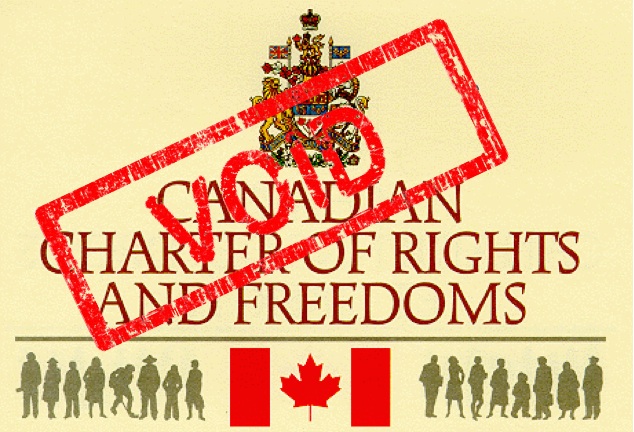
The Canadian Charter of Rights and Freedoms

- -
graphic Danni Siemens

Share

This website uses IntenseDebate comments, but they are not currently loaded because either your browser doesn't support JavaScript, or they didn't load fast enough.

6 Comments »

  • sr said:

    i was just stopped in canada, since I turned the wrong way WHILE DRIVING. THE COP stated that I smell like alcohol(I have a cold, but I do not smell like alcohol, nor do I drink!! the cop threatened me with jail, etc, and made me take a breathalyzer. I was completely humiliated. This was a violaTION OF MY RIGHTS. L WOULD LIKE TO SUE THE COP….ANY COMMENTS?

  • Daniel Arnot said:

    @ sr – So…you got pulled over for turning the wrong way…WHILE DRIVING? (why is this upper case? you don’t get PULLED OVER for turning the wrong way in Thorvaldson) If you weren’t drinking than what were you so humiliated about? The rookie cop thinking you were drunk or that you suck at driving?

    Alex did you even read the Charter? instead of skipping over the parts that don’t support your argument, maybe you should enlighten yourself before making an ass of yourself. The part that destroys your argument appears BEFORE section six. Your articles are either disingenuous or you just suck at knowing about what you choose to blather about… You are either ignorant or completely full of shit…You are either in the top 99th percentile for vocabulary or your articles are thesaurus enhanced. But in any case your articles are not worth the paper they are printed on.

  • Remi Aubin said:

    I say NO to roadside breathalyzer testing in Canada or anywhere else for that matter. I do not condone drinking and driving, however, these roadside stops set a dangerous precedent to our rights and freedoms in this country.
    In this day of electronic gadgets and cellphones I can guarantee that if any driver is observed to be driving incoherently he or she will be quickly snitched upon.
    I might add that in this new economy there are very few people that can afford to stop at the bar after work and for those who can the bar is legally obliged to cut off any patron who is approaching imparedness.

  • Sherry Colbourne said:

    While random breath testing would certainly be good for my business, I believe it is an affront to our civil rights. To drive this point home in a more realistic way, imagine having an appointment with an important business client or even your doctor. You’re merrily making your way to a 9:00 a.m. appointment, fighting traffic. A well-intending officer pulls you over for a random breath test in hopes of catching a “morning after the night before” offender, making you even later still.

    Does this really seem reasonable to anyone? No probable cause, just being in the wrong place at the wrong time.

  • Sherry Colbourne said:

    A better solution than throwing more enforcement at this problem is to educate social drinkers about their BAC through the use of modern day technology. The likelihood of catching a high BAC driver through random breath testing is a flawed assumption. High BAC drivers demonstrate behavioural impairment ie. erratic driving. The vast majority of people affected by random breath testing will be non-drinkers and low BAC drinkers. There are already plenty of extremely onerous sanctions in place for high BAC drivers and the only thing needed in this domain is an increased rate of conviction…something random breath testing will do nothing to affect.

    People should remember that the reason it is not illegal to drink and drive is because there is no evidence to suggest that low levels of BAC impact driving – refer to the Grand Rapids Study that has, incidentally, been conducted and re-conducted several times with the same results…low BAC driving is neither connected to fatalities or even accidents.

  • Sherry Colbourne said:

    The challenge lies in getting social drinkers – given the existing laws – to know, with certainty, what their BAC is when they’re consuming. That is where enforcement quality breathalyzer technology or forensic-quality software applications come into play. In the 21st century, the technology exists and the consumer is savvy enough to figure out how to use these technologies. To suggest otherwise is simply fear mongering.

    The time for “informed consumption” is at hand and I hope that these continued discussions about increased sanctions give our society a clear indication of how serious a problem alcohol misuse is and compel social drinkers to solve the problem themselves.

    Use the tools people. What gets measured, gets managed!