
THE UNIVERSITY OF SASKATCHEWAN’S MAIN CAMPUS IS SITUATED ON TREATY 6 TERRITORY AND THE HOMELAND OF THE MÉTIS.
THE UNIVERSITY OF SASKATCHEWAN’S MAIN CAMPUS IS SITUATED ON TREATY 6 TERRITORY AND THE HOMELAND OF THE MÉTIS.
ALISON COOLEY
Arts Writer
Donald Roach explains, “If somebody says that something is not worthy of looking at or observing, then you just simply haven’t looked carefully enough or done it in the right way.”
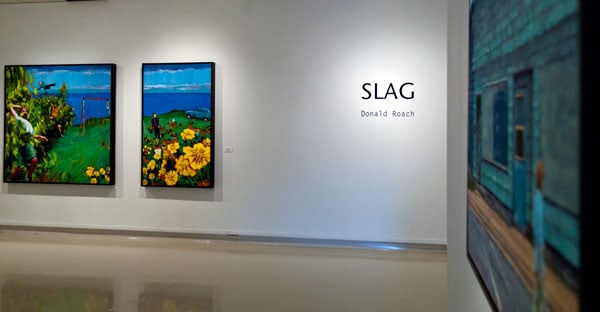
This theme runs throughout his MFA graduating thesis exhibition, entitled Slag, in the Snelgrove Gallery this week. The exhibition consists of two series. One series of woodcut prints traces the industrial history of his hometown, New Waterford, N.S., while a second series of paintings looks at the day-to-day life of its residents.
“[New Waterford] was at one time a very thriving coal mining town,” Roach describes. “With the advent of oil, coal mining started to go away, starting in the ’60s. By the time I had finished high school, all of the coal mines had closed and a lot of people had started moving away, and moving to places like Alberta and Saskatchewan to get jobs. So the population of my home town has kind of been halfed since I was in, like, junior high school…. Over the past 25 to 30 years, it’s been becoming a ghost town.”
Roach’s woodblock prints have an archival feel. Working from photographs and memory, Roach used the prints to reconstruct the history of the coalmining industry: its labourers, its structures and its wastes. The prints provide a context for the exhibition — an image of the development and decline of the industry, and a new perspective from which to look at Roach’s intense and colourful paintings of New Waterford life.
Roach chose his media carefully, working with the connotations of both paint and the printed image.
“I’d thought about doing this kind of historical series with painting,” Roach says, “but I wanted something that was more immediate and more about line — and the fact that they’re black and white. The history of coal-mining is about that blackness [is signi…. In some of them, I even used coal dust in the ink.”
In contrast, Roach’s paintings are vibrant, their surfaces thick and their subjects both celebratory and mundane.
“[The paintings] are more about the people who are living there and the kind of life they live, what the mood and what the character of that town is and how it is shaped by those events and that history,” and shaped also, by Roach’s memory.
The paintings, which depict otherwise ordinary people in ordinary scenes — walking the streets of plywood avenue, New Waterford’s Main Street, riding the bus in Montreal or playing in coastal backyards — have an element of fantasy, drawing from Roach’s own mythologies about his hometown. While some appear surreal, enacting fantasies from Roach’s childhood, even the ordinary street scenes are alluring in their peculiar colours and perspectives. A central theme to Roach’s work is, as he explains, “the idea of looking at ordinary places, ordinary street scenes, trying to find something extraordinary.”
Looking at the people of New Waterford, in both the past and present, Roach hopes to draw attention to their lives beyond industry. “I like the title [Slag] because… in the coalmining industry it’s what can’t be used. And for me it makes a very strong reference to what people are to industry often — they get left behind after they’re no longer useful — towns are no longer useful to them, when they can no longer operate their industry there.”
And while Roach’s show focuses on New Waterford, he suggests that, “because de-industrialization is a universal thing… my work talks about more than just my home town. I think it talks about something universal — something about people and their experience. Saskatchewan’s filled with ghost towns either Coal-mining, potash-mining, forestry, farming, all kinds of industry has come and gone.
“I would hope that this kind of work — if you’re talking about the relationship of people to an industry — it should be, and I would hope that my work is — in some way universal.”
– –
image: Pete Yee

Leave a Reply