
THE UNIVERSITY OF SASKATCHEWAN’S MAIN CAMPUS IS SITUATED ON TREATY 6 TERRITORY AND THE HOMELAND OF THE MÉTIS.
THE UNIVERSITY OF SASKATCHEWAN’S MAIN CAMPUS IS SITUATED ON TREATY 6 TERRITORY AND THE HOMELAND OF THE MÉTIS.
MALCOLM RADKE
News Writer
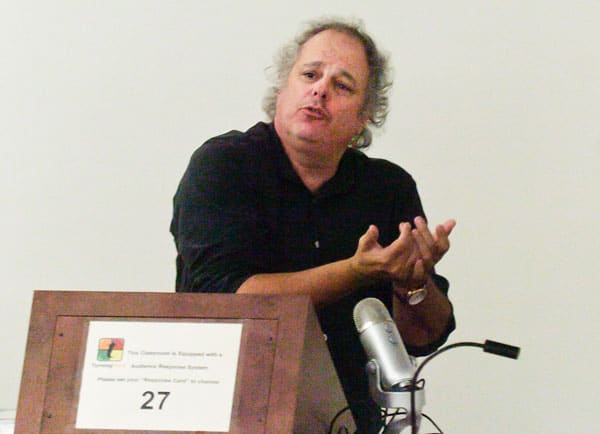
The first ever Saskatoon Economic Justice Summit gave Michael Albert a chance to present a whole new economy.
The Sept. 24 and 25 event was held at the University of Saskatchewan and focused on developing local economies, examining the impact of trade agreements and promoting global justice and co-operative alliances.
As part of the summit, keynote speaker Michael Albert spoke about participatory economics. Albert is an American activist, speaker and writer who also co-founded Z Magazine. His talk was largely related to his 2002 book PARECON: Life After Capitalism.
PARECON, a term for participatory economics, suggests building an economy from a system of balanced job complexes, which would reward effort and sacrifices.
This theoretical economy would make group decisions based on producer and consumer councils.
Albert began the two hour lecture by efficiently tearing apart the current system of capitalism and markets beyond any listener’s doubt.
“We live in a world that is so much more insane than any of you have ever imagined. It is mindblowing,” said Albert of the status quo.
Through an island analogy, Albert explained that the current economic system is somewhat like having one per cent of the shipmates owning the entire island — flawed, to say the least.
He went on to disarm traditional alternatives to the current economic situation, such as employee ownership and job rotation, localization of economies and communism. As Albert explained, these solutions either do not solve the problems that matter, are too inefficient or simply create too many other problems.
His solution, then, is PARECON. In addition to making use of group decision making at a micro level, the system would involve whole-community participatory planning meetings to determine which and how many resources to produce.
This system would in theory promote solidarity, diversity, equity, self-management and efficiency. It would essentially abolish markets, destroy capitalism, redistribute wealth fairly and keep the good while shedding the bad.
At first glance, such a system would have many potential flaws. But what was refreshing about Albert’s message compared to most radicals is that above all, he is not concerned with being right or proving someone else wrong.
“You should not believe me right away,” Albert explained near the end of his presentation, “You should go home and think about it on your own and do some research and discuss it with other people.”
He is concerned about getting people to think critically about the status quo and thus begin a balanced replacement of capitalism in small stages. This gradual shift in thinking will slowly lead to individuals taking action and making progress.
And it is a real-world change that is worth infinitely more, in Albert’s eyes, than having thousands of people studying and going to post-secondary education.
“The more education you get, the dumber you are,” Albert proclaimed, because you are misusing time becoming overly specialized in an area of knowledge, likely studying a system that is flawed and losing the opportunity to learn in the real world.
Albert’s belief seems to come from his own experiences and conversations with fellow academics in his field.
He galvanized his crowd to start thinking about interesting questions with a challenge.
“90 per cent of economists in this school can’t answer important economic questions that require a little bit of thinking.”
– –
image: Pete Yee
Leave a Reply