
THE UNIVERSITY OF SASKATCHEWAN’S MAIN CAMPUS IS SITUATED ON TREATY 6 TERRITORY AND THE HOMELAND OF THE MÉTIS.
THE UNIVERSITY OF SASKATCHEWAN’S MAIN CAMPUS IS SITUATED ON TREATY 6 TERRITORY AND THE HOMELAND OF THE MÉTIS.
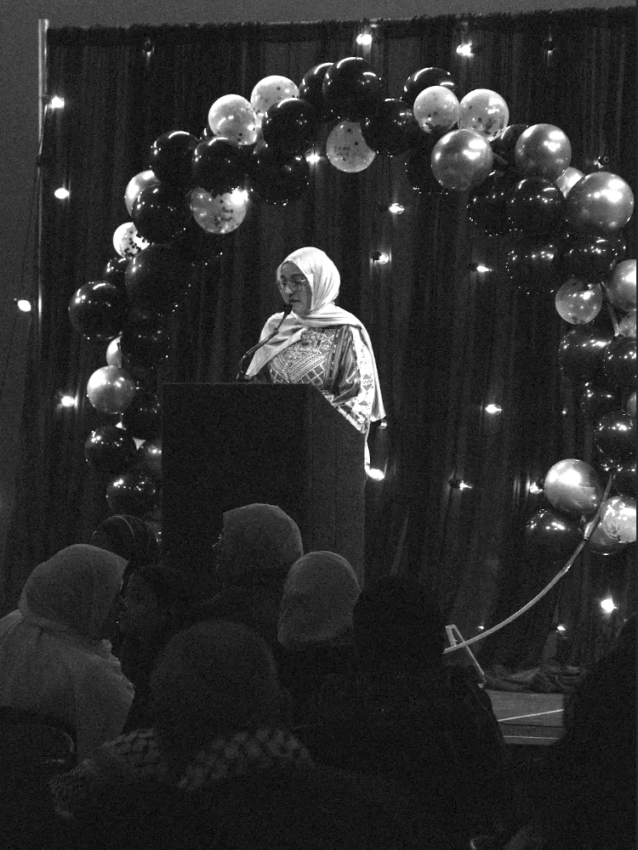
A conversation with SJP President May Elsayed on the February Gala, looking back on activism and what’s ahead
Students for Justice and Peace (SJP) is a USask organization founded in 2024 in response to the human rights violations that Palestinians are suffering under Israeli occupation. A United Nations Commission has determined that it constitutes genocide, and a UN Special Rapporteur has described the occupation in the West Bank as an apartheid system.
In Sept. 2025, The Sheaf sat down with May Elsayed, President of SJP, and Nada, the Director of Divestment and Outreach for SJP, to discuss USask’s policy of non-divestment in Israeli companies despite activism by both students and faculty to adopt the Boycott, Divestment and Sanctions strategy in investing.
Since then, SJP has hosted numerous events, including their annual gala to raise funds for Palestinian aid. The Sheaf caught up with Elsayed for a year-end interview reflecting on what the SJP has done this year and what the group’s plans are moving forward.
February 2026 Gala
When asked how the gala went this year, Elsayed said that “It was a beautiful night of everyone coming together. It was, I would say, our most diverse gathering yet. There were so many new members [and] new attendees that hadn’t come to any of our events before, which was really lovely to see.”
“Our speakers were really great. We had a wide variety of speakers, but everybody had really beautiful things to say, and I also learned a lot just listening to them. We had a community activist who spoke about her journey, about learning about the history of Palestine and what has brought us to this point, [and] she spoke about acknowledging her own bias and her own privilege and how she was able to live without really knowing about what was happening.”
Another speaker was “a little girl named Maryam from Palestine who spoke about her family and her situation and what she’s been going through and how her life has been made harder just because she’s Palestinian. [Although] everything is so visible in the news, which is good, she’s having a hard time in elementary school with her classmates picking on her.”
The gala also heard from “two twin fathers. They’re second-generation immigrants. Their dad moved here when he was 18 years old, after he was kicked out of Palestine. And they were born and raised here in Saskatchewan … They spoke a little bit about their experience as Palestinian immigrants, growing up Canadian and not really going back home until they were much older. And so there is a mosaic of perspectives that were shared, which I really appreciated.”
The gala raised roughly $15,650, which was donated to various organizations for Palestinian aid and relief. Elsayed explains that they chose a number of places to donate because “putting our money into little different pools allows for different avenues to be able to help out when needed.” These charities include Islamic Relief Canada, Strong Spirit and The Sameer Project.
A new charity they donated to this year was able to use the funds almost immediately in hard-to-reach areas in the north of Gaza. “They were able to send out water trucks with water tanks, and they sent us videos of that to see, which was also really nice. It made us reflect about how, for these people, this is a reality. They’re not shying away from having a camera put in their faces in their most vulnerable moments, because that’s just what they’ve been living through over the past couple years, which was really sad, but then also just seeing that they were able to get that help from the money we fundraise was also really good to see.”
Since Elsayed and much of her founding executive team are graduating, this was the last gala they would be able to host together. “It was a little bittersweet for all of us. We’re all going to continue working to support Palestine, towards awareness for Palestine in our own different ways, but it was the last time we would do it on this campus as a group, which was really sad at the moment because this work is so vulnerable and also taxing mentally. You build connections with the people you work with, and so saying goodbye to that version of friendship and that little second family we built was really bittersweet, but we all had a really good time. We were really thankful [for] everything we were able to build together.”
General Academic Assembly
The interview with Elsayed happened just two hours before the General Academic Assembly was scheduled to take place, where the only motion being brought forward was to have USask divest from weapons and arms manufacturing and a call for a renewed focus on a commitment to responsible investment grounded in principles of human rights and international law. The full motion can be found on the USask website at governance.usask.ca under Governance, General Academic Assembly.
Elsayed was asked what she hoped would happen at the assembly: “I just hope that voting members do end up showing up and voting for what matters, and I hope that the president does take what we have to say and not just brush it off, and [that he] does acknowledge the fact that we are not neutral as an institution. We’ve never been neutral. Our finances make us not neutral.”
“There’s a right, and there’s a wrong at the end of the day,” Elsayed continues. “I just hope that we all think as human beings and not as corporate conglomerates and not about the PR side of things or how the university is going to look in the media. If we all just thought of each other as human beings and got down to the core of what truly is happening, then there’s really no question about what should happen today and how things should go. I just really hope that everybody thinks with their heart a little bit and remembers that we’re all humans, and all we’re saying is that other humans don’t deserve to die needlessly, and they don’t deserve to be starved. They don’t deserve to have their lives uprooted in a second just because somebody in a fancy office someplace with tons of money in their hands can drop a bomb on them without feeling any of the repercussions.”
The General Academic Assembly did not make quorum on April 2, and the motion was unable to be passed, but the president did promise to take the motion to the board of governors.
SJP Moving Forward
When asked about the future of SJP and what the new executive team will look like, Elsayed said that there are discussions about whether to put together an election campaign or a hiring campaign and when that will begin. “Whatever thing the members are wanting to do and if they want to do it now, [or] in the Spring or Summer semester is really up to them. But our team has always been open to anybody that wants to participate … There [has been] nobody that I said, no, you’re not a fit for us. So I do think that anybody who reaches out and says they want to be part of the team next year, there’s many open spots for them and they can kind of figure out whatever they want to do.”
Reflecting on her time with the group, Elsayed said that “I’m honestly proud of SJP as a whole. Just getting started [and] getting off the ground was a struggle, there was so much pushback and so many difficulties. It would have been easy to be like, ‘You know what, I’m good, I don’t want to do that.’ But the way we were able to come together as a team and persevere and push forward and realize that this is something that we want to put our time and effort into, and reaffirm our intentions and follow through on everything — that’s the core of the people that have been part of SJP, that I’m exceptionally proud to have worked with. They’re individuals who never shied away from anything, who are always very honest and truthful and very loving, and anything that we’ve done with SJP has been with the intention of just being helpful and helping in whatever way we can.”
“I feel like when there’s so many things being tossed at you, [like accusations that] we’re trying to exclude people, [or are] being racist, anti-semitic or anything like that, that would take away from what we do and it would start to impact our mentalities and changed our perspective on things, I’m really proud that that never happened. We always [stayed] true to our core beliefs and our intentions.”
Advice for Getting Involved in Activism
Elsayed’s biggest piece of advice for students who are interested in advocating for peace and humanitarian causes is beginning conversations. “Getting involved with your campus in whatever capacity is a great first step because then you can talk to like-minded individuals. We can at least make sure [through dialogues] that we’re not being fed any propaganda. We can make sure that we are in the know in terms of what’s actually happening. When you have a group of people around you who are like-minded individuals, who are not okay with living in a world that lets so many bad things happen, then you can protect your mind in a way. You’re not letting yourself just become desensitized and not letting yourself feed into the propaganda [that] ‘everything’s fine [and] it doesn’t concern us.’ You can build a community of people who can support you and help you grow as a person and as an intellectual.”
Elsayed also suggests remaining updated and seeking out reliable sources of information. “Staying updated and following the news in a way that is not just blindly following what corporations are telling us, but seeking information to make sure we know what’s actually happening.”
“Beyond that, there are so many petitions that are always being shared for us to sign [to tell] our municipal, provincial and federal governments to tell them that we’re not okay with Canada exporting weapons to Israel or any other country that’s partaking in any genocide or war, [or] that we’re not okay with Canada being a participant in a war against Iran … I don’t think we’re in a [place] to say ‘Oh, I’m not into politics.’ If we’re not into politics, politics is into you. It plays a role in everything that we do in our life.”

Leave a Reply