
THE UNIVERSITY OF SASKATCHEWAN’S MAIN CAMPUS IS SITUATED ON TREATY 6 TERRITORY AND THE HOMELAND OF THE MÉTIS.
THE UNIVERSITY OF SASKATCHEWAN’S MAIN CAMPUS IS SITUATED ON TREATY 6 TERRITORY AND THE HOMELAND OF THE MÉTIS.
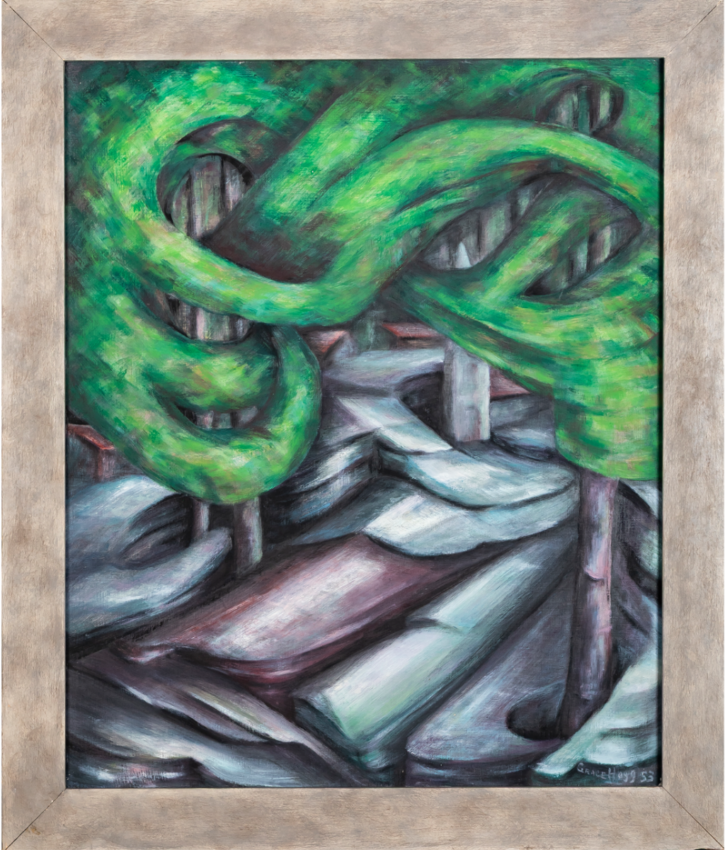
An exhibition that uses the weather as a lens into the past
Weather usually gets written off as small talk — background noise to everyday life. Just a matter of circumstance. Not really something you dwell on, unless your profession calls for it. At most, you’re probably scanning the weather app absently, trying to determine if you’ll still need to wear a jacket this week or not.
Forecast, now on view at Remai Modern, pushes that aside and treats weather as something much more loaded, personally, politically and culturally. The exhibition brings together over 100 works — including curated pieces dating back 100 years — from the Remai Modern Collection to explore how people relate to land and how those relationships have been shifting alongside the climate.
Instead of presenting climate change as a distant or abstract theoretical concept, Forecast asks its audience to interpret it through memory.
It urges onlookers to think about their own experiences — winters that used to feel early and endless, summers that seemed hotter and drier than usual, places that are significant because of how they felt in different seasons. In doing so, climate change stops feeling like something happening somewhere distant and starts to feel immediate, lived and close to home.
The exhibition spans a wide range of artists and time periods, which gives it a layered perspective on the environment. Historical Saskatchewan artists like James Henderson, Hilda Stewart, Ernest Lindner and Grace Hogg offer early interpretations of the prairie landscape. Their work tends to be attentive and grounded, with a focus on observation — light, terrain, atmosphere. At the same time, they reflect a specific historical moment, shaped by settler perspectives and ideas about land as something to be captured.
The inclusion of the Group of Seven adds another layer. Their paintings are deeply tied to Canadian identity, often showing wilderness as vast, dramatic and untouched. In the context of Forecast, however, those images shift. They don’t feel like neutral depictions of uninhabited or newly settled lands anymore — they feel carefully contrived. Spaces shaped by what’s included and what’s left out.
Contemporary works push that feeling even further. Artists like Rebecca Belmore, Lori Blondeau, Brian Jungen, Meryl McMaster and Shelly Niro foreground Indigenous perspectives, making it clear that relationships to land aren’t universal. Their work connects environmental change to histories of displacement, resilience and ongoing stewardship. Climate issues, here, aren’t separate from colonial histories — they’re deeply tied together.
Within the walls of the exhibit, landscape becomes something more complex than just scenery or backdrop. It transforms into a space where a critical tension between past, present and future ways of understanding land sits. It’s not all about extreme weather and rising temperatures — think of it more like how those phenomena have come to pass.
Climate change, in this context, is about relationships that have been disrupted between land and stewards and the uneven ways those disruptions have been felt.
The range of media spread across the installation helps reinforce that idea. Paintings older than most of their audience sit alongside photographs, sculptures and mixed media works from recent years, each approaching the theme differently.
Some of the selected pieces are more observational and nuanced, asking for your lengthy analysis rather than an instantaneous answer. Others are more direct about their meaning or even confrontational. They challenge the viewer to come to terms with their own experiences on the landscape; how the weather has changed in their lifetime, and how they’ve had a hand in it.
Moving through the exhibition means constantly adjusting how you’re looking and thinking. There’s never a static moment; unlike Saskatchewan’s weather, funnily enough.
The curatorial approach that’s been implemented here doesn’t follow a single linear storyline for the audience to work through, beginning to end. Instead, in a true-to-Saskatoon kind of way, it builds bridges.
A historical landscape might sit near a contemporary work that challenges it. A piece focused on beauty might be followed by one that points to environmental damage. Those juxtapositions do a lot of work, making it easier to see how ideas about land have shifted — and how they haven’t.
What stands out is how grounded the exhibition feels in place. Saskatchewan isn’t treated as separate from global climate issues — it’s part of them. For audience members who grew up in Saskatoon, that makes the experience hit differently. The landscapes aren’t abstract or foreign. They’re familiar, even if they’re changing.
There’s also an emphasis on storytelling. Weather is something people talk about all the time, mostly in passing. But sometimes, we find ourselves elbow deep in long discussions about what the world we live in used to look like; those conversations often carry more weight than they seem to.
A memory of an intense winter storm isn’t really about the actual storm — it’s about where you were, who you were with, what it meant. Forecast builds on that, showing how personal stories about weather can open into larger reflections on environmental change.
Notably, the exhibition doesn’t lean on statistics or scientific explanations. Instead of data, it offers images and experiences that ask you to interpret, reflect and connect. It doesn’t replace scientific understanding, rather it offers a way of thinking about climate that’s emotional, cultural and rooted in lived experience.
A lot of the works in Forecast are being shown at Remai Modern for the first time, which adds to the sense that there’s something new here, even for regular visitors. But the point here isn’t about seeing new art pieces for the first time, but rather seeing well-worn ideas from an entirely new angle altogether.
The exhibition makes it clear that weather has always been part of how people understand place, memory and identity. Now, as those patterns shift and as the world changes in a way that cannot be undone, paying attention to that connection feels more important than ever.
While it can’t force you to see the world differently, Forecast hopes to change the way you look at art, at land and at the sky overhead.
The wind will blow in whatever direction it wishes; whether you go along with it or push against the breeze is up to you.
Leave a Reply