
THE UNIVERSITY OF SASKATCHEWAN’S MAIN CAMPUS IS SITUATED ON TREATY 6 TERRITORY AND THE HOMELAND OF THE MÉTIS.
THE UNIVERSITY OF SASKATCHEWAN’S MAIN CAMPUS IS SITUATED ON TREATY 6 TERRITORY AND THE HOMELAND OF THE MÉTIS.
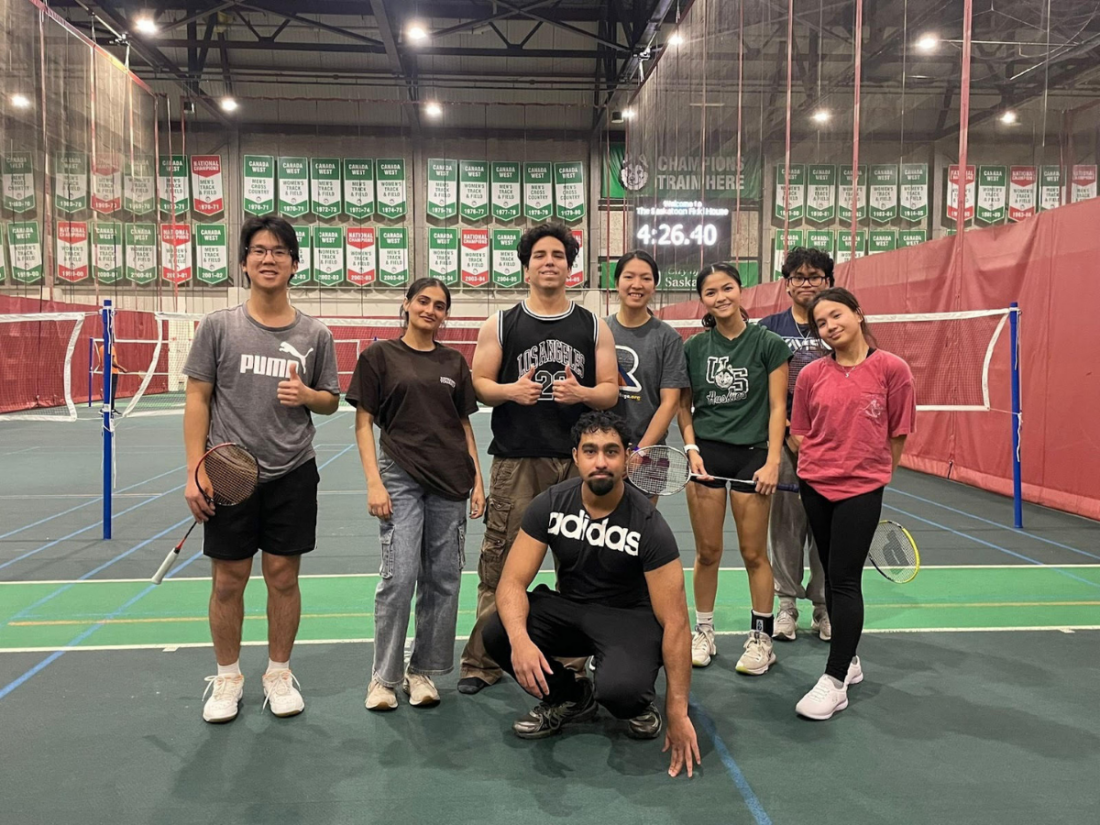
The Student-Led Revival of Badminton at USask
When the University of Saskatchewan’s badminton club first launched, it wasn’t chasing medals or headlines. It was chasing something simpler, a voice.
“We felt our sport needed a unified voice,” says Doris Yim, co-president of the USask badminton club.
Before the club was formally established and was only a few people, the badminton community at USask was struggling quietly. Court times were shrinking. Scheduled gym slots were occasionally cancelled or moved to less accessible hours without much notice. What had once felt like a thriving pocket of campus life was slowly thinning out.
“It hurt seeing a thriving community shrink simply due to lack of communication and opportunity,” Yim explains, through a shared interview through email.
The idea to change that came casually, during a study session after playing. Yim and her now co-president, Alex Camacho began talking about what badminton could look like if students had stronger representation and better communication with university recreation management.
“We wanted to give our community a unified voice to talk to the university directives with.”
What followed was not a solo effort, but what Yim describes as “a massive collective effort” involving the executive team, existing members and USask Rec. Since forming the club, they’ve established direct, reliable communication with sports management, which is something that has already changed the landscape for players.
And the response? Immediate.
“We started with only ten registered students,” Yim says. Within weeks, that number jumped past 100. Just a couple of months later, the club is now sitting at nearly 300 officially registered members, and counting.
And that figure doesn’t even include community members outside the university who regularly drop in to play. The growth speaks to more than just interest in a sport. It reflects something students at USask are actively looking for: connection.
Especially in Saskatoon winters, when daylight fades early, and motivation can fade with it, organized recreation becomes more than exercise; it becomes mental health support.
“It’s about getting out of your apartment, playing a sport and seeing people,” Yim says. “That’s so incredibly important for mental health during these very cold winter seasons.”
For students who might feel intimidated walking into a competitive gym space, Yim is quick to emphasize something important: This club is for everyone. “Badminton is a very beginner-friendly sport,” she says.
Skill levels range from students who picked up a racquet for the first time a week ago to players who have been competing since childhood. The club does not currently separate competitive players from recreational ones through tryouts.
“Right now, we don’t have a tryout to separate competitive players from recreational players, as we want everyone to just play and enjoy themselves,” Yim explains. “Even if you are a total beginner, you will always have someone to play with.”
That inclusivity has become one of the club’s defining characteristics. Still, the executive team has bigger plans in mind. Creating a separate competitive team is something they would love to implement down the line, especially as interest continues to grow.
Growth hasn’t slowed the club’s ambition; it’s expanded it.
“Our future goals include hosting self-funded tournaments with amazing prizes to push the sport into the university’s competitive scene,” Yim says.
They’ve already discussed inviting players from other Canadian universities for tournaments. Bringing inter-university competition to USask isn’t just a dream; it’s a direction forward.
The club is also planning to bring in professional coaches for both beginner and intermediate players. That step would allow new members to develop fundamentals while offering more experienced players structured improvement.
It’s clear the leadership isn’t thinking small. But what makes badminton distinct on campus is not only its competitive potential.
“What makes badminton unique is the perfect balance it strikes,” Yim says.
“It’s a highly social sport that pushes you to catch up with friends, but it’s also a sport that is easy to pick up and very hard to master.” That balance, casual enough to laugh between rallies and competitive enough to keep you chasing improvement, is part of what has sustained interest.
Yim speaks about the “constant chase of improving.” The sharp snap of the racquet against the shuttlecock signals progress.
“There is nothing like finally hitting that one shot you’ve been practicing.” For many members, that incremental improvement is what keeps them returning week after week.
When asked what surprises people about the club, Yim doesn’t hesitate.“How welcoming and embracing the community is to newcomers.” She speaks from personal experience.
“I am someone who initially struggles to pick up sports,” she says. But veteran players encouraged her. They wanted to see her improve. That culture of support pushed her to continue.
Now, she wants to be that supportive presence for the next wave of beginners.
Sports can be cost-prohibitive, but another positive of badminton on campus is the cost, or lack thereof.
“It’s offered for free by USask Rec on campus,” she says. “You don’t even need to own a racquet or a shuttlecock to try it out.” In an era where cost can be a barrier to participation in student activities, keeping badminton accessible has been a top priority.
“One of our top priorities is keeping costs down so the sport remains accessible.”
Students can attend open rec sessions hosted by USask at the education gym, and the club is planning frequent low-cost learn to play sessions, particularly for beginners. The message is simple: Show up.
When asked about a proud moment so far, Yim doesn’t cite a championship or a single event. She talks about numbers. “The sheer volume of students showing up to our events.”
Dozens upon dozens of players are arriving eager to play and support the scene.
“We do not take that for granted.”
That turnout validated something important: this wasn’t just a small niche interest. There was demand. There was hunger for this space.
The club plans to continue expanding by hosting bigger events, developing resources, building brand identity and even launching merchandise. But underneath those ambitions is a constant priority.
“Our members are, and always will be, our top priority.”
At its core, the USask Badminton Club represents something larger than rallies and tournaments. It represents student initiative. It represents reclaiming space.
It represents what can happen when a small group of students sees a gap in campus life and decides to fill it.
From ten to nearly 300 in just months, the growth isn’t an accident. It’s built on accessibility, intentional leadership and an environment where beginners aren’t sidelined, they are welcomed.
In a university environment that can often feel isolating, especially in winter, spaces like this matter.
They give structure to the week.
They give a reason to leave the apartment or dorms.
They give a sense of progress that isn’t tied to grades.
And sometimes, they give you the satisfying snap of a perfectly timed smash.
As the club looks ahead to inter-university tournaments, professional coaching and expanded programming, one thing remains constant: the original goal.
A unified voice. A stronger community. A sport that finally has its place.
And judging by the energy in the gym, that place is only getting bigger.

Leave a Reply