
THE UNIVERSITY OF SASKATCHEWAN’S MAIN CAMPUS IS SITUATED ON TREATY 6 TERRITORY AND THE HOMELAND OF THE MÉTIS.
THE UNIVERSITY OF SASKATCHEWAN’S MAIN CAMPUS IS SITUATED ON TREATY 6 TERRITORY AND THE HOMELAND OF THE MÉTIS.
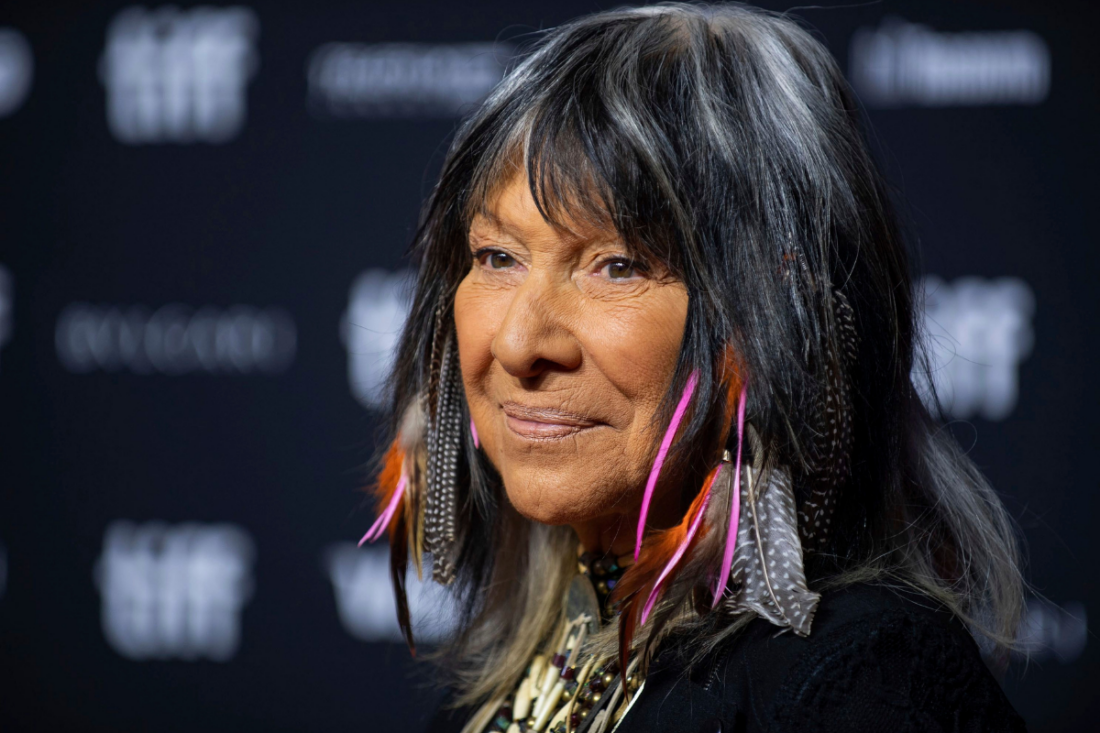
The Sheaf sits down with Indigenous Student Union members to chat about the controversial singer-songwriter’s honorary Master of Letters from USask, which has not yet been revoked
Buffy Sainte-Marie is an American-born singer-songwriter who has released over two dozen albums and received numerous awards over her lifetime. Sainte-Marie has claimed to be born and raised Cree from the Piapot First Nation in Saskatchewan, and the majority of her work has used this claim to Indigenous ancestry for the success and fame of her career.
Sainte-Marie rose to prominence as a folk singer-songwriter in the 1960s and 1970s, being named “Favourite New Female Vocalist” by entertainment magazine Billboard in 1965 and appearing on numerous Canadian and American television shows. Most notably, Sainte-Marie appeared regularly on Sesame Street, in which she showcased Native American and Indigenous culture for the first time on the program.
However, in Oct. 2023, an investigation by the CBC questioned her claim to Indigenous ancestry after receiving a tip that she was of European ancestry. The resulting investigation found a string of inconsistencies and inaccuracies in her claim to be Indigenous, supported by accounts by Sainte-Marie’s biological relatives and documentation that proves she was born in the United States and not in Canada as she had previously claimed.
The CBC investigation led to Sainte-Marie being stripped of the Order of Canada, her Juno Awards and Polaris Music Prizes, as well as the revocation of her inductions into the Canadian Music Hall of Fame and the Canadian Country Music Hall of Fame.
Sainte-Marie was also awarded numerous honorary degrees by universities across Canada. Early this year, Dalhousie University revoked the honorary degree it gave to her in 2018 after an Indigenous student advocated for its removal.
The Sheaf recently received a comment from its tip line with similar concerns, which reads, “It is time the U of S revokes the honorary doctorate bestowed upon Buffy Sainte-Marie (aka. Beverley Santa Maria) in 2003. Her actions in assuming a cultural identity for whatever motives stole opportunities, awards and recognition from deserving Indigenous people here in Saskatchewan, across Canada, and internationally … As a graduate of this university, I am ashamed that the U of S has not moved more quickly on revocation. I urge the U of S to revoke this honorary doctorate without delay.”
For a student-led and Indigenous perspective, The Sheaf reached out to members of the Indigenous Student Union (ISU) for an interview.
Nate Desjarlais, whose portfolio is Student Support & Advocacy for the ISU, said that his opinion on Sainte-Marie was that “[If] you’ve led your career on being disingenuous, you might have taken opportunities from other Indigenous people who might have had those [opportunities]. But it’s important to [have] a balanced opinion. I had thought [that] there were benefits to her doing that as well. She inspired a lot of people. I know Indigenous people who knew her and thought, ‘wow, she’s doing amazing things. She’s promoting the culture. She’s taking part in it. She loves Indigenous people’ … [But] it’s dangerous to promote somebody who’s built their whole career on lies, because it sets a precedent that other people might follow and decide, ‘you know what, I will take the same viewpoint. I will apply for these scholarships [because] I’m Indigenous at heart.’ But these are limited resources at the end of the day, and they have to be reserved rightfully towards Indigenous ancestry, which is what they’re designed for.”
Mya Graham, Public Relations, Internal Communications and Coordination Director for the ISU, adds that “I was very concerned with taking resources and the voice away from Indigenous people … A lot of people are passionate towards advocating for certain marginalized groups, so by her stepping into that role and pretending, it’s very strange, because she could have been an ally, she’s very passionate about this — she could have taken an initiative to just simply be an advocate … I think there’s an important distinction to be made between cultural appropriation and cultural appreciation in this situation, because you can support and be an ally, and if you grow up on reserve [but] are from European origins … [you] still aren’t Indigenous. And with being Indigenous, there is also the aspect of ancestry and your ancestors that still lies in you and lives through you. That’s a huge part of being Indigenous is that ancestry is your lineage.”
Graham continues, “I think it’s great that people want to appreciate the culture, want to learn about it, want to be a part of it, because it’s so fun, it’s so beautiful, it’s such a good community. It’s a great thing to be a part of. And I totally love any interest that people have in it or wanting to learn, because that does help keep the culture alive … But there is that line that needs to be drawn between giving teachings or pushing something as if you’re Indigenous when you’re not, because that’s just really not your place.”
Noah Merasty, Research and Analysis Director for the ISU, says that “For me personally, my mom was her biggest fan growing up … A lot of times she viewed Buffy Sainte-Marie [as a] source of inspiration. And I know when this news came out, she was very hurt by it and she felt just as confused, because she was like, ‘Okay, Sainte-Marie did do great things for Indigenous people. But the bottom line is, I believe a lot of her platform is built on lies, not ignorance.’”
When asked if they thought USask should revoke Sainte-Marie’s honorary degree, Graham said that “They should revoke it, that is something they should do. And I think that this is going to be very important to start the conversation of [needing] to remove it because one of the [university’s] supporting pillars is reconciliation. I don’t think that they’re necessarily being malicious [by] having her page up [about] her degree. It honestly might have just slipped through the cracks. It was a long time ago, [and] I don’t think we should condemn the university … I think they need to do it. And once it’s called out, then that’s where the condemning factor might come in [if they say] ‘we’re not taking it down.’”
Merasty added, “I agree that we shouldn’t necessarily condemn the university for doing it because it might have been ignorance. If the response is [them] saying ‘no, we shouldn’t revoke it,’ then yeah, we can condemn you.”
The Sheaf reached out to USask for a comment on the Sainte-Marie situation. They responded that, “Any decision around revoking an honorary doctorate at the University of Saskatchewan would be made by our Senate, in accordance with The University of Saskatchewan Act, 1995. Discussions related to individual honorary degree candidates or recipients are confidential in nature, although decision outcomes would be made public.”
Under USask’s Guidelines for Honorary Degrees, revocation can be because “The individual, after investigation, has obtained the honorary degree or been added to the honorary degree nominees list by fraud, deception, or any other inappropriate means.”
USask did not provide any further information on when a Senate meeting would take place or what the procedure is during these meetings.
A final conjoined statement from Graham, Desjarlais and Merasty on the matter is the following: “We want the university to do what is right by revoking her honorary degree and status. Follow suit with other institutions by acknowledging the fact that her platform was built on lies.”
Leave a Reply