
THE UNIVERSITY OF SASKATCHEWAN’S MAIN CAMPUS IS SITUATED ON TREATY 6 TERRITORY AND THE HOMELAND OF THE MÉTIS.
THE UNIVERSITY OF SASKATCHEWAN’S MAIN CAMPUS IS SITUATED ON TREATY 6 TERRITORY AND THE HOMELAND OF THE MÉTIS.
“Donate what you cherish”: A Student who started a winter initiative for helping the homeless
For Abd Alfatah Alras, a third-year medical student at the University of Saskatchewan, one such night changed the way he viewed homelessness in the city and inspired a community initiative that continues to grow each year. The Sheaf conducted an interview via email with Alras to learn more about the Muslim community at the U of S for the Homelessness Support Initiative.
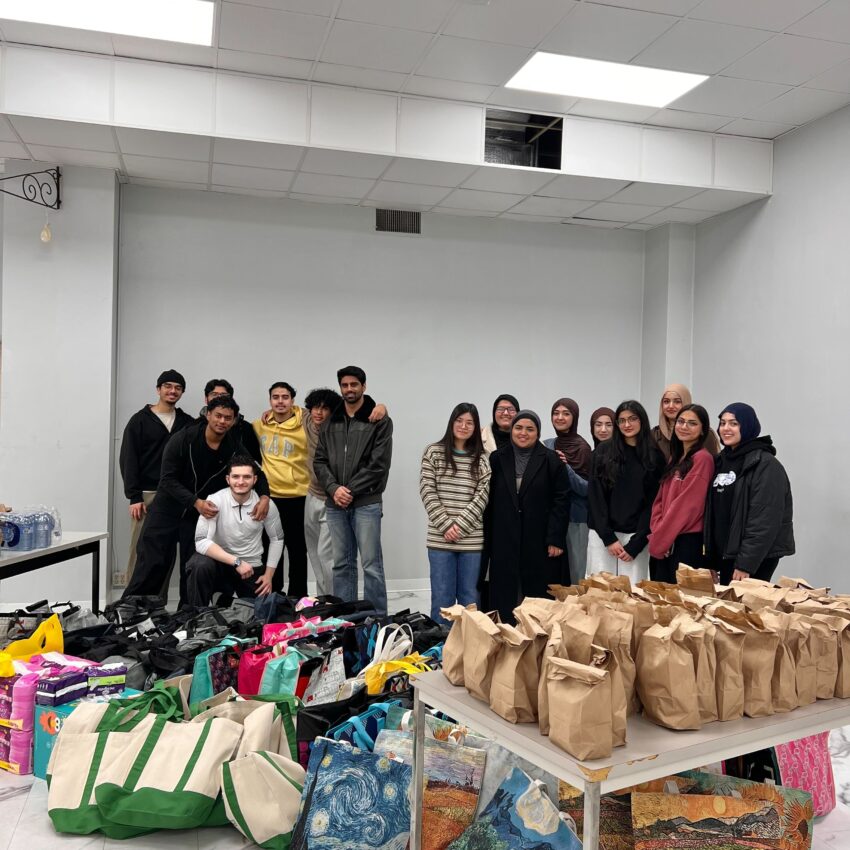
Every winter, volunteers from several muslim organizations across Saskatoon come together to prepare and distribute winter care packages and meals for people experiencing homelessness. This year, volunteers assembled and distributed 150 winter packages and 150 meals, bringing together students, community organizations and donors to support some of the city’s most vulnerable residents.
The packages contain basic necessities designed to help people survive the harsh prairie winter: gloves, socks, toques, scarves, blankets, bandages and hand warmers. Hygiene supplies such as shampoo, soap, lip balm, moisturizer, toothbrushes, toothpaste, wet wipes and nail clippers are also included. Alongside the care packages, volunteers distribute simple meals consisting of a sandwich, banana and juice.
But behind the initiative is a deeper motivation, one rooted in both faith and personal experience. “One of the five pillars of Islam is to give a fraction of your wealth to the needy,” Alras said. “It purifies wealth and the soul, and it is especially directed toward helping the poor and vulnerable.”
He pointed to a verse from the Quran that has become a guiding principle for the project:
“You will never achieve righteousness until you donate some of what you cherish.”
For Alras, those words are not simply philosophical. They represent a responsibility. Yet the moment that pushed him to act happened outside the hospital during his first year of medical school.
Late one night in 2022, Alras left the hospital around 11 p.m. As he stepped outside into the bitter cold, he noticed a man sleeping near the entrance. “What caught my attention immediately was that he wasn’t wearing gloves,” Alras recalled.
As a medical student, his thoughts went immediately to the potential consequences of prolonged cold exposure. Frostbite and nerve damage can develop quickly in extreme conditions. Concerned, he went home, grabbed a spare pair of gloves, and returned to give them to the man.
The man told Alras he had once worked as a truck driver. After a serious accident, he lost his ability to continue working. Debt began to accumulate, and eventually he lost his housing.
“That moment stayed with me,” Alras said. “It reminded me that hardship is often not the result of laziness or lack of effort, but circumstances that could happen to any of us.”
That encounter became the foundation for what would eventually grow into an annual winter outreach initiative.
Groups supporting the initiative include the Islamic Dawah Society, Saskatoon Islamic Academy, the Amal Humanitarian Club, the Muslim Medical Association of Canada, the Saskatchewan Arabs Society, the Muslims Professionals Society, Islamic Relief U of S and the One Faith Foundation.
While organizing so many groups could easily become complicated, Alras said the collaboration has been remarkably smooth.
“Those clubs have a passion to help the community,” he said. “Many individuals leading them are already volunteering around the city. Bringing them together was a natural process because we all share the same goal.”
Volunteers gather ahead of the distribution to assemble the packages, sorting items and preparing supplies before heading out across Saskatoon. On the day of distribution, volunteers travel both on foot and by car, reaching individuals across different areas of the city.
Despite its growth, the initiative still faces challenges each year.
Funding is always a concern, as organizing hundreds of care packages requires months of fundraising and donations. Time is another obstacle.
“It takes months to put everything together,” Alras said. “Every year we try to hold the event earlier in the winter, but sometimes logical challenges push it later than planned.”
Another challenge is finding a location where volunteers can safely organize and distribute supplies.
“Finding a place to do the distribution is not always easy,” he explained. “Sometimes it can result in an increase in homelessness in the area, which can affect surrounding businesses.”
This year, organizers were able to use the parking lot and facilities at the Saskatoon Islamic Academy to coordinate the project. Alras also expressed gratitude to Affinity Credit Union, which had allowed volunteers to organize distributions outside one of its branches in previous years.
Despite the difficulties, the initiative continues to grow with each passing year.
“It grows every year,” Alras said. “More people are willing to help, and more people are willing to donate. It’s becoming something our community looks forward to.”
Alras also says that the most meaningful impact of the project is not only felt by those receiving the packages, but by the volunteers themselves.
“I truly believe that we, as volunteers, benefit from this just as much as the unhoused community does,” Alras said. “This experience forces you to feel a level of gratitude for things you once took for granted.”
Participating in the distribution can shift perspective in unexpected ways. Something as simple as having a warm jacket, a meal waiting at home or a roof overhead can suddenly feel far less ordinary.
“When was the last time you paused and felt grateful for simply having a jacket during the winter?” Alras asked.
Through years of organizing the initiative, Alras has also gained a deeper understanding of homelessness in Saskatoon. One of the biggest misconceptions, he said, is that homelessness is always permanent.
“Before starting this project, I thought many individuals had been homeless for a long time,” he said. “But in many cases, homelessness is transitional.”
Unexpected life events, medical emergencies, job loss and rising housing costs, can quickly destabilize someone’s life.
In one instance, Alras even met a person experiencing homelessness who had previously been a student at the University of Saskatchewan.
“They were an international student who couldn’t afford rent anymore because of increasing tuition and living costs,” he said.
For Alras, the lesson is clear: addressing homelessness requires compassion, awareness and a willingness to act.
“Saskatchewan is our home,” he said. “We live in a province with harsh winters and a significant homeless population. A society is judged by how it takes care of its vulnerable, the children, the elderly, the sick and the poor.”
Through a simple act of giving things like gloves, a meal or a moment of human connection, volunteers hope to remind people experiencing homelessness that they are not invisible or alone.
And perhaps, just as importantly, the initiative reminds the community that compassion can begin with something as small as noticing someone in the cold.

Leave a Reply