
THE UNIVERSITY OF SASKATCHEWAN’S MAIN CAMPUS IS SITUATED ON TREATY 6 TERRITORY AND THE HOMELAND OF THE MÉTIS.
THE UNIVERSITY OF SASKATCHEWAN’S MAIN CAMPUS IS SITUATED ON TREATY 6 TERRITORY AND THE HOMELAND OF THE MÉTIS.
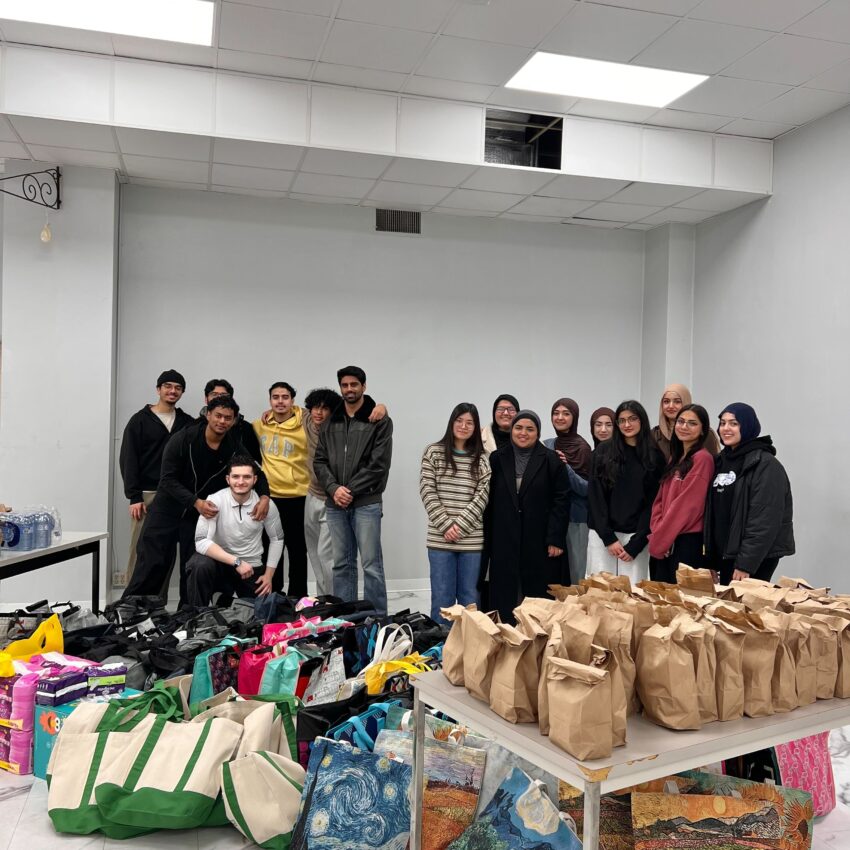
A brief overview and highlights of Humanity First’s Panel held this March, with insights from panellists about international struggles and university advocacy
On March 4, Humanity First’s USask chapter hosted ‘For Humanity,’ a panel on global struggles, resistance and collective care that brought together a diverse set of voices to speak on international, political and local issues. Campus clubs focused on addressing global and local struggles were also in attendance and tabled after the panel discussion.
Humanity First is an international charity that focuses on humanitarian issues, volunteerism and education. The panel featured Ahmad Al-Dissi, a Palestinian associate professor and advocate; Bruce Sinclair, a Metis drama professor and artist; Martin Gaal, a political studies professor and founder of Global Café initiative; May Elsayed, president of Students for Justice and Peace, a Palestinian activist group at USask; Lubna Musa, a Sudanese activist and alumni from the University of Regional; and Nathaniel Desjarlais, an Indigenous student involved with the Indigenous Student Union at USask.
Some of the topics that were touched on during the panel include how political and historical factors shape human rights issues, as well as how art, storytelling and culture could be used as tools of resistance to amplify marginalized voices. Topics included challenging colonialism, racism and war, among others, with each panelist delivering a unique perspective to the conversation.
One of the first questions asked to the panel was “Although the contexts you’re speaking from are different, what common patterns of injustice or marginalization do you see across these struggles?”
Desjarlais responded, “One pattern I see is the feeling of not being recognized when you’re feeling injustice or marginalization. A lot of the time, it’s easy to feel like nobody’s listening … So when reconciliation happened, it taught me [that] if there’s attention brought to these issues, we can make a difference.”
Al-Dissi pointed to the way power operates within systems of colonization and violence. “[The violence] is becoming normal, unfortunately. So we need to have the conversation that the law is there to be abided by, and hold people responsible for what they have done.”
Gaal added that “it’s the structure itself that facilitates violence, that facilitates inequality, that wants us to make us feel small … [and] if we understand that together, we’re able to be better, we’re able to support each other, we’re able to build community, [those acts] will be able to affect change.”
Elsayed said that “one pattern I see across the board when it comes to conflicts is people basing the importance of a conflict on the proximity they feel to that country, or the proximity they feel to the people of that country, and how much they relate to them.”
The panellists also discussed how the university and students specifically have a role in addressing political injustices.
Elsayed discussed how “I think our university should be admitting our agency and acknowledging their participation in injustices.” She adds that “students should not be shy about speaking out and using their voice. If we don’t speak out now, who’s going to speak out?”
After a conversation from the panelists around the daily impacts of colonialism and racism towards marginalized peoples, Desjarlais wrapped up the panel by saying, “I know I talked about some negative things that are uncomfortable, but those are the truths, and that’s the way I decided to live my life – tell the truth – no matter how uncomfortable it is.”
He continues, “As far as the role universities have related to these issues, first of all, these are educational spaces. We should spread acknowledgement and awareness, and create safe, diverse environments that discuss these and educate people. And I think the University of Saskatchewan does a decent job at that.”
Musa said that “we have so many people from different places going to university, and we don’t realize how much we have in common with other people until we sit and talk to them. It’s one thing to read about what’s happening in the world, but to hear it [for the] first time really changes your perspective and deepens your understanding about what’s happening.”
Al-Dissi sees difficulty in addressing some issues in the university context. “Unfortunately, the moment you mention Palestine [here], you get events cancelled and security [called] … There is a one-sided story that’s being told more and more, even in universities, and we have to break that to introduce the other side as well.”
Gaal noted that “Administration is an institution of power. It’s not the university. The university is us. [It’s a] university of the students, faculty [and] student groups … It takes people to make change. It takes people who are really organized. It takes a community, and the university is a community. As soon as we understand [that], we can start to challenge it, we can start to work on issues that we share, and start to work on structural things and make a difference.”
The panel included campus clubs such as UNICEF USask, which is a student-led campus chapter of UNICEF Canada, which supports children and youth globally; the Students for Justice and Peace, a campus group devoted to peace and social justice created in response to the human rights violations that Palestinians are suffering; Islamic Relief USask, an international charity focused on humanitarian causes; and the Indigenous Students’ Union, which represents Indigenous people at USask.
If students are interested in attending future Humanity First events or wish to connect with the group can visit the club’s Instagram @humanityfirstusask.
Leave a Reply