
THE UNIVERSITY OF SASKATCHEWAN’S MAIN CAMPUS IS SITUATED ON TREATY 6 TERRITORY AND THE HOMELAND OF THE MÉTIS.
THE UNIVERSITY OF SASKATCHEWAN’S MAIN CAMPUS IS SITUATED ON TREATY 6 TERRITORY AND THE HOMELAND OF THE MÉTIS.
Material, movement and the choice to leave meaning unresolved
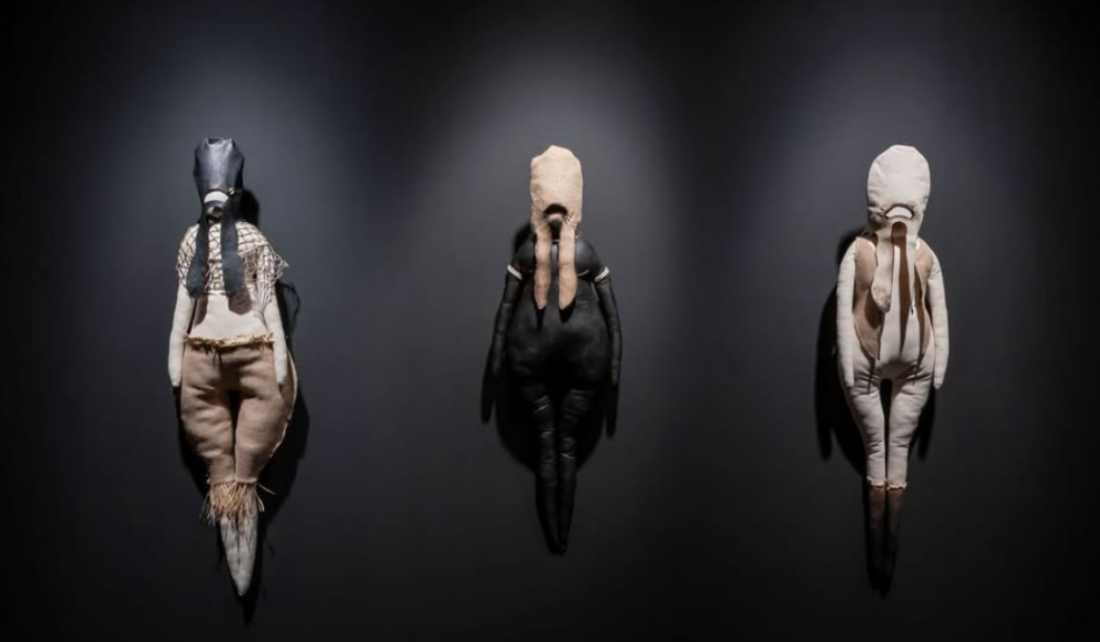
Braxton Garneau’s work begins with the materials he uses — where they come from, how they’re handled and what they carry with them into the spaces they eventually occupy. In Ebb, the solo exhibition curated by Leah Taylor of Garneau’s newest and most recent works, asphalt, raffia, cotton, linen, sugarcane pulp, bones and shells aren’t just materials, but active participants in the dialogue between art and audience.
Garneau is a visual artist based out of Edmonton. He earned his Bachelor of Fine Arts from the University of Alberta and has presented solo exhibitions in major art centres, including the Art Gallery of Alberta in Edmonton (2024), Efraín López in New York (2024), GAVLAK in Los Angeles (2023), and Stride Gallery in Calgary (2021). His work has also been included in significant group shows, such as Land, Sea, Sugar, Salt: Terrestrial and Aquatic Contemplations of the Caribbean at Remai Modern and Black Every Day at the Art Gallery of Alberta. In 2024, his piece “Pitch Lake (Pietà)” was acquired by the Museum of Contemporary Art San Diego through the Northern Trust Purchase Prize at EXPO Chicago, and he received the Lieutenant Governor of Alberta Emerging Artist Award. In Spring 2025, he completed a residency at the International Studio & Curatorial Program in Brooklyn.
While Garneau’s presence in the art world continues to grow, his latest exhibition does not rely on it. Rather than feeling like a milestone, Ebb feels like a continuation.
Garneau’s practice is shaped by working between cultures and histories. He pulls from classical and contemporary visual languages, sometimes referencing religious or sculptural forms, complicated by the materials he uses — substances that are tied to land, labour and extraction. The result is work that feels familiar at first glance, then harder to place the longer you spend with it. He doesn’t aim for polish or resolution. Instead, his work stays with the in-between — between materials, between traditions, between what feels finished and what still feels open.
A key idea in Garneau’s practice is what he calls “material honesty.” Rather than forcing materials into submission, he lets them behave as they want to. Fibres fray. Surfaces crack. Marks of handling remain visible upon presentation. There’s a sense that the work is collaborating with the materials rather than mastering them. That openness carries through the exhibition as a whole — nothing feels overly resolved, and nothing insists on being read one way.
Garneau works in painting, sculpture, printmaking and installation, but these categories often overlap in practice. Materials are reused and shifted from one form to another, making it difficult to separate one medium from the next. Surfaces show signs of layering and handling, with the process left visible. Rather than aiming for a polished finish, the work remains open and unresolved.
The title Ebb points to cycles of movement and return, and that rhythm runs quietly through the show. Many of the works feel caught mid-shift, as though they could change again depending on where they’re placed or who encounters them. That openness mirrors Garneau’s interest in transformation as something constant and subtle, rather than dramatic. This sense of continuity — of things unfolding rather than concluding — means there isn’t one clear takeaway waiting at the end. Nothing feels final. Instead, the exhibition feels like part of a longer conversation, one that doesn’t stop when you leave the gallery.
A lot of Garneau’s work focuses on costuming and adornment, which show up throughout the exhibition as a way of thinking about how bodies move through the world. Clothing, texture and surface become tools for navigating visibility, protection and belonging. Masquerade, in this context, doesn’t appear to be about hiding — it’s about becoming something else, even temporarily, in order to survive or adapt.
Garneau’s use of natural materials grounds these ideas further. Sugarcane pulp, bones and shells point to cycles of use and reuse, growth and decay. They also carry traces of systems that shape our lives — agriculture, mining, consumption — without spelling those connections out too neatly. The work leaves room for viewers to make those links themselves.
What stands out in Ebb is how physical it feels, how it resists a quick reading. These are pieces that ask you to come closer. Every minute detail contributes to the conversation at large. The meaning doesn’t arrive all at once. In an era where consumption is evaluated based on speed rather than quality, its pace is refreshing. It asks for patience, for attention, for the kind of observance that happens when you’re willing to stay a little longer than feels efficient.
As you move through the gallery, it becomes clear that pacing is important to Garneau. The exhibition asks visitors to pay close attention to how materials shift under light, how textures repeat or change across works. It encourages viewers to spend time with uncertainty rather than rush towards an objective interpretation. That slower rhythm allows relationships between pieces to emerge gradually, reinforcing the sense that meaning here is cumulative, built through observation rather than delivered outright.
By the time you reach the end of the exhibition, there isn’t a neat conclusion waiting for you. Instead, there are fragments: the weight and texture of certain materials, the feeling of surfaces that have been worked and reworked, the sense that the transformation is never quite finished. The pieces don’t try to explain themselves away. They leave space for you to sit with it, to bring your own experiences into the room and to let the heart of the gallery reveal itself over time.
There’s no rush here. Ebb asks for patience, curiosity and a willingness to stay with uncertainty a little longer. For those open to that kind of encounter, the exhibition offers something rare: not answers, but room to think — and to return. Not something to consume quickly, but something to move through, revisit and carry with you afterward.Ebb is currently on view at College Art Gallery, and will remain on display until April 24, 2026.
Leave a Reply