
THE UNIVERSITY OF SASKATCHEWAN’S MAIN CAMPUS IS SITUATED ON TREATY 6 TERRITORY AND THE HOMELAND OF THE MÉTIS.
THE UNIVERSITY OF SASKATCHEWAN’S MAIN CAMPUS IS SITUATED ON TREATY 6 TERRITORY AND THE HOMELAND OF THE MÉTIS.
More than machines, the USask Robotics club constructs a community of creators.
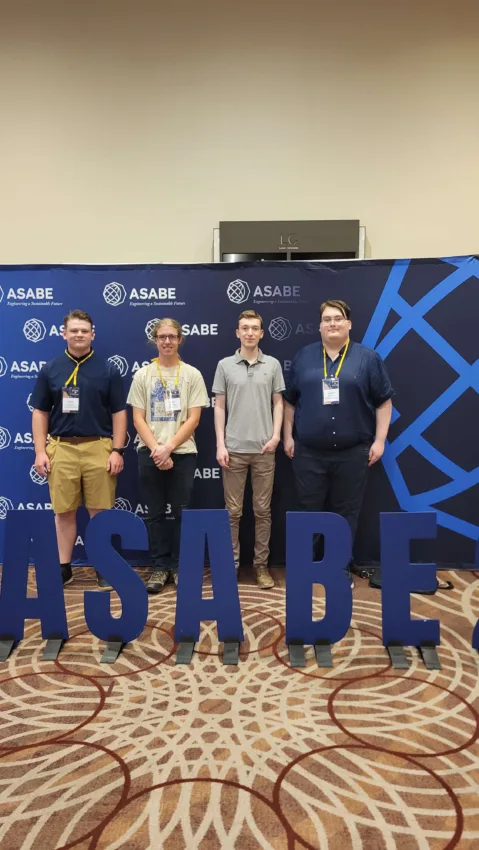
In a quiet corner of the Hardy Lab, tucked among 3D printers, tangled wires and a faint buzz of soldering irons, the University of Saskatchewan Robotics Club is bringing machines to life. What started as a few students’ shared fascination with automation has quickly morphed into one of USask’s most hands-on, collaborative and forward-thinking clubs.
For founders Evan Digney and Dawson Puderak, both engineering students, the club’s story began not with wanting to boost their resume, but with a simple shared curiosity. “It really started out of Project club,” explained Puderak, now in his fourth year of electrical engineering, referring to a project club, a defunct, informal student-run space where students could experiment with hands-on engineering projects.“We wanted to give students the chance to develop real engineering skills in a fun, flexible way before their capstone projects, and to create a space where people could build things they normally wouldn’t have the tools for.”
That vision resonated immediately with Digney, a third-year Mechanical engineering student, who has long been fascinated by robotics and automation. “I’ve always been obsessed with the idea of robots doing the dirty, dangerous and dull work, all the stuff humans don’t want to do,” he said. “That way, people can focus on the things that make us human: art, creativity, culture.”
Though the Project Club had existed previously, its structure was an informal and open-ended place to tinker, but lacked a clear direction. “It was hard to get people to commit to long-term projects without a real goal or deadline,” Puderak admitted. “The Robotics Club gave us that structure… It still has the same spirit, curiosity, creativity and collaboration, but now there’s a purpose driving it.”
The official kickoff came in November 2024, after a conversation between Digney and Dr. Scott Noble, a professor in Mechanical Engineering who had previously advised several successful student design teams, including the USask Aeronautics Club and Tractor Design Team.
“Dr. Noble mentioned the American Society of Agriculture and Biological Engineers (ASABE) Robotics Student Design Competition, the same organization that hosts the annual tractor design challenge, (…) and it clicked,” Digney recalled. “We realized this was exactly what we were looking for: a defined project, a national competition and a reason to start building.” With Noble’s encouragement and guidance, the newly formed Robotics Club spent the rest of the academic year designing and constructing their first competition robot.
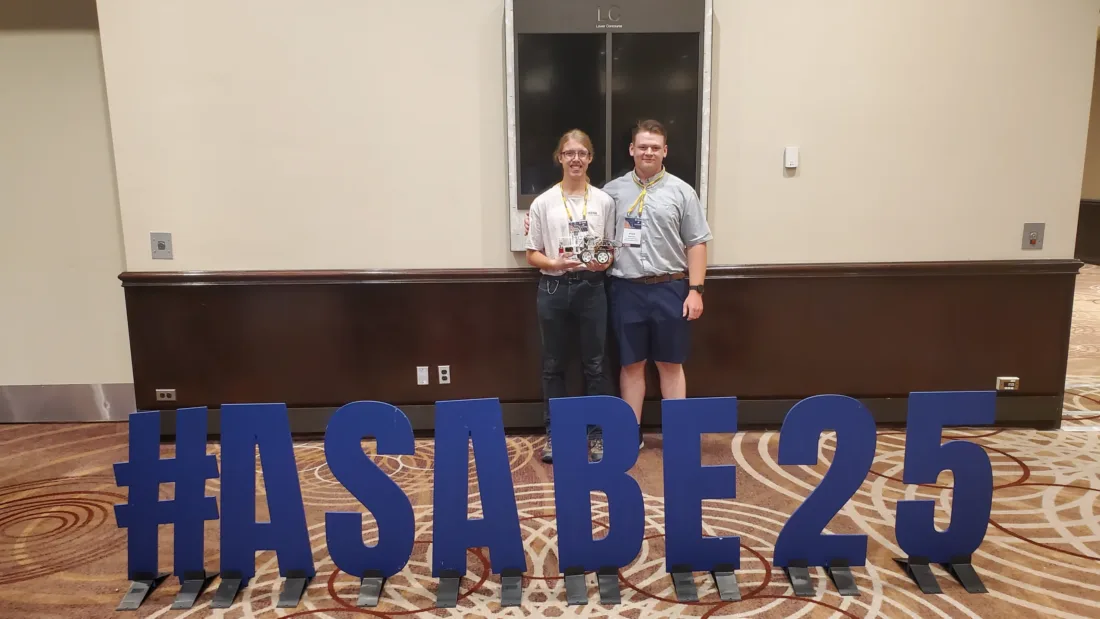
The ASABE Robotics Competition, held each summer, is no small challenge. Each year, student teams from across North America are tasked with designing autonomous agricultural robots to solve real-world problems.
“Last year’s competition was all about eggs,” Puderak laughed. “We had to build a robot that could collect, sort and transport wooden eggs across an eight-by-eight-foot grid.”
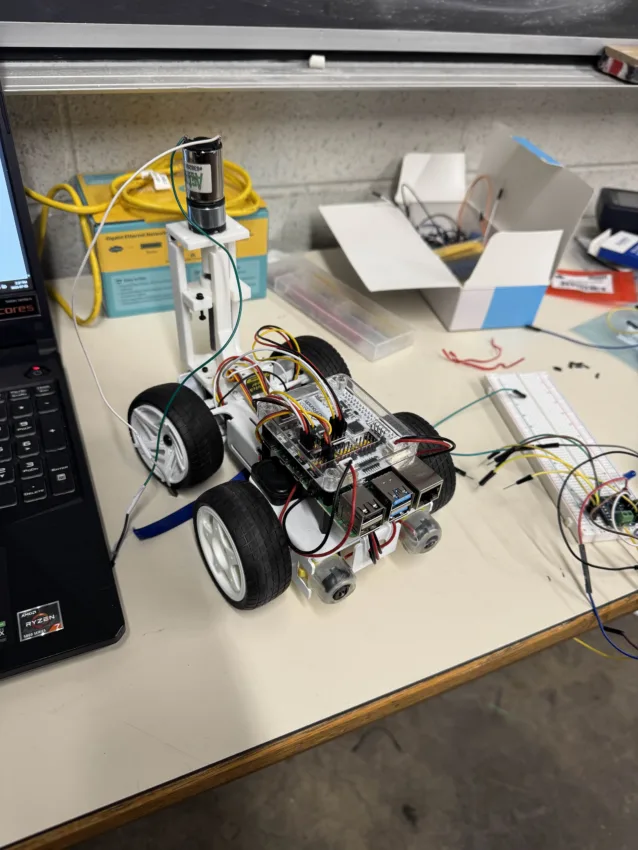
The robot’s job: detect which eggs were “good” or “bad” using colour sensors, pick them up, and move them into designated bins, all autonomously. The competition was hosted in Toronto.
Each year’s challenge is inspired by its location and agricultural context.
“It’s a uniquely Canadian type of robotics challenge,” Digney explained. “A lot of our students come from agricultural backgrounds, so it’s practical and familiar, (…) and it’s also just really fun to see something mechanical come to life.”
Despite being a brand-new team with limited time, the group performed admirably. “We did really well in the colour-detection section, but we just didn’t have as much time to perfect every
other section,” said Puderak. “Still, we scored high on our written design report, and that process taught us a ton about documentation, teamwork and iteration.”
The club now boasts about 20 members, though Puderak estimates around half form the consistent “core” team. “We expect a little attrition each year; it’s normal,” he said. “But the people who stay are really dedicated.”
Leadership is fluid, with Digney and Puderak serving as co-directors and others taking on multiple roles.“We don’t box people into one role. If you’re interested in administration, technical work or outreach, you can do a mix.” Digney said
Currently, the team meets every Saturday from 3–5 p.m., a schedule designed to work around busy lab times and multi-disciplinary class schedules.
“Anyone at USask can join; you don’t need any prior experience or to be in engineering.” Puderak emphasized. “We’ve got a QR code posted around the Engineering Building and a Discord server where anyone can join.”The club is also listed on the USask Clubs Discord directory, which helps connect new students with campus-based clubs and engineering teams.
From a technical standpoint, the Robotics Club’s projects “follow the engineering design cycle, identifying a problem, defining constraints, conceptualizing functions, prototyping and testing.”“We start with theoretical discussions, what the robot needs to do, how it should move, what sensors we might need,” Digney explained. “Then we split up tasks: one group might focus on 3D modelling and printing components, another on colour sensing, another on movement and controls.”
The process is deeply iterative. “We’re constantly revising and learning,” said Puderak. “Everyone brings feedback, and we host workshops on things like soldering, 3D printing and circuit design, so people can build skills as they go.”
Beyond the technical work, members gain experience in administration, communication and project management, skills that are often overlooked in class. “Even just picking components or
managing deadlines teaches you a lot about how real engineering projects work,” Digney noted.
Much of the club’s success so far has been made possible by partnerships and institutional support. Through the Institute of Electrical and Electronics Engineers, the team has access to a 3D printer, soldering equipment and workspace in the Hardy Lab. The University of Saskatchewan Engineering Students’ Fund also provided funding for competition expenses and materials.
“Without that support, it would’ve been impossible to get off the ground,” Puderak said. “We had to cover some of the costs ourselves because the funding wasn’t enough to cover everything, but we’re really grateful for what we did receive.”
Evan credits Dr. Noble as another cornerstone of their success. “He’s been an incredible mentor, helping us navigate logistics, connect with the right people and stay focused,” he said.
While the team didn’t win their first ASABE competition, they came back with something arguably more valuable: perspective.
“Seeing what other teams built was incredible,” Digney reflected. “There were people who approached the same challenge in totally different ways, some made smaller, faster robots;
others built elaborate storage systems. It was inspiring to see so many creative solutions.”
The biggest challenge, both founders agreed, was time. “We really only started designing in January for a July competition,” Puderak said. “We were rushing near the end, and a few components failed right before competition week. (…) But this year, we’re already ahead, we’ve got plans to test earlier and iterate more.”
For many members, the Robotics Club has become more than just an extracurricular, it’s a community. “The best part is that everyone who’s here really wants to be here,” said Digney. “You’re surrounded by people who care, who are curious, who believe in what they’re building.”
Puderak agreed. “In [my] first year, I was really academic; I didn’t think extracurriculars were for me. But this club changed that. I’ve learned more practical skills here than in some classes, and it’s helped me solidify what I want to do.”
Both hope the club will continue on after they graduate. “Our long-term goal is longevity,” said Puderak. “We want the Robotics Club to keep going, even after we graduate, to grow into an independent, ratified organization.”
Digney added, “The short-term goal is simple: do well in this year’s competition. But the bigger goal is to keep learning and helping others learn.”
Asked what advice they’d give to students considering joining a club or starting one, both founders had the same message: just start.
“You only go to university once,” said Puderak. “You have access to labs, funding, equipment and people who want to help. Take advantage of that, you won’t get these opportunities later.” Digney agreed. “It’s such a different experience from class, you’re meeting deadlines, collaborating, solving real problems. It gives you a head start in the real world.”
As they prepare for another season of design, iteration and the occasional all-nighter in Hardy Lab, the Robotics Club members remain grounded in the joy of creation. “It’s about celebrating small wins,” Digney said.
As their soldering irons cool and the hum of the lab fades into quiet conversation, it’s clear that what’s being built here, despite what the name might tell you, is a lot more than some robots, but rather a wonderful community of future engineers and tinkerers.

Leave a Reply