
THE UNIVERSITY OF SASKATCHEWAN’S MAIN CAMPUS IS SITUATED ON TREATY 6 TERRITORY AND THE HOMELAND OF THE MÉTIS.
THE UNIVERSITY OF SASKATCHEWAN’S MAIN CAMPUS IS SITUATED ON TREATY 6 TERRITORY AND THE HOMELAND OF THE MÉTIS.
The USSU Exec sits down with The Sheaf, offering a glimpse into themselves and a behind-the-scenes look into what they got up to this summer in their roles.
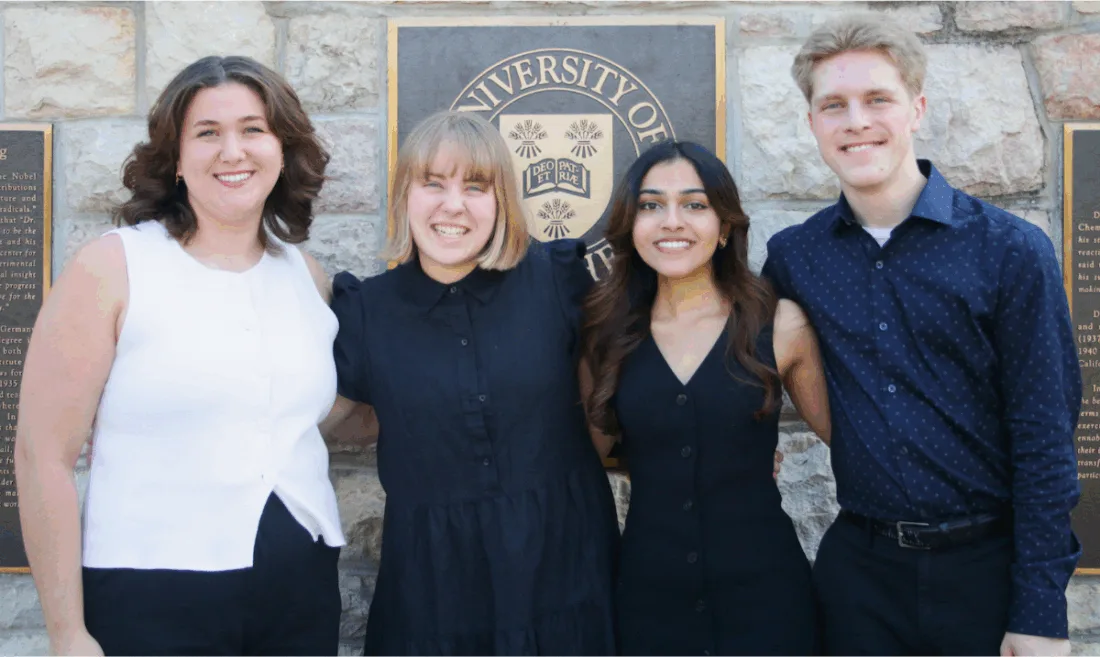
Founded in 1909, the University of Saskatchewan’s Students’ Union (USSU) represents, supports and advocates for the academic and non-academic needs of undergraduate students at USask. The Executive Committee is composed of the President, Vice-President Operations and Finance, Vice-President Student Affairs and Vice-President Academic Affairs.
USSU President Emma Wintermute is in her fourth year of a Bachelor of Arts Double Honours. She is pursuing degrees in Gender, Sexualities, and Social Justice Studies, as well as History. The President is the chief spokesperson for the student union, and Wintermute describes her position as being a “liaison between students and university leadership on all the governance and advocacy fronts.”
Vice-President Operations and Finance Owen Deis is a fifth-year Bachelor of Arts Honours student. He is pursuing a degree in History, while also working towards a Certificate in Peace Studies. He says his role includes the more behind-the-scenes tasks of the USSU.
“I handle everything to do with campus groups—so funding, ratification, space booking and insurance. I oversee the U-Pass, health and dental plans for undergraduate students as well as help with student fees and the USSU budget,” says Deis.
Norah Jacob is the Vice-President Academic Affairs and is pursuing a degree in Psychology, minoring in Math. Her position focuses on advocating for students in the academic context.
Jacob breaks down her role in two areas: students and university administration. “[With] students, I assist them in any kind of academic situations—appeals, misconduct, cheating, required to discontinue (RTD), anything that kind of has some kind of academic effect on their life. On the other hand, I also work with [university] administration. This is anything that falls under the teaching and learning umbrella, such as scholarships, AI, regulations and really any kind of policy that is related to students and misconduct.”
Vice-President Student Affairs, Emily Hubick, is a fifth-year student majoring in Cellular, Physiological and Pharmacological Sciences. She describes her position as a counterpart to Jacob’s. “I’m interacting mostly with students regarding all the non-academic aspects of student life—housing, parking, safety and security, sexual violence and events to enhance the student experience.” Hubick also liaises with the USSU Centres, which include the Women’s Centre, Pride Centre, Help Centre, Food Centre and Student Crew.
When asked how they chose their degrees, each executive had a different and unique process.
Wintermute says she never looked back after taking WGST 112: Introduction to Women and Gender Studies, a class she recommends all USask students take at some point in their degree. “[It] provided me the landscape to understand some of the thoughts I had and the opinions that I felt, but didn’t know how to communicate.” Wintermute went on to say how proud she is of the Women’s and Gender Studies program for “helping students learn to advocate and identify injustice and different systemic issues and barriers.”
Hubick says that she was inspired by science camps taken during the summer months as a kid, such as SCI-FI, which showed her how interesting medical sciences can be. In a meeting with a guidance career counsellor, USask’s physiology and pharmacology program was recommended to her as it was “one of the only ones in the country that was tailored to students interested in medicine and human bioscience.” Hubick jokingly says, “I’ve loved every second of [my program], except for when I hated every second of it.”
While Hubick’s degree is in biomedical sciences, she recommends students take either of the first-year art history courses, specifically with Dr. Jon Bath, regardless of where they are in their degree. She says that learning about “all of the different details about different art pieces and times” and “how it was influenced by culture and then how it influenced culture” was especially interesting, given her science program didn’t have much exposure to the humanities.
Deis’s journey to deciding his major was more straightforward than most students. “I declared my major literally the second I could,” with his reasons being that “this was the topic that interested me the most and the topic I did best in.”
He recommends all undergraduate students take HIST 388: Mass Killings and Genocide in the 20th Century. He says the class covers important historical events and that “[while] it’s very difficult to a point, it is a very important and interesting class.”
If Deis’s major selection was a walk on a straight path, then Jacob’s was a wandering stroll through a maze.
“I’ve always been someone who kind of falls in love with everything that I do”, says Jacob. “The second I took a physics class, I was like, ‘I want to be a physics major,’ and then I took a math class and thought ‘I’m gonna be a math major,’ and then an English class and thought ‘I’m gonna be an English major.’” Ultimately, Jacob settled on psychology because she felt it encompassed a lot of the things she liked, such as math, statistics and psychophysics.
When asked her thoughts on students changing their degree, Jacob responds with “I love it when I hear about students that change their major every five minutes because nobody who hates university is changing their major every second. It’s always the people that love and want to continue learning.”
She continues by addressing the fear associated with switching majors and the uncertainty that academic decisions bring. “I get a lot of students in my office who are really worried about losing time, especially students who have been [given a] RTD or need time off in their degree for other reasons. They keep saying, ‘I’m really worried because now I have to extend my degree by a semester.’ I don’t want that to be the mindset that we go into university with. I think we can all recognize that there’s an importance in getting a degree. But this idea that you need to do everything as fast as possible is just so counterproductive to what university actually represents, which is learning and respect for your craft and for your field, and just gaining an understanding on a deeper level.”
Over the summer, the USSU Executive Committee has been busy with meeting with various members of the university administration and communities, attending conferences such as the Studentcare/Alumo Conference and the Student Union Development Summit, and planning many of the events for the upcoming school year.
One issue that Hubick spent her summer focusing on in her role was learning more about what supports are offered and what is lacking in supports for sexual and gender based violence prevention and responses on campus. In collaboration with the Saskatoon Sexual Assault & Information Centre, the USSU is launching the Demanding Change, Uniting Community coalition to address sexual and gender based violence through advocacy and education.
For Jacob, a main focus of her summer was developing the academic handbook. “I get a lot of students in my office who continuously say that they didn’t know about certain things. They just don’t know the systems in place that are meant to protect them,” she says. Jacob’s aim with the handbook is to present the complex policies and regulations in a concise and readable manner to students. She also adds that there are helpful academic resources in the handbook, such as information about the library, Help Centre and tutoring centres. Follow the link to access the online version: https://ussu.ca/wp-content/uploads/2025/08/USSU-Academic-Handbook-2025.pdf
Deis focused on updating the campus groups handbook. “I looked a lot into what supports we currently offer to campus groups, how our policies are written and how they are communicated—especially how ratification funding and insurance policies are written and communicated to campus groups.” To access the online version, follow the link: https://ussu.ca/wp-content/uploads/2025/07/Campus-Group-Handbook-2025.pdf
Deis stresses the importance of taking advantage of the non-monetary supports that the USSU provides to campus groups. “When we ask campus groups, ‘What do we need to do to support you better?’ They often ask for an increase in grant budgets. We did increase the budget for campus group grants this year. We’re providing over $100,000 worth of supports to campus groups, including in-kind services. That said, I’m trying really hard to focus on what we can do that isn’t monetary.” He mentioned that campus groups have access to a Google account through the USSU with 30 GB of free storage space, book Louis’ for free, and get credits at XL Print and Design.
For Wintermute, her focus over the summer was developing a more active framework for equity, diversity and inclusion, especially with the new USask President, Dr. Vince Bruni-Bossio, starting in January.
“I had wholesome conversations with the International Students and Study Abroad Centres and the Indigenous Students’ Union over the summer to begin what will hopefully continue to be rich relationships and connections throughout the year and beyond. Discussing ways to engage community and learn more from each other, these shared spaces of dialogue have been incredibly meaningful,” expresses Wintermute.
She continues, “When our new president takes his role, we hope to have a strong foundation to begin to carry out a community-oriented action framework where we are aware of different student needs and different forms of student leadership.”
Wintermute summarized the work done over the summer by the team, saying, “The real hope of our summer was to make sure students felt that we were accountable to them. Even if [students] were not here on campus, we were still working for them.”
Throughout the year, Hubick says she hopes that students get involved in many of the fun events that she planned over the summer. “They’re going to be fantastic. I’ve worked as hard as I possibly could to fill out the year, and I’m really looking forward to that.”
Wintermute ends the interview by expressing her own joy and that of the Executive Committee for the year. “We’re so excited to have all of our students back! We’re so excited to get the actual year going. We’ve been doing all of our behind-the-scenes stuff, but now is the time for it to really get going. We’re beyond excited.”

Leave a Reply