
THE UNIVERSITY OF SASKATCHEWAN’S MAIN CAMPUS IS SITUATED ON TREATY 6 TERRITORY AND THE HOMELAND OF THE MÉTIS.
THE UNIVERSITY OF SASKATCHEWAN’S MAIN CAMPUS IS SITUATED ON TREATY 6 TERRITORY AND THE HOMELAND OF THE MÉTIS.
Rugby Canada is calling on Canadians for help with their “Mission: Win Rugby World Cup” fundraising campaign.
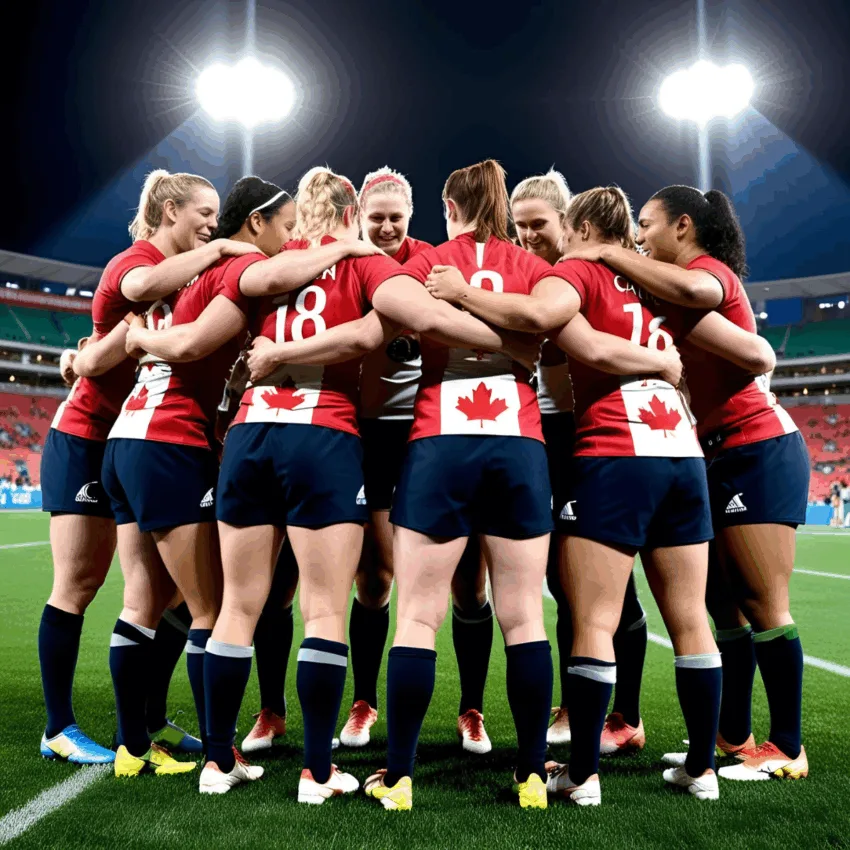
Rugby Canada is asking for the public’s help to fundraise one million dollars to send the women’s national 15s team, ranked number two in the world, to the 2025 Rugby World Cup, hosted in England from August 22 to September 27.
Rugby Canada has experienced a host of successes on the women’s side. The team finished fourth out of 12 teams at the most recent World Cup, held in New Zealand in 2022. In 2024, they won the Pacific Four Rugby series, an annual competition between Canada, New Zealand and Australia, and the USA — the second, third, sixth and ninth-ranked teams in the world, respectively — for the first time ever. Additionally, this tournament marked the first win against the reigning Rugby World Cup champion New Zealand Black Ferns in Rugby Canada history. Most notably, the Canadian women’s rugby sevens team took home second place at the 2024 Paris Olympic Games, and many players from this silver medal roster are set to compete at the upcoming World Cup.
These players will look to replicate this success and more at the Rugby World Cup, hoping to take it home for the first time in team history; however, they will have to do so with the added challenge of scarce funds.
Rugby Canada was only able to find $2.6 million in their budget to send the team to the tournament, significantly short of the estimated $3.6 million required for expenses such as training camps, warm-up matches, flights, accommodation, nutrition and physiotherapy.
Even if this million-dollar goal is achieved, Canada will still be one of the lowest-funded teams in the tournament despite their high ranking.
Canada’s team is considered “amateur,” meaning that players are not paid salaries to represent their country. This sets them apart from other nations at the top of the world rugby rankings. England, New Zealand and France, who boast the first, third and fourth-ranked women’s teams in the world, are all “professional” teams, meaning that their players receive a salary.
Just a few years ago, Canada Soccer came under fire for making cuts to the budget of their highly successful women’s national team and was accused of treating their female players as an “afterthought.” While funding successful women’s teams is often seen as secondary to their male counterparts in Canada and around the world, that is not the case here.
This lack of funding is not due to malpractice or corruption from Rugby Canada, who fund their men’s and women’s teams equally.
Rather, the issue seems to stem from two sources – firstly, the lack of popularity of rugby in Canada, and secondly, a general funding crisis which seems to be plaguing National Sport Organizations (NSOs) across the nation.
In 2023, Rugby Canada reported revenue of $15.57 million. By contrast, England’s Rugby Football Union recorded revenue of $325.3 million Canadian dollars in its 2023-24 annual report.
Canada’s national rugby teams must therefore make do with a fraction of the budget available to their competitors, a symptom of the relatively low popularity of rugby across the country.
While rugby is quickly growing, it is still much less popular than other team sports in Canada. In 2023, Rugby Canada reported around 40,000 “active participants” (coaches, referees, volunteers, and players). By contrast, Canada Soccer reported almost one million in 2019.
Of Rugby Canada’s revenue, about $3.35 million came from Sport Canada, which funds Canada’s 62 unique NSOs for summer and winter Olympic sports.
Currently, many of Canada’s NSOs are experiencing financial difficulties. Funding sport has been put on the back burner at the federal level.
The last increase in yearly core funding to be split between Canada’s sport organizations was in 2005, meaning the efficacy of this funding has essentially been slashed by two decades of inflation.
Additionally, the position of minister of sport has been somewhat of a revolving door of MPs throughout the Liberal government’s tenure, with six changes in the past eight years, and possibly a seventh if the results of the upcoming federal election result in a cabinet shuffle.
While in 2024 athletes across Canada received increases in their athlete assistance program cheques, which provide monthly stipends to support their needs while they train, core funding remained unchanged despite the Canadian Olympic Committee (COC) and Canadian Paralympic Committees (CPC) lobbying for a $104 million increase in the core budget.
According to the COC, “80 percent of NSOs are skipping competitions athletes would normally attend, 70 per cent have paused, scaled back or eliminated programming, 90 per cent have reduced or eliminated training camps and 80 per cent have increased athlete fees” due to the financial difficulties they are experiencing.
A Deloitte study commissioned by the COC forecasted that Canada’s sport organizations will run a combined $329 million deficit over the next five years.
The COC and CPC will continue to lobby the federal government this year, now seeking a $144 million annual increase in core funding in the 2025 budget on behalf of their NSOs.
It is extremely impressive just how far the women’s national rugby team has come with such little funding compared to their competitors. But without either a major increase in rugby’s nationwide popularity or in NSO funding, it will be increasingly challenging for the team to continue to replicate its international successes.

Leave a Reply