
THE UNIVERSITY OF SASKATCHEWAN’S MAIN CAMPUS IS SITUATED ON TREATY 6 TERRITORY AND THE HOMELAND OF THE MÉTIS.
THE UNIVERSITY OF SASKATCHEWAN’S MAIN CAMPUS IS SITUATED ON TREATY 6 TERRITORY AND THE HOMELAND OF THE MÉTIS.
Dear reader, to make it through this past year we’ve all had to adapt.
Like rubber bands being stretched to their limit and then some more, in the process of trying to live differently we’ve developed some funny, quirky and in some cases downright weird habits. We would be remiss if we let the one year anniversary of the pandemic pass and not take stock of them.
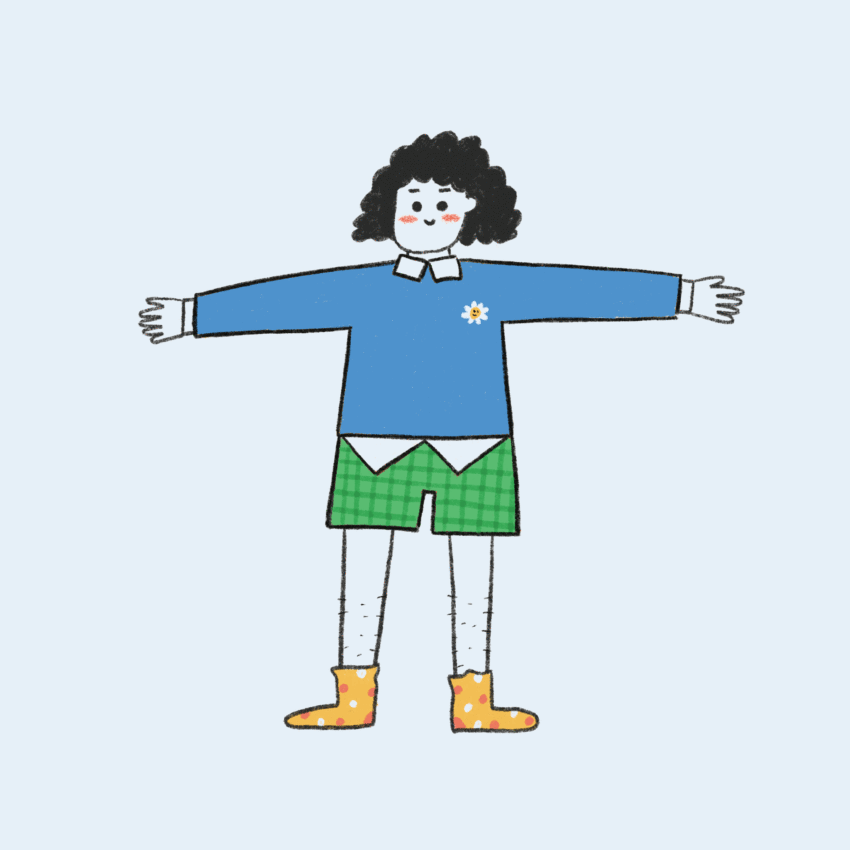
Let us begin with a moment of appreciation for the unofficial pandemic attire — dressy on top and PJs on the bottom.
I can’t tell you how much I’ve enjoyed indulging in this fashion. Contrary to what some may think, it’s not about being too lazy to get dressed. For me, it’s all about prioritizing comfort.
After all, the pandemic might be a good time to start living for ourselves, rather than following incredibly uncomfortable fashion trends.
Next comes what I call the “30-second dash.”
No longer having to transport ourselves physically to other locations, many of us can easily make it from classes to meetings in a very short period of time. And by very short, I mean seconds.
The “30-second dash” is when we transform our rooms from living space to meeting space. Blankets get tossed aside, strewn clothes get relocated, towels get pulled down, the door is shut and with one sweep, the desk gets cleared.
Without fail, this all happens within 30 seconds and this efficiency is something I hope we can all take with us into the future.
Up next is the series of video-meeting mannerisms we’ve had to develop.
You’d think a generation that grew up with video chatting as replacements for phone calls and cameras to document every moment of life would transition quite smoothly to a video-meeting environment. However, the number of times I haven’t been able to figure out video-calling software, asked if my mic was on, wondered where to look, or started talking, only to figure out I was muted after all, would suggest otherwise.
A year later, these things don’t bug me anymore, instead they provide a much-needed source of comedic relief during the day.
Another new addition has been to the “gosh darn, I forgot …” list for when leaving the house. As if it wasn’t long enough before and critically important already, masks have found their way to the very top of this list.
How many times have you left the house, only to turn back around because you forgot the ever-so-important face cloth? I think from now on I’m going to need to put it on a cord.
On the note of getting out, navigating public spaces has become an even more awkward experience. When going on walks, we now do a delicate dance of leaving enough distance between us and others walking, while also trying to be polite about it.
If the situation wasn’t so serious, it would be quite amusing to watch people skirt left and right to avoid others, even when they are a whole sidewalk away from them. But it’s this adherence to public health guidelines that’s going to see us through this.
Lastly, this year would not be the same without all the words we learnt to understand it. From physical distancing to mRNA vaccines, case count, isolation, restrictions, waves of infection, transmission rate and variants — these terms have all become a part of the ever-expanding COVID-19 lingo.
After all this, we will be proud of the scientific, epidemiological, medical and public health vocabulary we have adapted into regular use. I hope that these words, and the thinking behind them, are here to stay.
All jokes aside, while some of the habits we’ve developed are funny to think about, they also point to the incredibly adaptable nature of humans.
While this year has been hard and we’ve had to adjust, we’ve forged a set of new habits, one that made this year not only survivable, but better. And I think that deserves a laugh.
—
Vaidehee Lanke | Opinions Editor
Graphic: Anh Phan | Graphics Editor
Leave a Reply