
THE UNIVERSITY OF SASKATCHEWAN’S MAIN CAMPUS IS SITUATED ON TREATY 6 TERRITORY AND THE HOMELAND OF THE MÉTIS.
THE UNIVERSITY OF SASKATCHEWAN’S MAIN CAMPUS IS SITUATED ON TREATY 6 TERRITORY AND THE HOMELAND OF THE MÉTIS.
ALISON COOLEY
Arts Writer
This week, three shows at the Gordon Snelgrove gallery tackle place, landscape and identity.
Outsiders by Emily Corbett deals with the disconnect between people, landscape and technology. In Rachelle Hodgins’ show These Roots Run Deep landscape is more closely tied to labour and the small town lifestyle, while Shaela Verma’s show Ticky Tacky is about a quest for home.
In Emily Corbett’s show, Outsiders, she faced the challenge of using printmaking, a 16th century means of communication, in a modern context. So she turned to installation art.
“I thought it was important to add something new to the discourse of printmaking, since it’s a relatively ancient medium,” Corbett said.
In her two-part installation, she uses prints, both traditional and digital, to create a space the viewer can physically enter.
In an enclosed installation, a digital panoramic print acts as a screen for projections. The panoramic landscape, with evidence of human life but no human subjects, highlights the disconnect between humans and their environment and between each other, which Corbett feels is brought about by modern technology.
Paired with the installation are 144 etchings of human figures removed from the landscape. Arranged in a grid along the walls, they further emphasize this disconnect.
“Neil Postman’s book Amusing Ourselves to Death was a really big inspiration to me when I started this project, because it deals a lot with the media as epistemology; how people learn in relation to the media they consume,” Corbett explained. “In today’s world, we are sort of force-fed these little pieces of information, and these pieces of information really have no correlation to each other…. In the same way, I wanted to take these figures, remove them from any context, repeat them over and over until they lose all meaning and sort of arrange them in a nonsensical, random pattern.”
Corbett’s message may seem somewhat bleak but her intentions are more provocative.
“It’s hard to point to this lack without seeming really pessimistic,” Corbett acknowledged, “but I do feel that, by pointing at this lack, perhaps other people will start to think about ways that they’re connected or disconnected from each other, from their landscape and from their lives in general.”
Rachelle Hodgins, a photographer, deals with a different kind of tradition based on media in her show These Roots Run Deep.
“Documentary photography has had a history in Saskatchewan but a lot of the images you see are romantic images of falling down buildings and old farm lots and stuff… I wanted to show the life that’s actually there and the working farms that are actually being used,” Hodgins explained.
Hodgins’s show consists of a series of photographs that document the lifestyle of rural Saskatchewan, drawing parallels between locations across the province. One series of work arranges photographs of the main streets of small towns in a road-like grid across the wall.
“In the main street ones I am doing a typology of small town Saskatchewan,” Hodgins said, “showing how they’re the same but also different, showing the changing sky and weather. Anyone who’s lived in a small town or even just driven through one can probably relate.”
Her work also strikes a personal note, and serves as a tribute to her own family farm, which celebrates its 100th anniversary this summer.
In a second series of photographs, she situates herself in the tradition of farming, as well as photography. More than merely documenting, Hodgins is, in her own words, “reflecting on a tradition that I’m now taking part in.”
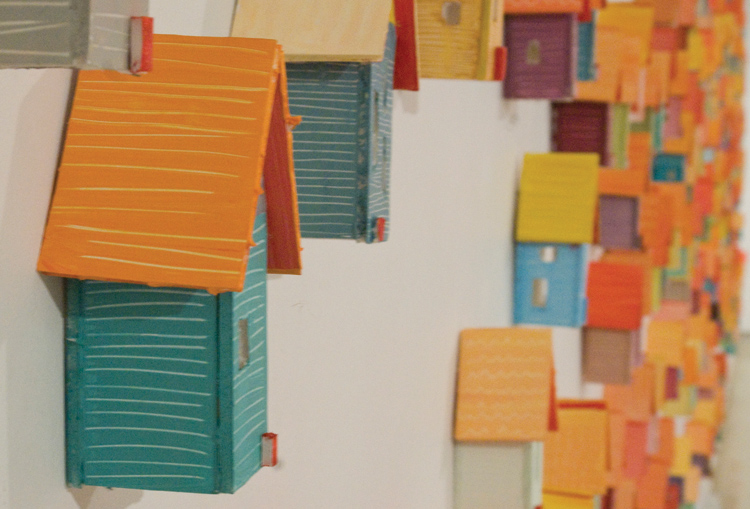
Shaela Verma’s show Ticky Tacky is all about living spaces. Through acrylic paintings, Polaroid photographs and a sea of 300 hand-painted foam core houses, she explores themes of place and family.
“I’m dealing with the concept of finding your adult home,” Verma explained. “I think as kids we associate home as being where your mom and dad are, and the house you grew up in — slowly but surely it isn’t home anymore.”
Verma’s show is, more personally, a way of mourning her grandfather’s passing.
“The photographs felt really appropriate because they were taken in my grandfather’s house,” she said. “(He) gave me my first camera. He was a commercial and portrait photographer and owned his own photo studio…. He was a very distant grandpa, and I think that that was the one object or thing or passion that we both had and shared.
“I like the idea that a Polaroid is supposed to be a snapshot that you can never reproduce, but it’s still reproducible. It can be this little intimate object — or it can be this really daunting big object.”
This sense of nostalgia echoes throughout Verma’s show. Although her paintings and sculptures (all of houses) have a more playful aesthetic, they deal equally with the search for a true home. The sculptures, painted in bright and pastel shades, are both precious and overwhelming.
“They’re their own little suburbia in a way. There’s probably things going on inside that you’re not aware of.”
One sculpture on the fringe of the wall stands alone. “That’s the little home. Or the home that doesn’t have a home.”
– –
photo: Greg Reese
Leave a Reply