
THE UNIVERSITY OF SASKATCHEWAN’S MAIN CAMPUS IS SITUATED ON TREATY 6 TERRITORY AND THE HOMELAND OF THE MÉTIS.
THE UNIVERSITY OF SASKATCHEWAN’S MAIN CAMPUS IS SITUATED ON TREATY 6 TERRITORY AND THE HOMELAND OF THE MÉTIS.
TANNARA YELLAND
Arts Writer
On a hot and stormy night in Calgary — the kind of night that sees retired sailors anxiously eyeing the shores in hopes of returning to the open ocean — Jason Hattie drank with bar staff after a gig for his band 9/11 Turbo and discussed interesting ideas to bring people in during the week.
“I was like, ”˜Man, you could just have, like, a late night talk show every Wednesday or something and it would be unreal,’ ” Hattie recalled. “And we kind of laughed and forgot about it. Then I told some people a couple of days later — namely, Adrian — and we just kind of started figuring out how to bring it to life.”
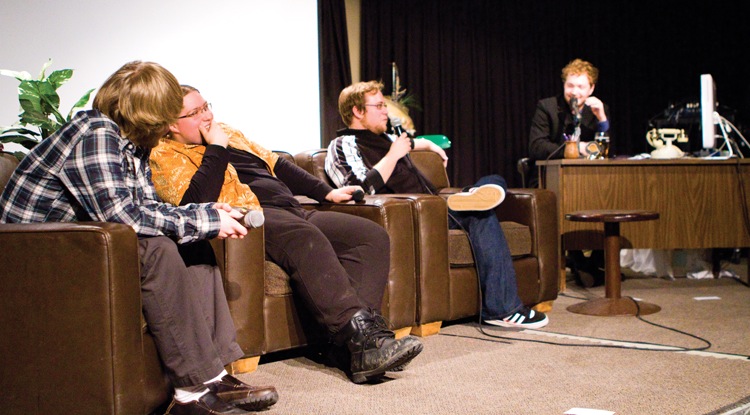
Talk Show is the brainchild of Hattie, Adrian Chappell and Jordan “Paul” McMurtry. Chappell and McMurtry were the first to say it was a genuinely good idea, and the three friends now form the nucleus of the Talk Show operation.
The show, which started at Lydia’s, eventually moved to Louis’. The move was predicated on several factors. Louis’ has enough space that it is no longer necessary to pack the entire set of the show into Hattie’s van every week. Hattie’s friend Dan Smolinski, who manages Louis’ on Monday evenings, was also a draw.
Now a regular fixture on the Talk Show stage, Smolinski introduces the show and acts as a sounding board for jokes before the show.
“If we ever have problems,” Chappell said, “we can just come to him and he usually has some kind of solution or tells us we’re dumb.”
Though Smolinski began to help the group plan and organize the show, Chappell remains the organizational mastermind of the show. Preferring to stay out of the limelight, she has spent her time convincing McMurtry to stay with the game plan when he gets overwhelmed by stage fright, and she generally keeps the boys from getting too drunk before the show. Lately, she has also taken on the task of prepping guests for their interviews.
McMurtry brings to the table an appreciation for late-night talk show host Conan O’Brien and an understanding of the subtleties of comedic timing that balances Hattie’s often outrageous showmanship. McMurtry performs under the stage name “Paul,” despite the fact that both he and Hattie often do the show intoxicated, making slip-ups common. An audience that may or may not be laughing at the jokes is almost certain to interject when Hattie calls “Paul” the wrong name.
But the star of the show is undeniably Hattie, who bravely walks out on stage to do the — sometimes less than hilarious — opening monologue each week. McMurtry sits on the side and offers some support. But when a joke fails it falls squarely on Hattie’s shoulders, and, given the improvisational nature of the show, failed jokes are not entirely uncommon.
“The monologue is, uh, it’s a different beast,” chuckled Hattie. “Sometimes it hits and sometimes it misses, but either way, whatever.”
“On regular talk shows,” McMurtry interjected, “those guys are on every night, so there’s a regular flow you can get into.”
Despite doing a talk show weekly and having come up with the idea himself, Hattie claims to have no interest in the format. In fact, he says he hates television altogether. He finds the format appealing principally for the opportunities it offers.
“It just gives you the freedom to do whatever you want,” Chappell explained. “You can throw all sorts of different elements into it.”
Indeed, the show’s format is anything but ordinary. While the opening monologue and the Top Nine are weekly fixtures, a series of different segments pop up from week to week. The audience is often called to participate in a competition, which ranges in nature from a drinking contest to a grilled cheese eating contest to an intense questioning known as the “Lightning Round.” The last is an intense battle of wits, wherein two audience members compete to provide funnier off-the-cuff answers to a set of bizarre questions.
Perhaps the most spot-on humour comes from the homemade videos the team routinely shoots. Clearly, the whole team enjoys making the videos that have periodically popped up, likening them to English class projects. Guest Tim Vaughn appeared in one, pretending — one hopes — to have a creepy obsession with Prince.
For the first show of 2010, Hattie and McMurtry trolled the halls on campus looking for students with interesting New Year’s resolutions. In the end, McMurtry and Hattie made their own resolution to play Dance Dance Revolution, and, accordingly, attempt to play In the Groove, a game akin to DDR. Hattie struck out almost immediately “Life depleted?” he read off the screen incredulously. “Get fucked!”
On the other hand, McMurtry was impressively skilled: by the time he finally lost, he had doffed his shirt and was shooting the screen with the gun from a neighbouring game.
Perhaps the greatest aspect of the show is its laid back approach. Both laughing with and laughing at is encouraged and supported, and the more vocal the better. If heckling is your thing, there’s a new venue for you: Talk Show with Jason Hattie.
– –
photo: Rory MacLean

Leave a Reply