
THE UNIVERSITY OF SASKATCHEWAN’S MAIN CAMPUS IS SITUATED ON TREATY 6 TERRITORY AND THE HOMELAND OF THE MÉTIS.
THE UNIVERSITY OF SASKATCHEWAN’S MAIN CAMPUS IS SITUATED ON TREATY 6 TERRITORY AND THE HOMELAND OF THE MÉTIS.
RORY MACLEAN
News Editor
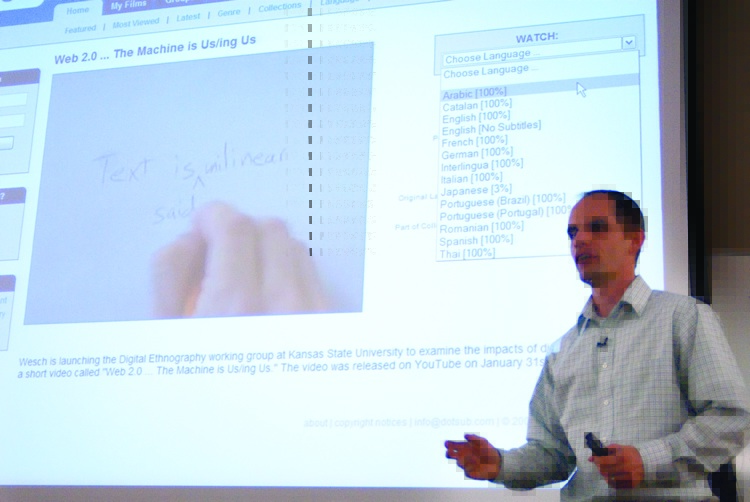
The machine is changing us, asserts Michael Wesch.
Our personal relationships are being profoundly altered through the rapid worldwide growth in online communication. As the Internet increasingly overtakes television as the most popular form of media, Wesch, a professor of anthropology at the University of Kansas, says people are increasingly becoming active participants in the creation of culture instead of being passive consumers.
Wesch echoes Canadian media scholar Marshall McLuhan: the medium is the message — in other words, the form of the media determines what the content looks like. As opposed to television, which is a one-way medium, the Internet allows for endless streams of communication.
The web has always been about connecting people, but with the development of web 2.0 tools and social networks like YouTube, Flickr, blogs, Twitter and Facebook, it’s easier than ever before to share videos, photos and text and to remix and mash up older content into something new and unique. The emphasis is on user-generated content.
This is not all positive. Looking at the comment section on YouTube can slowly disintegrate one’s faith in humanity, for instance.
But Wesch remains an optimist. He approaches all of his courses with a heavy emphasis on media literacy and participation. He is a bugle boy for the democratic potential of the Internet.
His influential work can be seen on YouTube and includes the videos the Machine is Us/ing Us and An Anthropological Introduction to YouTube.
Wesch sat down with the Sheaf on a recent visit to Saskatoon to discuss just how exactly the machine is changing us, including its ramifications for social organization, law and even love.
Sheaf: What is the focus of your work?
Michael Wesch: How our culture today is profoundly mediated; the difference between a mass media culture and a new media culture. I think we’re missing out on a lot of opportunities. We’re not really preparing our students to fully participate and take advantage of new media. The Internet is a very sort of empty platform. Who can have a voice, who can say when and where, all those things are kind of up for debate now.
Sheaf: I can see how people are communicating differently now. But perusing Twitter and YouTube sometimes makes me wonder how profound it actually is. I mean, look at the comments section.
MW: It is profound, and yet it’s not. I think a lot of these new media tools are so dependent on who is using them.”¦ I view it simply as potential — it’s all about how you utilize that potential. I think you’re right to have some misgivings about it. You also have to consider the age of a lot of people using YouTube. If a comment sounds really adolescent, it’s probably because it was made by a 12-year-old kid somewhere. I was travelling here today and you end up in a lot of public bathroom stalls when you travel, so you get to see all the stuff that’s written there. The conditions that produce those comments are similar; you have a relatively anonymous platform and it produces pretty similar results.”¦We still see a lot of junk dialogue. We also see a lot of replication of mass media superficialities.”¦ We still live in a pretty passive culture for the most part, and that’s where teaching comes in.
Sheaf: Speaking of teaching, what is it like to take one of your anthropology classes?
MW: I try to create what some would call an ”˜authentic’ learning environment. I try to have students take on real problems in the real world. For example, in a digital ethnography class, which is the study of digital culture, instead of me telling them what all these great theorists of digital culture have said, we’ll think of ourselves as a research group. At the end of the course students prepare a five minute documentary on their findings from the class.
In my bigger classes”¦ instead of following a traditional textbook, we try to collect all the information we can about the state of the world right now”¦. We basically become a huge research team of 200 to 400 students, looking at why the world is the way it is and how we can change it.
Sheaf: In your video The Machine is Us/ing Us, you argue that the Internet will totally change the way we see our relationships with each other, including love. What do you mean by that?
MW: Well, I’ll give you a quick run-down of love over the last eight centuries. 800 years ago, you may have been in love with somebody but chances were you wouldn’t marry the person you were in love with. Who you married was not up to the individual; it was a relationship between families, so it was an arranged thing rather than built on love.
Fast forward to the dawn of the printing press, the industrial revolution and these things”¦ people are increasingly mobile, going where the jobs are. They’re leaving the extended kin networks — becoming increasingly disconnected from the networks that found them marriages. This goes hand in hand with the rise of individualism. At the same time, people are becoming more and more lonely, so who we choose as a mate becomes increasingly important. You can trace that through the growth of all industrial processes.
The basic point about love in the near future is that we’re transforming now, out of modern culture.”¦ It’s been happening now for 40, some would even stretch it to 80 years, so it’s not just the Internet. But it is, however, tied to electronic processes and the Internet is just one form of that. We’re at a point in history where we’re seeing broad, sweeping changes in our culture and it will change the way we think about love. More than half the people in the West think it’s OK that men love other men and women love other women and that was not the case 50 years ago. I don’t know what it will look like, but it could be as profound as something like, love may not be about finding ”˜the one.’ I don’t know.
To help him understand how text and other communications media affect societies, Michael Wesch headed to a remote mountain village in Papua New Guinea to study a society that was only just beginning to come to terms with the introduction of print and print practices, including mapping and census taking.
Before census taking began, most villagers did not have set names. Their names were decided in their relationships to other people; how other people addressed them — mother, brother, son, friend and so on. Many villagers wound up adopting names for the sake of the census.
Even the practice of law took on a different character after the introduction of the written word. Originally, questions of village law were decided in public, with the goal of healing any rift in villagers’ relationships. Now disputes are resolved in a private courthouse and are judged against the letter of the law.
It was from this experience in Papua New Guinea that Wesch became interested in the idea of how media affects social relationships; that all relationships are mediated — this became the springboard into his study of the Internet.
– –
photo: Raisa Pezderic
Leave a Reply