
THE UNIVERSITY OF SASKATCHEWAN’S MAIN CAMPUS IS SITUATED ON TREATY 6 TERRITORY AND THE HOMELAND OF THE MÉTIS.
THE UNIVERSITY OF SASKATCHEWAN’S MAIN CAMPUS IS SITUATED ON TREATY 6 TERRITORY AND THE HOMELAND OF THE MÉTIS.
ISHMAEL N. DARO
News Writer
Back in June 2000, PC World magazine asked, “Do you want e-mail everywhere?” describing new mobile phones that were capable of sending and receiving email, paging, faxing and some limited web browsing.
“Powered by a single AA cell,” the writer boasted, “the BlackBerry 950 has a 1-by-2.5-cm screen displaying either six or eight lines of 25 to 32 LCD characters each on an unlit screen.”
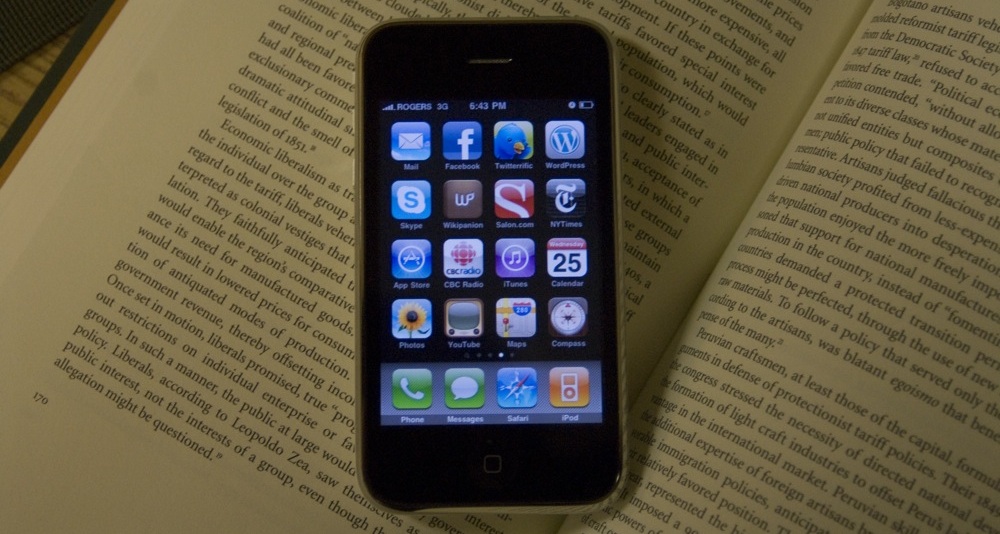
Nine years later, the Canadian-made BlackBerry is still on the market, along with a range of other similar devices like the Palm Pre and Apple iPhone. These “converged mobile devices,” commonly known as smartphones, have more processing power than even average home computers from 2000, and their popularity is only growing.
“You can see smartphones getting a little bit more accessible and you can see cellphones getting a little bit more usable, so the happy medium is to have a low-end smartphone,” said Eugene Fiume, computer science professor at the University of Toronto who does research in digital media.
Fiume says prices and features have been improving in cellphones, especially with the advent of touch-screen keyboards, encouraging more people to go mobile.
Today smartphones represent the fastest growing part of the phone market. According to research firm Gartner, 41 million smartphones were sold in the last year. Apple recently surpassed Nokia to become the world’s most profitable handset vendor on the strength of the iPhone, the success of which has helped bring smartphones to the maintream.
Still, compared to other countries, mobile usage in Canada is relatively low, with up to 30 per cent of people without cellphones. This is in stark contrast to countries such as Japan, South Korea or Italy, where cellphone uptake exceeds 100 per cent.
This reluctance on the part of some Canadians to buy cellphones is likely due to inconsistent coverage across the country and the unreliability of 911 emergency calls from cellphones, although the Canadian Radio-Television and Telecommunications Commission has ruled that wireless providers must bring their systems up to speed by February of 2010. Additionally, Canada’s existing landline phone grid is much more reliable than what is found elsewhere.
“Cell technology was really used to leapfrog wired technology in a lot of countries,” said Fiume. “If we look at the proliferation of cell phones, in various countries they simply didn’t have a wired option or they leapfrogged it. They simply used the wireless option as their single-source phone.”
There are currently about 4.5 billion handsets in the world and for people in some developing countries, the cellphone is the gateway to the World Wide Web. The proliferation of mobile technology has the potential to help improve everything from education to incomes.
One new application for cellphones has been the use of mobile money, a system of transferring funds between phones. The most successful example of mobile money has been Kenya’s M-PESA, which launched in 2007.
Mobile money is much safer and faster in places where roads are poorly maintained and services like money transfers are risky or just too expensive. Customers can buy credit for their mobile accounts at local retailers, who upload the money via text message. That money can be transferred again between individuals with yet another text message.
People who would normally not have access to banks and financial services can now easily transfer funds or even use their phones as savings accounts. According to a report by the think tank CGAP and the U.K. government, the income of rural users in Kenya increased by up to 30 per cent as a result of mobile banking.
Professor Fiume is quick to point out that for many people in the developing world, phone technologies are not identical. “When we talk about the mobile web, it isn’t just Internet stuff,” he said. “It’s any kind of data communication protocol.”
“Farmers who want quotations on average prices of the commodities they want to sell, five to 50 kilometres from their town, may well avail themselves only of SMS (text messages).”
If current sales of smartphones are any indication, the amount of data accessed wirelessly will only keep growing as people use their phones as either primary or secondary Internet devices. Small portable devices with Wi-Fi capabilities such as netbooks and e-readers like the Amazon Kindle will also fuel increasing demand for connectivity anywhere, anytime.
The mobile web may even prove lucrative. In early November, Google purchased the advertising company AdMob for a whopping $750 million, perhaps anticipating the mobile web to be the next frontier of the Internet.
– –
photo: Tannara Yelland

Leave a Reply