THE UNIVERSITY OF SASKATCHEWAN’S MAIN CAMPUS IS SITUATED ON TREATY 6 TERRITORY AND THE HOMELAND OF THE MÉTIS.
THE UNIVERSITY OF SASKATCHEWAN’S MAIN CAMPUS IS SITUATED ON TREATY 6 TERRITORY AND THE HOMELAND OF THE MÉTIS.
Ancient martial arts, student concerns, AI and the point of student media with the USask president
8:35 a.m., Sept. 2. I’m standing outside the Peter MacKinnon building having a staring contest with a bulldozer. So far, the bulldozer is winning. It’s my first day of classes, same as it is for most students, and thus my first look at what I’m sure will come to define the aesthetic of our beautiful campus in 2026: piles of mud, Bobcats and omnipresent yellow steel walls.
I turn heel, concede defeat to the bulldozer and bask in the majesty of the Peter MacKinnon building. A small and vaguely adorable security camera winks down at me from one of the building’s lofty, curtained windows. Students are squeezing up and down the ramps on either side of the entrance, their usual routes having been altered by the construction.
The air feels like a pinched nerve. Everybody seems stressed out.
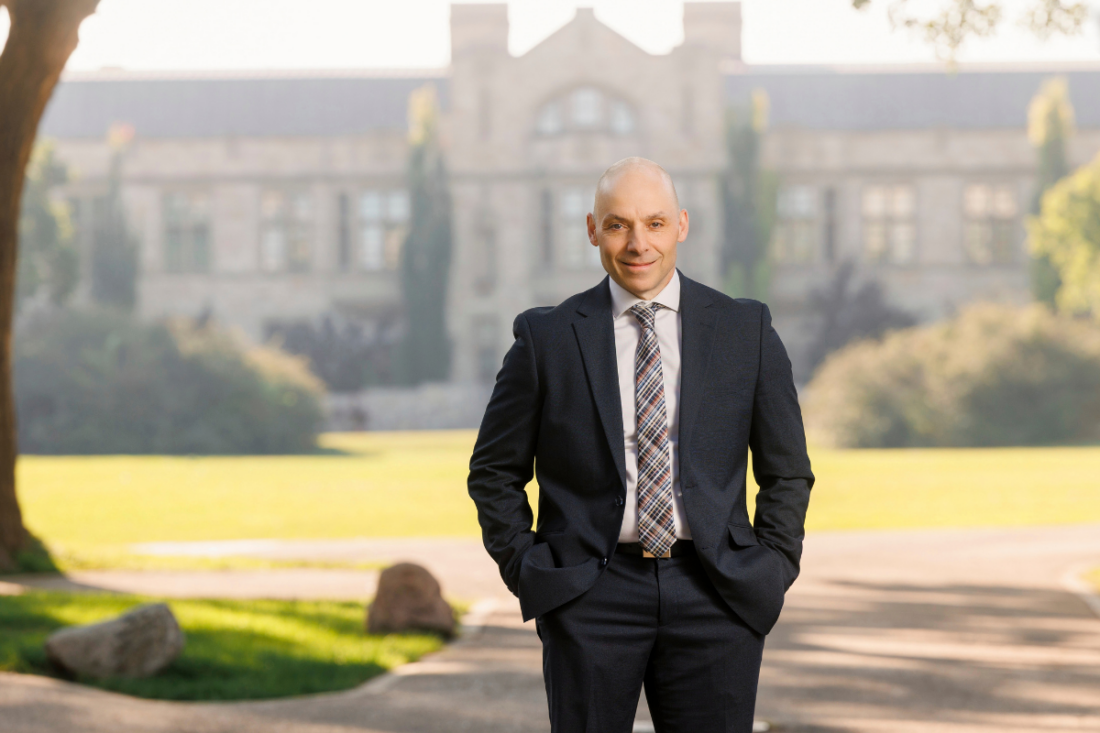
I don’t have class until later in the day. I am here on different business this morning: an interview with University of Saskatchewan President and Vice-Chancellor Vince Bruni-Bossio, now eight months into his term.
I walk into the Peter MacKinnon Building, up the stairs and into the president’s office. I’m immediately greeted by his team, who are perfectly hospitable and courteous. We make small talk. I indulge in a granola bar. There’s a story about the Montreal Canadiens’ salary cap in the day’s StarPhoenix on the coffee table in reception. I don’t see a copy of The Sheaf.
Bruni-Bossio is running a few minutes late. It’s his daughter’s first day of kindergarten, and he is dropping her off. It would take a degree of coldheartedness still foreign to me to fault any man, president or not, for that sort of holdup. Before long, the president walks in the room, sees me sitting and comes over to shake my hand.
Bruni-Bossio, two members of his team and I step into an adjacent room with a high ceiling. Any butterflies I did have about this are long dead. I’m given a coffee (not bad, by the way), and I set up what little equipment I need. We make more small talk.
His eyes light up when I mention that I once helped set up a PA system for Canadian hard rock legends Trooper. He tells me this might be the first time Trooper has been brought up in the president’s office and that it serves as a good omen. The opening chord from “Raise a Little Hell” plays in my head.
Now. Questions.
Q: “In the second article on history and philosophy compiled in the ancient Bubishi Karate Manual, Master Wang Fudeng offered 12 laws of wisdom. I’ve selected three from his list of 12, and here they are: ‘Patience is the foundation upon which security and a long life rest.’ ‘Trustworthy reputations are only gained from virtuous merit’ and ‘remain honest in your heart, true to your discipline, and refrain from overindulgence’. Which, if any, of these three jump out to you as significant?”
A: “So the one that talks about trust — I mean, that is the essence of every relationship and everything we go forward with. So I would say I focus a lot on relationships and trust, but the idea of honesty … avoiding overindulgence is something we’d all like to do. But being honest with yourself about who you are and what you’re trying to achieve — that’s what that’s really about. And then the patience, you know, that’s something that did come out of my training, in the sense that I really believe if you’re going to be a strategist, you’ve got to be a gardener.
You’ve got to plant seeds. You’ve got to water things, make sure the soil is good, and then you’ve got to wait and see what happens. And you kind of know what’s going to happen in general, but you don’t know exactly what’s going to happen. So you have to let go of control. Patience is really about taking your time and not trying to control the outcome, but waiting to see what emerges from the work you’ve been doing.”
There is something almost too appropriate about sitting in the president’s office, with windows overlooking a campus that has quite literally been dug up, listening to its newest president describe leadership as gardening.
Q: “I understand that you have a background in karate and judo. Is that correct?”
A: “Not Karate … not judo. I trained in meditative martial arts … internal martial arts. So I would have done some Wing Chun, some Tai Chi, some other forms, something called Yiquan, Qi Gong and then I did basic boxing.”
Q: “I just wonder if there’s anything else that’s interesting about you that you USask students might like to know?”
Bruni-Bossio takes a moment to tell me that he was involved in an accident in his youth which left him temporarily paralyzed from the waist down. He explains that he was able to overcome much of the stress that comes with such an experience by employing the lessons he learned from the martial arts.
A: “I learned … the importance of listening to people and listening to their perspective because their perspective matters. If you’re going to have empathy for somebody, you have to actually take a moment to listen and see the world from their perspective. And I think that came from having gone through a lot when I was younger. ”
It’s the sort of story you don’t hear often, and I’m glad he shared it with me. I’m struck by a feeling of having made the right decision to stick my neck out for this interview. My confidence bolstered, I follow up.
Q: “What’s been your favourite aspect of the presidency at USask so far?”
A: “I really enjoy connecting with people. I really enjoy the work we’ve been doing on strategy to set the direction of the university. I like being in a role where we have authentic relationships, even if they’re through the institution and different roles.
Being able to connect with people is really important, and it’s a very externally facing role. You know, whether it’s meeting with students, faculty, staff or people outside the university, you’re constantly relating to people, you’re constantly listening, and it goes back to that trust part of your first question.”
Q: “I’d like to talk about students a little bit. What do you believe to be the biggest concern for USask students broadly?”
A: “I think there are varied concerns. I’ve been talking to students, so what I’ve understood is that, of course, tuition and cost of living is a concern, and that makes complete sense to me because [the] cost of living is going up.
Students are concerned about their ability to meet financial obligations … but on a deeper level, there seems to be a concern around well-being, around mental health, you know, around the expectations society has on students and what they’re being thrust into in this new, changing world of uncertainty and AI and all these new things that are happening.
How do they meet those expectations? And [how] are they going to even just meet the expectations of the day, like even getting here today, you know, and all this construction stuff, and then having to go through classes … On one side, I believe there’s a concern around costs, but on a deeper level, I think there’s a concern around well-being overall, success in their lives.”
He’s right. I know he’s right because I’m one of the students he’s talking about. Not only that, I have many friends who are students and, regardless of major or plans after graduation, financial uncertainty is difficult to separate from the broader and esoteric anxiety Bruni-Bossio describes.
The thing is, I can’t help but wonder how far the level of that general angst would plummet if housing, groceries, gas and, in the case of students, tuition were more affordable. The matter of meeting financial obligations for many of us sits alongside overall well-being and success at that deeper level.
Q: “In May, our then news editor Colton Danneberg wrote an article about two farewell parties thrown by the university in honour of your predecessor Peter Stoicheff, which carried with them a combined price tag of over $60,000. I’m wondering if you’ve had the chance to read that article and if you have your reaction?”
A: “Yeah, of course I’ve read the article. Yeah, I understand. You know, again, students being concerned about spending, especially in a time when they’re struggling with financial costs. I think what is important to communicate about that is that the funding for those events … came out of donor funding, not operational funding. So it was donors who wanted to contribute to celebrating a president who had been here and done 10 years of work, and I don’t think it was just donors.
The whole community wanted to have the celebration. You know, we have a deep sense of community at this university, and a lot of work that Peter Stoicheff did set the foundation for the future, and I believe that people at this university wanted to celebrate that, and there was donor funding to do it.
I don’t see how it impacted negatively on students, but I can understand why students would ask the question, and I thought it was respectful for them to ask the question and [for] the article to be written.
In his 1949 treatise on consumption and expenditure, La Part maudite, French essayist Georges Bataille claimed that “real pressure … puts unequal organisms in competition with one another, and although we can not say how the species take part in the dance, we can say what
the dance is.’”
There is real pressure on young people today, whether you want to call it economic, psychological or both.
It would be wrong of me to disregard the desire of benefactors to celebrate Stoicheff’s decade as president. With that being said, reading that the farewell parties cost an estimated $60,000, regardless of where the money came from, inevitably invites comparison between institutional celebration and the financial strain many students experience.
The negative impact Bruni-Bossio is searching for comes in the form of an unavoidable mental calculus. How many students hear $60,000 and immediately translate it into semesters of tuition? Is that a fair comparison? Maybe not. But fairness has never prevented the human mind from making comparisons. When you have big numbers to think about, you end up playing funny games with them.
Q: “There’s a widespread belief, just generally, I think, that university degrees, specifically degrees in the arts and humanities, carry less weight in the professional world than they did at one point. Bearing that in mind, why, in your opinion, should somebody interested in pursuing a degree in the arts or humanities elect to do so at the University of Saskatchewan?”
A: “I have a degree in English. My first degree is in English and drama, so I have a degree that comes from the social sciences and the arts. Then I went and did a business degree as my second degree. I believe that the humanities and the social sciences are very important, especially in a world where we’re going forward into AI, because the lessons around critical thinking, the lessons around problem-solving, the lessons around how to break a problem down into different types of components all come through those classes.
So, if we’re going to foster critical thinkers, those are the classes [where] we will definitely have an edge in the world, and we need them more now than we ever did. I think our university has maintained its focus in these areas. It hasn’t retracted. It hasn’t said we’re not going to offer those courses. I think that we are positioned well, and I know there’s faculty in those departments that care deeply about teaching these principles to students … I know for a fact that faculty [really want] to teach critical thinking and teach skills that can help students be successful. Society needs those skills.”
Q: “You touched on AI. You were one of four collaborative authors of a 2025 Harvard Business Review publication entitled “AI Is Great at Routine Tasks. Here’s Why Boards Should Resist Using It.” Here’s a quote from the publication: ‘As organizations embrace AI, they must remain mindful of its impact on leadership and governance structures.’ Have you observed any difficulty with this specifically pertaining to leadership and governance structures at the University of Saskatchewan?”
A: “I think AI is touching all organizations, so I would say all organizations are trying to understand how to use it, and how and where it intersects with leadership and where it intersects with governance. Would I say that I’ve observed us, you know, trying to wrangle AI and figure out how to use it? Absolutely. But so has every other president that I talk to. I think the key thing for us to focus on, though, is [that] it goes back to our talk about students and what they’re learning. [AI can increase our] ability to do tasks and do things more effectively, but the actual decision-making and the actual critical thinking … is still a very human experience and is needed.
I think all leaders are trying to understand ‘how do I use this to facilitate my decision-making, but [not] make the decision.’ And [for] students in the classrooms, we’re trying to think about ‘how do we teach students to use this in a way that will help them in their jobs because employers expect them to know how to use it, but not in a way where we’re not teaching them those critical thinking skills and problem-solving skills.’
I think we’ve accepted that it’s not going away. We’ve accepted that it can be very helpful, and we’re learning how to use it … The challenge is that it keeps advancing too. So every time we get to a place where we understand, there’s a new type of AI that we have to figure out.”
Q: “In [relation] to that, over the summer we saw some anti-AI data centre rallies held in Saskatoon and Regina … There seems to be a growing push against AI implementation from young people across North America.”
A: “Well, I think these are discussions we need to have, and I support any kind of discussions society needs to have about using a new technology like AI. So I think the fact that these discussions are happening shows that we’re being responsible as a society. We’re thinking it through, and we’re starting to evaluate again how we use this new technology in an ethical, responsible way. ”
Q: “I agree. I want to talk a little bit about The Sheaf … Where do you believe the value of a student paper lies, or what do you think the point of a student paper is?”
A: “Well, I would be really interested in your answer to that question, but I will entertain it. Since this is an interview, I think this is a place for you to explore the things that students care about, for you to voice concerns. I also think it’s a place to build relationships and get answers and get new strategies emerging.
So, you know, the talk we’re having today and the relationship with The Sheaf can really help us think through our role because you’re a conduit into what the students are thinking about. It can really help you see what’s happening up here … to understand that there are a lot of people here that care deeply about students.
I don’t think anyone comes to work at a university if they don’t care about students. So they’re trying to do their best, and I think the place to meet and talk about that is a place where we can innovate and learn about each other and understand what matters and how to get things done better.
I think it works as an interface as well as a sort of place to voice concerns; there’s an interface and relationship building, going back to the trust that we talked about. Better trust between The Sheaf and administration can only lead to better decisions and better outcomes.”
Q: “So I guess it’s safe to say that you think that a lively student newspaper would be an asset for a university in a media landscape dominated in most part by newer and less traditional media.”
A: “My background is always about meeting, discussing, having more discussion than less. So I think a lively newspaper is an asset for sure to a university, and especially in this world when there’s all these different outlets and people are questioning truth and stuff.
If we have a really authentic newspaper [at the] university, it can be a place of real dialogue where people trust it more than they would trust other sources.”
An important piece of context sits behind the following question. During the early months of Bruni-Bossio’s presidency, The Sheaf made several attempts to connect with the president’s office and university administration. Among them were requests for an interview with the new president. This is also where the aforementioned questions surrounding the cost and funding of Stoicheff’s farewells were raised. The latter article included responses from USask Legal Counsel and USask Communications explaining the parties, their funding and the university’s rationale for holding them. But the estimated cost itself was not provided outright. The Sheaf arrived at its figure after reviewing a heavily redacted package of receipts and invoices.
The president had also not sat down with the paper for an interview.
What’s more, in preparing for this interview, I was made aware of emails from the office of Peter Stoicheff to The Sheaf dated around the time Stoicheff took office. These emails included invitations for The Sheaf to attend and cover all manner of administrative gatherings and press releases — invitations which have so far been absent during Bruni-Bossio’s term.
To give some grace, the administrative landscape has changed over the past decade, and there are myriad new factors to account for, including how institutions interact with media. Still, the lack of outreach, coupled with the initial lack of response for a presidential interview, was enough for me to press the issue.
Q: “I understand that you, as well as a large and specialized team, take a broad overview of what previous presidential transitions looked like. Your predecessor, Peter Stoicheff, sought out The Sheaf pretty quickly after becoming president and continued that relationship throughout his tenure, regularly inviting Sheaf representatives to major USask announcements and events.
Your administration seems to be taking a little bit of a more reserved approach to communicating with The Sheaf so far, and I’m wondering if we can expect that relationship to grow between administration and The Sheaf, or if it reflects just a change in the way that the USask administration sees student media in general.”
A: “The intention was not to push The Sheaf away or to not be connected to The Sheaf. I think, in fact, as soon as we realized, you know, that The Sheaf was trying to get this connection, we were struggling to try to get an interview to happen, which is happening today, which is great.
I only want to say I can understand how that perception, given what’s happened, comes around where you might think we’re pulling back, but in actual fact, my style is more to push in and to have important conversations …
I’m really grateful we get to set the relationship on a more positive path. Because what would be really sad for me is if we continued down a path where there was a division of some sort. That just wouldn’t gel with my values.”
Q: “I noticed that you were named a 3M National Teaching Fellow in 2022, and you told me that you have a passion for and background in education as well. When you look at the educational landscape in Saskatchewan in 2026, specifically pertaining to professors at this university, is there anything that worries you about trends in rising workload for professors?”
A: “Well, you know, this is an ongoing conversation at all universities where we’re looking at how to most effectively deliver the teachings and the research that we are trying to deliver as a university.
Workloads are a concern for faculty and it is a concern for us here as well and what we’re trying to do is think of strategies where we can help faculty to do their jobs. This goes down to the department level, where we have to understand every department and what is happening. So we’re trying to work broadly, but also deep into the organization.
I think it’s going to take time. We’re just going to have to keep having dialogs about what the faculty position looks like in 2026, and what expectations are. I don’t really have a baked answer for you, except to let you know that this is something that is on my mind. It’s something we’ve been discussing, and it’s something we care about. We care very deeply about our faculty, and I don’t want our faculty feeling like they can’t do their jobs.”
Q: “I’d like to return to talking about the student body. The character of a university president, as multifaceted of an administrative role as exists, is generally revealed over the course of their tenure in the position. This means that change is sometimes enacted over the long term, and it’s difficult for the student body to see [it] manifest very quickly … Are there any tangible shifts, changes, or improvements that you see to the University of Saskatchewan that could be coming down the pipeline sooner rather than later under your administration?”
A: “Well, the first thing we’ve been doing is creating our new strategic plan, UPlan 2035, and to do that, we’ve done consultations across the campus and across the province, including consulting with students through surveys and through different discussion opportunities. We have formulated the beginnings of what we believe our identity will look like and emerge [into] in this changing world.
So our question was, you know, what is our identity going to be in this time of change? What are we going to be? What is the thing that we believe we are? What are our values? What are our strengths? That plan has a large teaching component and [focuses] on student experience, and there’ll be structured goals that come out of that plan, and those goals will impact the student experience.
I think our goal is that the priorities of this plan will support students in areas like their learning environments. You know, things around space, collaborations, innovations. We want the student experience to keep evolving and to keep improving. I think students can expect a focus on student experience and their learning in the UPlan, and I think they will see that in the next three to four to five years.”
UPlan 2035 is the university’s strategic plan for the next decade. The plan is still being developed, and publicly available information includes a dedicated website, news releases and governance updates about the process. By May, the university reported that nearly 2,500 people had participated in internal and external engagement, with student experience, affordability, accessibility and transparency among the themes emerging from consultations.
One can only hope that in light of major changes already prompting valid questions from the student body — namely regarding the construction happening on campus — there will be clearer communication from the university around how the institution envisions the next decade unfolding.
After our conversation concluded, President Bruni-Bossio told me that if there was one thing he wanted to make perfectly clear, it was that he had no interest whatsoever in pushing The Sheaf away from his administration.
Time will tell us whether this reassurance was simply placation, or the start of a more productive relationship between The Sheaf and university administration. Such a collaboration would create space for access, difficult questions, disagreement and accountability.
The Sheaf plasters “for students, by students” all over our branding, and in keeping with that promise, our responsibility is first and foremost to them. That means asking questions on their behalf, seeking clarity when decisions are difficult to understand and holding the people and institutions that shape campus life accountable.
A strong relationship with the president’s office does not mean an uncritical one. If anything, trust should make room for more direct conversations. Student media can become the lens through which the often tumultuous relationship between students and their university comes into focus. It can surface concerns, challenge authority, chronicle change and serve as a mirror where students can see their own experiences reflected.
For The Sheaf, that means being both a record of campus life and an active part of it. A sanctuary where student voices are heard, institutions are questioned and the university community can better understand itself.
That brings us back to the question Bruni-Bossio turned on me during our conversation: What is the point of a student newspaper?
One of the unique sorrows of growing up in the age of the internet is the yearning for community and the seeming inability to find it in the physical world. Those who care still exist and still try their best to bring people together outside of digital spaces, but it is often easier for everyone to forgo these physical spaces entirely in favour of digital counterparts, which can leave us feeling, at minimum, unfulfilled.
This is where a student newspaper can act as an important catalyst for positive change in our current zeitgeist. It offers a rare middle ground for connection — something tangible that creates a community with one foot in the digital and the other in the living, breathing world.
The Sheaf’s job is to provide the students at the University of Saskatchewan, our students, with a community. A place where they can be heard and come together to build something unshakeable and stalwart amidst the hurricane of modernity that whips around us.
Whether The Sheaf can succeed in this mission depends on all of us on the team doing our jobs with dignity, care, accuracy and tact, which I hope to have embodied in this interview. Conversations like this one are only a small part of that work, but they prove that The Sheaf can be immersed in student life, willing to ask uncomfortable questions and present for the moments that shape the campus it has called home for 114 years.
Long live the University of Saskatchewan. Long live The Sheaf.