THE UNIVERSITY OF SASKATCHEWAN’S MAIN CAMPUS IS SITUATED ON TREATY 6 TERRITORY AND THE HOMELAND OF THE MÉTIS.
THE UNIVERSITY OF SASKATCHEWAN’S MAIN CAMPUS IS SITUATED ON TREATY 6 TERRITORY AND THE HOMELAND OF THE MÉTIS.
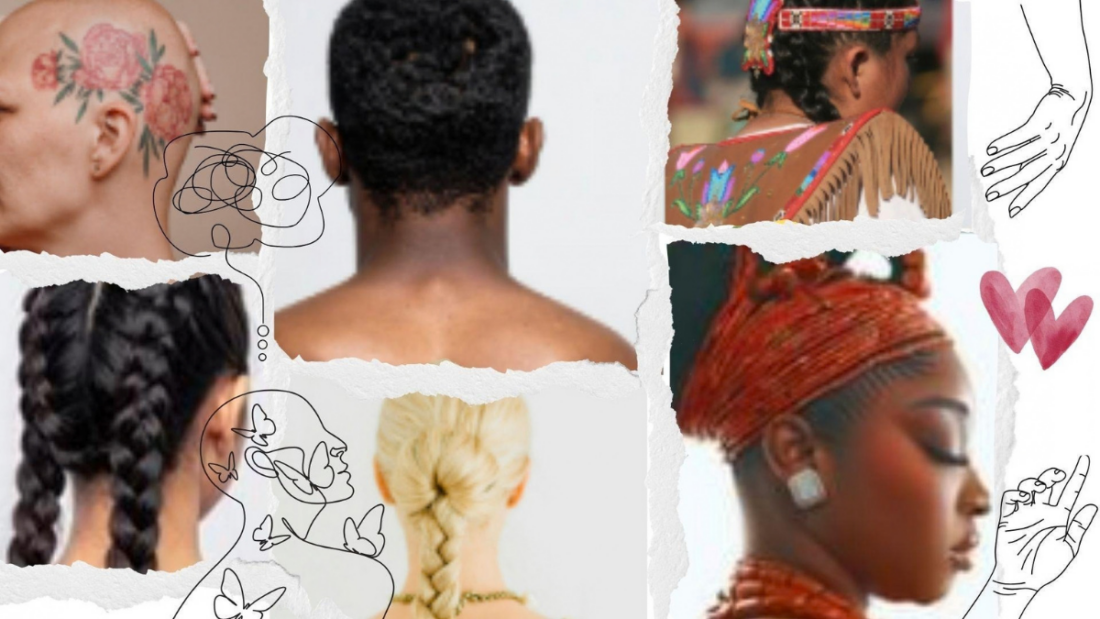
A conversation about the cultural, social and familial stories that shape our relationship with our hair, and why something so personal can also be political.
Every day when we wake up, we have to face ourselves in the mirror. Like clockwork, each morning we ask ourselves: “How should I style my hair today?”
“How [a] person chooses to style their hair is a decision between [themselves] and the mirror, and it almost always carries along with that person for the rest of the day,” explains Sophia Abiara, a guest editor for the University of Saskatchewan Undergraduate Research Journal (USURJ). She is currently working on Hair Story, a USURJ special issue that aims to create an autoethnographic collection exploring identity and culture through hair.
“I started working on this project at Peer Health, where I was the cultural wellness facilitator, and my goal was really to involve or highlight the everyday student or everyday person, and a big portion of that, or something that was significant for me, was because of my hair and realizing how much personality my hair had, and how I had to plan around it or style my hair for different occasions, and it wasn’t always a positive relationship, and I’ve just shifted a lot away from that,” Abiara tells me.
Hairstyling may begin as “a decision between yourself and the mirror,” but the decision rarely stays contained there.
“…[Hair is] deeply rooted in identity because it’s a very personal relationship that everyone gets to share with the world, and in turn, people often use hair as a way to judge people, for lack of better terms, to better understand. It’s part of how people choose to present themselves, and it can be a tool.”
Abiara’s observation shows why hair matters. A project like this aims to understand people, and hair is one way we show the world who we are.
“For me personally, [my hair is] tied deeply to my roots because hair has been a form of beautification. It has also been used by royalty in Nigeria. Styling it in different ways can mean different things. Also, learning about the slave trade… people would use [hair] to hide food when they were being transported,” explains Abiara.
While hair can be a medium for cultural celebration and self-expression, it can also become a source of prejudice. For example, research on hiring bias has found that Black women wearing natural hairstyles were perceived as less professional and less competent on account of their hair alone.
“…More ‘Eurocentric’ hair types and styling [are] often seen in the media. Naturally, it’s also reflected in our political institutions. So then, this is almost like a cycle where… the politicians who look a certain way always tend to be more favourable, especially in this part of the world,” states Abiara. “So this cycle is created. There are lots of cycles in this situation where there is racism in the institution. So then people with different hairstyles want to adapt to these expectations so they can get more favourable outcomes … They’re internalizing it, but then the institutions are not being forced to change because they just keep seeing people because people are adjusting to fit their expectations.”
The personal is political.
Our ideas around hair and the “right” ways to present ourselves are embedded into institutions, whether consciously or not. Hair can be used to other people by drawing visible distinctions between the “in-group” and the “out-group.” These distinctions can mark targets for prejudice and become grounds for stereotyping and discrimination.
“While there is an increase in the amount of diversity [in the media] that we’re seeing, this diversity is very imperfect. It comes with a lot of stereotyping and archetyping… this feeds into things such as internalized racism…” states Abiara, describing the role media can play in shaping how people perceive themselves.
It’s part of the reason Abiara would never blame someone for conforming. Can you blame someone for bending to an institution’s will when that institution is your employer? When you were taught from a young age that your natural hair is wrong? When the chances of getting hired increase just by straightening your hair?
We can see this discrimination everywhere, even at the highest levels of public life. Abiara points to former U.S. first lady Michelle Obama as a high-profile example. Obama has said she kept her hair straight during her time in the White House because she worried that wearing braids would become a political distraction. She has recalled deciding, “Let me keep my hair straight. Let’s get health care passed.”
Our ideas and stereotypes around hair can begin in childhood. Abiara has three younger siblings, and she says the media they consume lacks representation.
“Especially for children, like in children’s literature, there’s not a lot of different kinds of hair that are being shown, [in] the books or the cartoons that they’re watching. So I feel like there’s a lot of work that needs to be done, and I hope that’s something that happens.”
Hair Story seeks to collect these perspectives and identities while asking how those identities are shaped. For marginalized communities whose hair has historically been scrutinized or used as a basis for discrimination, a hair story can also become a story of resistance — a way of reclaiming identity from the institutions and expectations that have tried to shape it. It also challenges conventional ideas about what research can look like and whose experiences are allowed to become knowledge.
When asked what type of research she’d like to see in USURJ in the future, Abiara replied, “If everything goes well with this [Hair Story], I hope that there are quite a few submissions. So maybe there’s a volume two, or again, just delving into research where people can show up as themselves, kind of redefining what exactly can be viewed as research, and really highlighting components of the everyday person that are beautiful and, for lack of better terms, artistic.”
Hair Story isn’t meant to be read and forgotten. It has real-life implications. Abiara describes how her understanding of the stories around hair has shaped her life:
“…As someone who’s aspiring to be a physician, one of the things I’d like to achieve is seeing each patient for who they are as a whole… not just whatever they show up for, and really looking to provide excellent care in the sense that that does not just include the person who shows up there [but] includes their story and the story of their family, and really [takes] that into consideration in whatever care that I do choose to provide.”
Learning about hair is one way of learning about people, and each life we learn about can reshape how we see one another.
Abiara also sees her own natural hair as a form of representation.
“And then, with regard to representation, again, I am excited to be a Black woman in medicine… so that the generation after me can see, like, ‘Hey, this is something that’s very possible, regardless of how I choose to style my hair.’”
She wants to help create a world with less hair bias, one where no hair texture is treated as better than another. As an aspiring physician, she’s focused on making sure people feel accepted and know that “they don’t have to take away from who they are or their identities, including their hair, as they’re welcome to visit as they are, that is for [both] providers and those receiving care.”
Hair is personal. It’s political. It’s scrutinized. It’s celebrated. Perhaps most importantly, it’s an expression of self that shapes and is shaped by the world around us. With hair textures and styles so diverse, and infinite ways to wear them, hair is the perfect medium to show a personal journey.
Abiara puts it plainly, “Another portion of this for me is representation and taking the time to… acknowledge that there is beauty in this diversity, even if it’s a little thing such as complimenting a person’s hair, just knowing that it takes a lot of work, especially for hair like my own, and for someone outside to be able to acknowledge that is something that I feel like is very valuable.”
Every head of hair carries its own story.
Hair Story accepted submissions until Sept. 29.