
THE UNIVERSITY OF SASKATCHEWAN’S MAIN CAMPUS IS SITUATED ON TREATY 6 TERRITORY AND THE HOMELAND OF THE MÉTIS.
THE UNIVERSITY OF SASKATCHEWAN’S MAIN CAMPUS IS SITUATED ON TREATY 6 TERRITORY AND THE HOMELAND OF THE MÉTIS.
Performance in the panopticon with palm trees
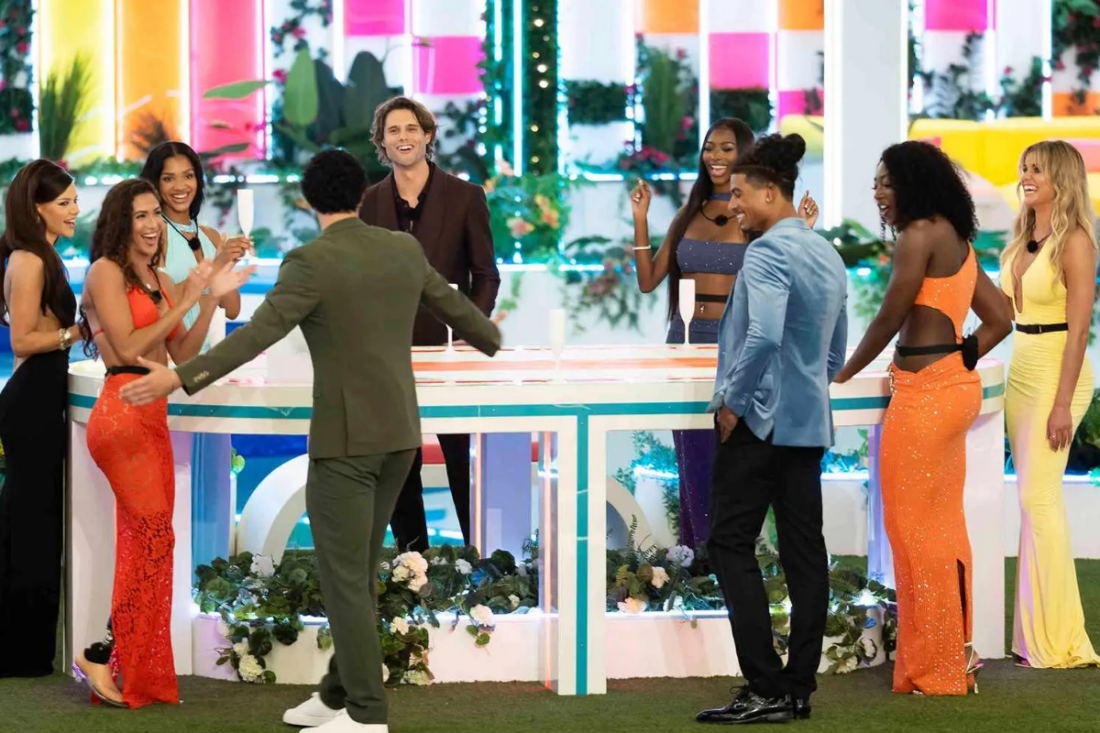
Amidst the crystal blue waves of the South Pacific Ocean and the lush green of the Fijian forest, a camera waits. Watching. Listening.
It is there, in the Love Island USA villa, where cultural conversation concentrates as eyes from around the globe scrutinize ten sexy singles for six weeks.
The reality dating show stands out among its contemporaries like The Bachelor/Bachelorette, Love is Blind and 90 Day Fiancé for its ability to capture a more modern, youthful culture toward love.
Contestants are usually in their early 20s and rarely go past 30. Throughout their time in the villa, the islanders pair off into couples and compete in messy challenges in the hopes of finding love. The nature of the show requires testing multiple connections with fellow islanders, and the forced proximity not only rushes islanders toward romance but grips viewers with relationship dynamics ripe for dissection.
The show is no stranger to creating cultural moments that divide a room. From Rob Rausch jumping in the Villa pool to Serena Page yelling at Kordell Beckham on the dock, Love Island USA has created many viral snippets that spark deeper conversations about relationships. With no screens, music or books in the villa, all the contestants have to pass the time is each other. They fight, make up, break up and (usually a fan favourite) get back together.
This year, however, there was a remarkable acidity to the cultural discourse that Love Island produced. Rather than creating small factions of people with slightly differing views, this season’s contestants and their actions created cataclysms in their wake. In the cracks of those online discussions, a deeper understanding of the current social climate begins to emerge.
Previous seasons had set certain expectations for the show. Love Island stood out among other reality dating contests by pushing diversity front and centre. In its utopia, beauty standards were levelled as they upheld people with varying skin tones, hair textures and ethnicities as faces of the show.
From darker-skinned Black women like JaNa Craig and Olandria Carthen to Paralympic athlete Beatriz Hatz, women who are traditionally excluded from the limelight were presented in a romantic light, which was rarely, if ever, seen before on reality TV. This representation became an important part of the show’s appeal and, in particular, attracted many women of colour to the show.
As the loyal Love Island viewers tuned in for the newest season, what they saw play out was markedly different from previous years. Fans hoping to run away from the political environment of the real world were instead greeted with the same issues that plague modern society. The show which they once sought comfort from became a time capsule of sociopolitical issues.
Contestants of colour always faced racial harassment which the show refuses to formally address, instead putting out general statements emphasizing this was “LOVE island.” In Season 8, the racial tension was taken from the comments and replicated on screen.
While the challenges were as sexual as ever, a more conservative attitude towards sexuality was perpetuated by the contestants. This intersected with more misogynistic language towards female islanders and replicated the mundane stereotypes and bigotry of the real world but with palm trees.
With nearly 2 billion minutes streamed in Season 8, more eyes than ever were on this year’s contestants, and people were appalled with what they watched.
Racial tension infiltrated the season from the first night, with Kenzie Annis taking great offence when her partner confessed that she, the Southern blonde belle, was not his type. This brought an onslaught of confusion for the only white girl in the main cast, as she had never experienced someone telling her she wasn’t their type.
This theme continued through Kenzie’s comments toward male contestants of colour, including her desire to kiss them and her need to feel like a gazelle being hunted by a lion. She repeatedly mentioned how big they were in comparison to her, playing into hypersexual stereotypes surrounding her partners. These ideas of masculinity, in conjunction with the stereotype of the fragile white woman, contribute to the fetishization and harassment that many Black men in particular face.
By contrast, during scenes with white Carolina cowboy Caleb McDaniel, Kenzie discussed her future with him and how they saw themselves with families, jobs and kids. Those conversations were noticeably absent from her interactions with men of colour on the cast. Regardless of intention, the contrast still highlights the fetishization of men of colour and treats them as exotic species rather than complex human beings.
As time went on, misogyny among some of the male cast members also began to bubble to the surface. Kuman Chandler, also known as KC, called his then-partner Aniya Harvey a “grandma” for refusing to sleep with him, proclaiming to a room full of guys that he “spoke life into her every day.”
KC and Aniya were clearly romantically incompatible with each other. However, KC lashed out and used degrading language against her in response. The limits of acceptable language toward female islanders were pushed, closely resembling the Overton window that has been pried open in our broader social discussions.
With KC’s proclamations, a space was created for a new demographic to enter the online discourse surrounding the show. He became the new champion for a certain male community online, and they were ready to fight for his right to explore, which Aniya allegedly encroached upon. They justified his comments and echoed the narrative that KC was too scared of Aniya’s reaction to pursue other women, and he deserved to have some fun after being shackled to this woman. The misogyny intersected with racism, helping cast Aniya as the aggressor.
KC himself was a target of racial slurs and harassment online, which Love Island USA refused to address. Among the explicitly racist comments, some viewers noted that the numerous critiques toward KC also represented a more implicit form of colourism. Unlike his lighter-skinned counterparts who had also done their partners dirty, like Zach Georgiou and Sincere Rhea, audiences had less leeway for KC. Rather than being seen as a multidimensional human being, he was flattened into a caricature of an evil Black man.
The dumping of Gabriel Vasconcelos saw another pivotal moment in the show: a hot new bombshell entered the villa, and her name was Lust.
Gabriel, a Brazilian immigrant, entered the villa as a bombshell whose job was to break up couples and find his own connection. He left the villa as the dispassionate Latin lover who was there for all the wrong reasons.
Despite outlining his feelings toward his partner the night prior during the Love Letter challenge, the girls in charge of his fate reiterated their fear that he was always going to be interested in the next bombshell who came in. They brought up how he had acted with them when he first walked into the villa, asking for kisses and playing up his sexuality, as evidence of him being there for the “wrong reasons.”
The act of kicking Gabriel off was a normal part of the show; what was not par for the course was the justification for that decision. From that moment, the sexual actions of the islanders became scarlet letters … on a dating show where challenges routinely involve dancing on and making out with other people.
“Lustful” became the biggest insult in the villa, and hyper-religious and conservative attitudes toward sexuality emerged. Contestants became nauseatingly concerned with their connections being perceived by the public as sexual rather than focusing on their partners. The panopticon was in plain sight, creating a vicious relationship between the performers and viewers.
Then, there was Casa Amor, the infamous house known for tearing apart couples and planting the seeds for the messiest drama. After the islanders get to know each other for three weeks, the couples are separated and placed into different houses with new bombshells primed to tempt them away from their original pairings. This season saw the combination of Casa Amor and the Heart Rate Challenge, where contestants dress in sexy costumes and try to raise each other’s BPMs.
After behaving like gentlemen (a.k.a. giving the women the bare minimum level of attention and affection), the men were ready to let loose with the Casa girls. In their tightest and brightest outfits, each girl danced and kissed the men one by one, and not a single objection was heard. The challenge was livestreamed to the women in the villa, and the girls were confronted with the reality of how the men acted when they weren’t around.
The difference in how the men treated the Casa Amor women compared to those in the villa was stark. Due to their sensual introductions on the first night, the men of the villa felt free to touch, squeeze and talk to the Casa women however they wanted. Again, the window of acceptable behaviour on the show was pried open, and the objectification of women so often seen in real life was reflected on screen.
The core relationships of the season also encapsulated the situationships and toxicity of the modern dating landscape. From Kayda Bosse and Zach Georgiou to Melanie Moreno and Sincere Rhea, many of the couples this season had a rough start to their love stories.
Zach was very quick to lash out in a not-so-joking manner. He threatened not to make Kayda breakfast multiple times (a cardinal sin in this series) and was visibly irritated when she explored a connection with Caleb, the Carolina cowboy.
The Hideaway is a huge milestone for most couples on the show. For one night, one lucky couple gets to sleep in a private bedroom and finally be alone together. As they were fixing the bed and getting ready to sleep, Zach asked Kayda if he could still explore other bombshells, mimicking the noncommittal relationships most friends are tortured by in real life to an astonishing degree.
While these antics were childish, none compared to the floundering of Sincere Rhea. From one girl to the next, he would promise each a whole new world. From calling Sol Mýa and Melanie Moreno “beloved” to telling Amora Cachée that if they had more time she “would’ve been the one,” his wandering eyes were on full display for everyone to see, including the islanders themselves.
After four weeks of misogyny and dishonesty, production rolled out the red carpet for the contestants on Movie Night. From the second a text announced the event, the men began apologizing to their partners and rationalizing their behaviour. Audiences had been flooding social media with comments praying for Movie Night. Battered and bruised, the show’s core fanbase was tired of seeing these women being made to look like fools.
Yes, the majority of the girls stayed true to their couples even after the Casa Amor livestream.
Yes, the majority of them stayed loyal even though they could sense something was wrong.
Still, there was hope that maybe, just maybe, if the girls knew the full picture and saw what the public was viewing, they would finally stand up for themselves and deliver the audience some catharsis after a torturous summer.
Alas, despite being isolated from the outside world in every way possible, the core women on the show simply gave verbal lashings to their partners, then settled back down into the arms of the men who lied to and deceived them.
After crying and questioning her sanity for most of the summer, Melanie Moreno had arguably the most valid reasons to break up her connection and move on. She voiced her doubts about the relationship multiple times, saying that the prize is not being picked; it’s being respected. However, her friends’ chants of “Team Sincere!” and his half-baked breakfast date drowned out her hesitation.
At the end of the day, the priority was not the quality of the relationship but the presence of one.
In retrospect, this season encapsulated not only modern dating standards, with the islanders perpetuating misogynistic talking points, but also the fraught political and social tensions of the current era.
The islanders internalized the presence of cameras, creating an air of hyper-vigilance that choked the entire season. With contestants reluctant to hold one another accountable for fear of being seen as confrontational, messy or there for the “wrong reasons,” conflict was stifled rather than brought to any meaningful resolution.
Kenzie’s behaviour went under the radar, disguised by her white innocence. KC was forgiven by Aniya not even 24 hours after being confronted about his own actions and did not address the blatant misogyny he perpetuated. Kenzie lied once to Caleb and was labelled the “female Sincere,” yet Sincere himself faced no consequences from his fellow islanders for his egregious actions that led to the nickname.
During the reunion, rather than confronting the actions of the men on the show, most of the girls decided to hash it out with each other. Melanie Moreno, an undeniable breakout member of the cast, stepped out in a silver dress that could’ve been mistaken for armour, given how ready she was to battle that night.
She geared up, ready to face off with Beatriz Hatz, Kenzie Annis, Sol Mýa and Amora Cachée over their comments and interviews; meanwhile, seated next to the creator of many of those situations without directing any of her fury at him. The women on the show were held to a higher standard of sisterhood, and none of that heat touched the men beside them.
Ultimately, this season was marred by frustration, confusion and upset. The islanders’ lack of accountability and refusal to dissect conflict mirrored the mixed reactions online. Both the outrage and the praise they received became case studies in viewers’ attitudes toward the state of the current world. The rise of conservative attitudes toward sexuality, the slut-shaming, racism and misogynoir all suffocated the show this season, and when the credits rolled and screens turned black, all the viewers were left with was a disappointing reflection of the modern world they had tuned into reality TV to escape in the first place.
The paradise that once captured audiences with stories of love and friendship seems long gone. Whether it will be able to return to normal, only the next season will tell.