THE UNIVERSITY OF SASKATCHEWAN’S MAIN CAMPUS IS SITUATED ON TREATY 6 TERRITORY AND THE HOMELAND OF THE MÉTIS.
THE UNIVERSITY OF SASKATCHEWAN’S MAIN CAMPUS IS SITUATED ON TREATY 6 TERRITORY AND THE HOMELAND OF THE MÉTIS.
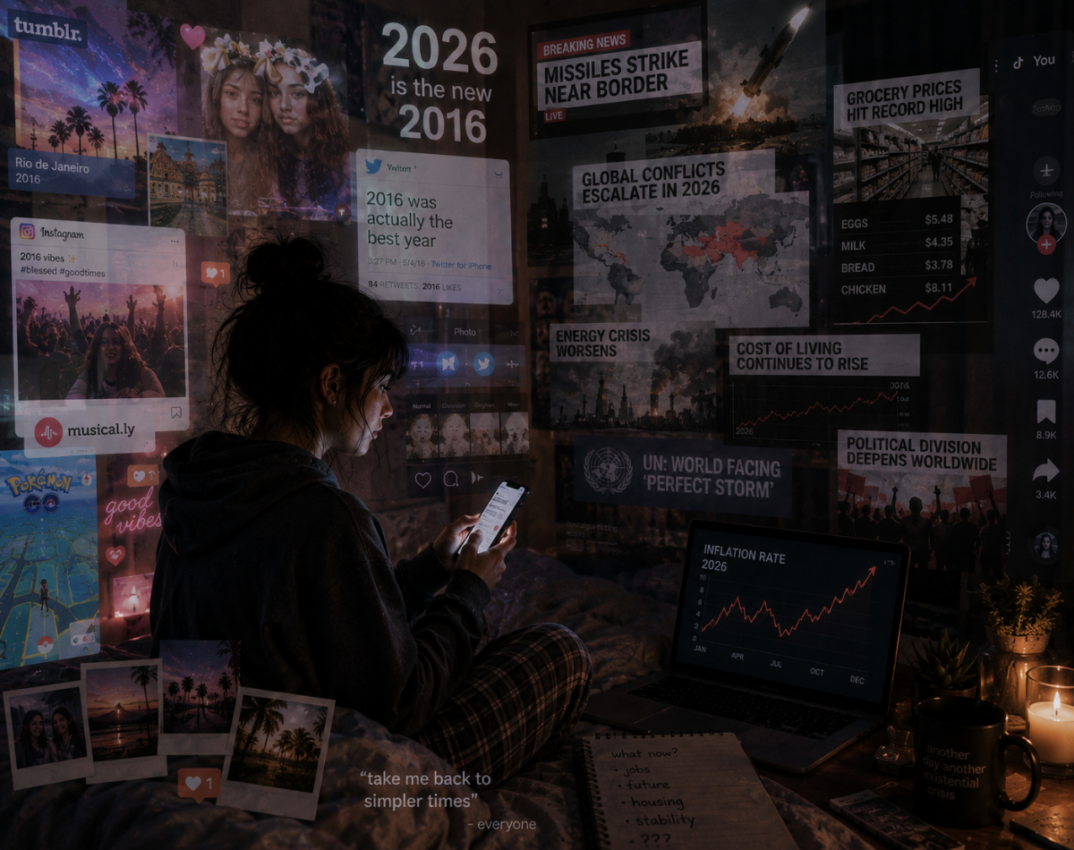
Recessionmaxxing, global turmoil and Zara Larsson on the radio. It’s like we never left.
In the first few weeks of 2026, something strange happened. The internet decided to go backwards.
Suddenly, timelines filled with blurry Instagram dumps, flower crown filters and grainy sunsets. TikToks declared, half-jokingly and half-seriously, that “2026 is the new 2016.” What started as a meme quickly became a full aesthetic movement, complete with tutorials on how to edit photos “like it’s 2016” and playlists recreating the sound of that era.
It would be easy to dismiss this as just another fleeting trend — except it reveals something deeper about how we relate to time, memory and the present moment.
The uncomfortable truth of the matter: people did not like 2016 while it was happening.
At the time, the year was widely associated with political upheaval, cultural tension and an overwhelming sense that the world was shifting in unpredictable ways. News cycles felt relentless. Social media was already saturated with outrage and anxiety. Yet, less than a decade later, 2016 is being reframed as something almost idyllic.
This contradiction sits at the center of what might be called nostalgia core — a cultural pattern where the past is stripped of its complexity and repackaged into something aesthetically pleasing and emotionally digestible. The current revival of 2016 isn’t really about the historical reality of that year. It’s about a curated version of it — one that highlights the vibes and aesthetics while quietly discarding the chaos.
A simple example makes this clear. When people reference 2016 now, they often point to things like early Instagram aesthetics, casual friend group photos, or viral moments like the rise of Pokémon GO. These are easy to visualize, easy to recreate and easy to share. What is less likely to be included in these nostalgic recreations are the political tensions, the global crises or the collective uncertainty that defined the same period — or even the fact that people were dying while playing Pokémon GO.
In other words, nostalgia is selective.
From a more academic perspective, this selectivity aligns with what scholars in media and cultural studies describe as reconstructive memory — the idea that remembering is not a passive retrieval of facts, but an active process shaped by present concerns. When users recreate 2016 aesthetics, they aren’t accessing a fixed archive. They’re producing a version of the past that reflects what they currently need that past to mean.
Social media does not just preserve memories — it edits them. Platforms like TikTok and Instagram encourage users to compress entire years into a handful of recognizable images and sounds. A “2016 edit” might include a montage of Polaroid-style photos, a trending song from that era and a caption about “simpler times.” Within seconds, a complicated year is transformed into a cohesive, emotionally satisfying narrative.
This process turns nostalgia into something performative. People are not just remembering the past — they are actively reconstructing it for an audience.
At the same time, nostalgia core is not just about aesthetics. It’s also a response to widespread dissatisfaction with the present. Many of the articles and video essays discussing this trend suggest that people associate 2016 with a version of the internet that felt less controlled and less commercialized. Compared to today’s algorithm-driven and ad-inundated feeds, that period is easily remembered as more spontaneous, even if that perception is not entirely accurate.
Consider a typical user experience today. You open an app and are immediately met with highly personalized content, optimized for engagement. Every post is competing for attention. Every trend is quickly monetized. Now compare that to how people remember 2016 — scrolling through chronological feeds, posting casually without overthinking engagement metrics, discovering content that felt less curated.
Whether or not this memory is entirely true is less important than the fact that it feels true. Nostalgia operates on perception, not accuracy.
This brings us to a larger issue: the way social media amplifies our sense of living through history. Today, almost every major event is framed as unprecedented, historic or defining. News alerts emphasize urgency. Posts go viral within minutes. Commentary is immediate and constant. As a result, people are not just experiencing events — they are experiencing them with the added awareness that these moments will be remembered and analyzed in the future.
We are always being told that we are living through history.
A clear example of this can be seen in how global events trend online. Within hours of a major development, social media fills with explainer threads, reaction videos, memes and predictions about long-term impact. The event is not given time to settle into collective understanding. Instead, it is instantly absorbed into a cycle of content production and consumption.
From a sociological standpoint, this can be understood through the concept of hyperreality, where representations of events begin to feel more immediate and significant than the events themselves. A breaking news story is not just experienced through direct information, but through layers of reaction, interpretation and aesthetic framing. The “moment” becomes something constructed in real time, shaped as much by how it is shared as by what actually occurred.
This creates a strange kind of pressure. If every moment is potentially historic, then the present begins to feel overwhelming and unstable. There is no distance, no time to process, no sense of completion. Everything feels unfinished.
In contrast, the past feels stable. A year like 2016 has a beginning, a middle and an end. It can be summarized, categorized and understood as a single unit. This makes it much easier to romanticize. The uncertainty that defined it in real time disappears, replaced by a sense of coherence.
Another useful framework here is presentism — the tendency to interpret both past and future primarily through the lens of current concerns. Nostalgia core, paradoxically, is not about escaping the present, but about projecting present dissatisfaction onto the past in order to reshape it. We do not revisit 2016 as it was; we rebuild it as a contrast to what we feel now.
Nostalgia, then, becomes a way of escaping the intensity of the present. It allows people to step into a version of time that feels contained and manageable.
However, there is another layer to this phenomenon — the speed at which nostalgia now operates. Traditionally, cultural nostalgia followed a longer cycle. People revisited trends from 20 or 30 years ago, often driven by generational shifts. Today, that cycle has accelerated dramatically. We are becoming nostalgic for periods that are less than a decade old.
This compression of time can be linked to what media theorists call temporal flattening or context collapse — the demolition of distinctions between past, present and future within digital environments. On a single feed, users encounter archived memories, live updates and speculative content all at once. As a result, time no longer feels linear. It feels layered, recursive, constantly looping back on itself.
For university students in particular, this creates an unusual relationship with memory. Many of us were teenagers in 2016. We remember it not as a distant historical period, but as a recent and formative time in our lives. Seeing it transformed into a trend can feel both familiar and disorienting.
It also raises an important question: if we are already nostalgic for 2016, what will we do with 2026?
Part of the answer lies in something even more unsettling — the realization that, in some ways, nothing has really changed. The language is different, the platforms are sleeker, the aesthetics have been updated, but the underlying conditions feel eerily similar. Economic anxiety persists, now jokingly reframed online as “recessionmaxxing,” where financial instability is turned into a kind of dark humour and lifestyle branding. Global turmoil continues to dominate headlines, each new conflict or crisis layered on top of the last. Somehow, you can still walk into a store or turn on the radio and hear Zara Larsson playing in the background.
It creates a strange sense of déjà vu — like we never actually left 2016, only re-skinned it.
This continuity complicates the idea of nostalgia. If the same anxieties, the same cultural touchpoints and even the same music persist, then what exactly are we longing for? It suggests that nostalgia is not about escaping a fundamentally different past, but about reframing a familiar reality in a way that feels more distant and therefore more manageable. In this sense, nostalgia core is less about time travel and more about emotional distance.
Right now, it is easy to describe the present as overwhelming. Between rapid technological change, constant connectivity and an endless stream of global events, it often feels like there is no pause button. But if the pattern holds, this same period will eventually be simplified, aestheticized and remembered as something cohesive.
At some point, people will post “2026 edits.” They will recreate the look of today’s apps, today’s music, today’s trends. They will talk about this moment as if it were simpler, more authentic, more meaningful than whatever comes next.
When that happens, the same contradiction will reappear.
Because the truth is, we rarely recognize “the good old days” while we are living in them. Instead, we construct them later, using fragments of memory and layers of reinterpretation. Nostalgia core does not reveal the past as it was — it reveals how we wish to remember it.
So the question is not whether 2016 was actually better, or whether 2026 will one day feel the same. The question is what we lose when we constantly frame the present as something to escape from.
If the same patterns keep repeating — economic anxiety, global instability, familiar voices on the radio — then maybe the difference is not in the world itself, but in how we choose to see it.
If every moment is either a future memory or a historical milestone, when do we actually experience it as it is? If it already feels like we have been here before, what would it take to finally recognize that we are here now?