
THE UNIVERSITY OF SASKATCHEWAN’S MAIN CAMPUS IS SITUATED ON TREATY 6 TERRITORY AND THE HOMELAND OF THE MÉTIS.
THE UNIVERSITY OF SASKATCHEWAN’S MAIN CAMPUS IS SITUATED ON TREATY 6 TERRITORY AND THE HOMELAND OF THE MÉTIS.
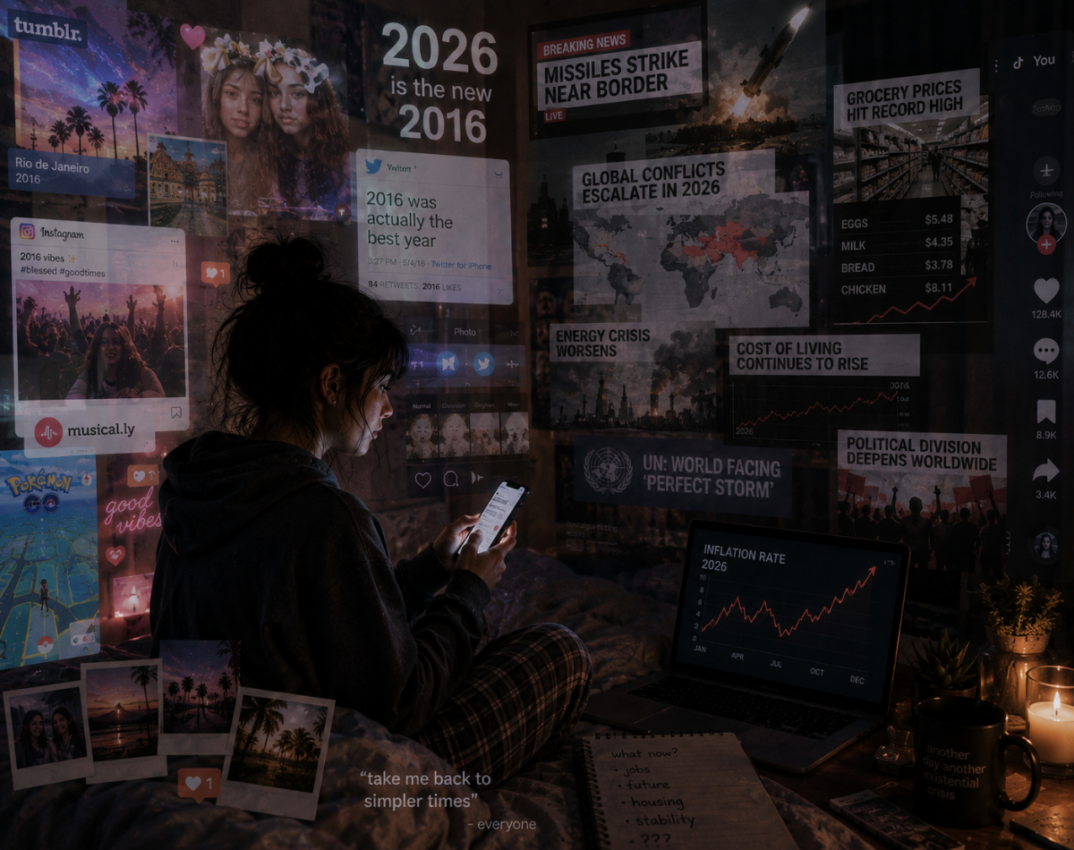
The public hangs onto nostalgia from a decade ago, while missiles fly overhead. 2016 is back in more ways than one.
Black Beatles, musical.ly and Instagram’s Rio de Janeiro filter have all taken over the last few months. 2026 is allegedly the new 2016, with DJs bumping Justin Bieber’s “Sorry” to a crowd of flower crowns.
Our playlists sound like 2016, our jackets look like 2016 and our politics hum the same tune: the arc of history is pointing downward while grocery bills skyrocket. If 2016 was the year we realized the old order was breaking down, 2026 is the year it becomes hard to pretend that breakdown was only temporary. The parallels are real, but they are more complex than simple nostalgia. The same themes are back, including anti-establishment politics, wars that reorder whole regions, economic anxiety, environmental procrastination and an unstable international system. The difference is that in 2026, some of those pressures are more global, as well as more stubborn.
One of the clearest parallels between 2016 and 2026 is that war is again shaping politics far beyond the battlefield. In 2016, conflicts in Syria and simmering tensions in the aftermath of Russia’s 2014 invasion of Ukraine signalled that the post-Cold War idea of a stable, rules-based order was weakening. The war between Russia and Ukraine illustrates this shift. What began as a territorial conflict has expanded into a wider geopolitical confrontation. European countries continue to supply military and financial support to Ukraine, while Russia increasingly frames the conflict as one involving the West more broadly. The result is that security policy, military production and alliance dynamics across Europe are now directly tied to the war. It shapes NATO strategy, defence spending and political decision-making across the continent.
At the same time, the conflict involving Israel and Palestine has expanded beyond its immediate geography. The war in Gaza, ongoing violence in the West Bank and rising tensions with regional actors such as Iran have turned it into a broader geopolitical issue. Governments across Europe and North America are divided over how to respond, and the conflict has influenced domestic politics, public opinion and international diplomacy. It also raises ongoing questions about international law, humanitarian intervention and the credibility of global institutions.
The U.S. conflict with Iran adds another layer by linking military escalation directly to global economic stability. Tensions involving Iran have affected energy markets, shipping routes, and regional security in the Gulf. When conflicts begin to influence fuel prices, trade flows, and infrastructure planning across continents, they become part of the structure of the global system rather than isolated events.
Beyond these headline conflicts, wars in countries like Sudan and Myanmar contribute to a broader pattern of instability. These conflicts generate large-scale humanitarian crises, strain international aid systems and receive uneven global attention. The cumulative effect is significant. Governments and institutions are forced to divide attention and resources across multiple crises at once, limiting their ability to respond effectively to any single one.
The key insight is that war in 2026 reveals how interconnected the global order has become. Conflicts are no longer contained within borders. They affect energy prices, migration patterns, alliance systems and domestic politics worldwide. However, there is also a constructive parallel. Just as 2016 exposed weaknesses in the international system, 2026 is prompting adaptation. Countries are coordinating more closely on defence energy and humanitarian aid, even when political disagreements persist. The system is under strain, but it is still functioning and evolving in response to these pressures.
2. Recession Indicator
Economic dissatisfaction was a major driver of the political shifts in 2016. In countries like the United States and the United Kingdom, many voters felt that globalization had produced uneven outcomes. Trade liberalization, outsourcing, and automation created clear winners, but also left entire regions facing job loss, wage stagnation, and declining economic security. These conditions helped fuel support for protectionist policies, skepticism toward free trade agreements, and broader anti-establishment sentiment.
In 2026, those same underlying grievances remain, but they are layered on top of more complex and interconnected economic pressures. Inflation, housing costs, and wage stagnation continue to affect large segments of the population across advanced and developing economies alike. In the United Kingdom, high living costs and economic stagnation remain central political issues, while in Argentina, persistent inflation has led to repeated political turnover and public frustration. These pressures mirror the discontent seen in 2016, but they now operate in a more unstable global environment.
What distinguishes 2026 is how closely economic conditions are tied to geopolitical conflict. The war between Russia and Ukraine disrupted global grain and energy markets, affecting food prices and fuel costs far beyond Europe. Similarly, tensions in the Middle East, particularly involving Iran, have created volatility in global oil markets, contributing to inflationary pressure worldwide. Trade policy has also returned to the center of political debate, echoing 2016. The use of tariffs and industrial policy, particularly in the United States and in relation to China, reflects a shift away from the earlier assumption that free trade should be the default. Governments are now more willing to intervene directly in markets to protect domestic industries, secure supply chains, and reduce dependence on geopolitical rivals. This includes efforts to reshore manufacturing, restrict technology transfers, and invest in strategic sectors such as semiconductors and energy.
At the same time, global supply chains remain deeply interconnected, which creates an ongoing tension. States cannot fully disengage from the global economy without significant economic cost, but they also face political pressure to reduce vulnerability to external shocks. This contradiction defines much of the current economic landscape. Policies aimed at “economic security” or “de-risking” reflect attempts to manage this balance rather than resolve it entirely.
3.
In 2016, the election of Donald Trump and the Brexit referendum were treated as political earthquakes. Both reflected frustration with elites, globalization and institutions that felt disconnected from everyday life. The assumption at the time was that these were disruptive exceptions. At the time, these outcomes were treated as shocks to otherwise stable democratic systems.
By 2026, those same dynamics have become normalized and institutionalized. Trump’s return to the presidency reinforces how durable anti-establishment politics have become within the United States, particularly around issues like trade, immigration, and the role of federal institutions. In Europe, Brexit continues to influence debates about sovereignty within the European Union, with ongoing disagreements over migration policy, fiscal coordination, and the limits of supranational authority. More broadly, political actors across democracies now regularly frame institutions not as neutral frameworks, but as contested spaces that must justify their legitimacy.
This shift has contributed to a gradual erosion of democratic norms. In countries like Hungary and Poland, disputes over judicial independence, media freedom, and electoral fairness have persisted for years, often in tension with European Union standards. In the United States, debates over election integrity, the role of courts, and the boundaries of executive power have become central to political competition. These developments do not represent the collapse of democracy, but they do indicate that norms once considered stable are now actively contested.
The effects extend beyond national politics into global governance. Institutions like the United Nations rely heavily on cooperation among member states and a shared commitment to basic rules. However, divisions among major powers and declining trust in multilateralism have made it more difficult for these institutions to act decisively. Gridlock in the UN Security Council, particularly on major conflicts, reflects this broader challenge. When states prioritize domestic political narratives or strategic competition over collective decision-making, the effectiveness of global institutions is reduced.
4.
Energy politics used to feel technical. In 2026, they are personal. The war in Ukraine disrupted energy supplies, especially for countries like Germany that relied on Russian gas. Tensions involving Iran continue to affect shipping routes and global oil markets.
The result shows up in everyday life. Higher fuel costs, rising utility bills, and economic pressure all tie back to global events. Energy is no longer a background issue. It is a central political concern that links foreign policy directly to household budgets.
Governments are responding by accelerating energy diversification. Investments in renewable energy, alternative suppliers, and coordinated storage strategies are becoming priorities. These shifts are partly reactive, but they also point toward long-term transformation.
Energy insecurity highlights how tightly connected the global system is. A disruption in one region quickly spreads elsewhere.
5. And They Were Roommates
In 2016, tensions between the United States, China, and Russia were rising. In 2026, that competition is central to how the global system operates. Trade disputes, technology restrictions, and regional influence shape their relationships.
This competition makes global coordination harder. Disagreements slow decision-making in international institutions and complicate responses to global challenges. At the same time, cooperation has not disappeared. Countries still work together on climate policy, global health, and financial stability when their interests align.
The system now runs on selective cooperation. States compete in some areas while collaborating in others, creating a more complex and less predictable environment.
6. More like Hurricane Tortilla
In 2016, the optimism around the Paris Agreement suggested that global cooperation on climate change was possible. At the same time, that optimism was fragile. The United States’ later withdrawal under Donald Trump highlighted how quickly domestic politics could disrupt global environmental commitments.
By 2026, climate change is even more central, but also more politically complex. Extreme weather events, from wildfires to floods, are more frequent and more visible across regions. Countries are under pressure to reduce emissions while also managing economic growth and energy security. In Europe, climate policy is tied to energy independence after the Ukraine war. In developing countries, climate adaptation is linked to funding, debt, and global inequality.
International climate negotiations continue, but progress is uneven. Agreements are often incremental, and enforcement remains a challenge. At the same time, there has been real movement. Investment in renewable energy has increased significantly, and more governments are setting long-term emissions targets. Climate policy is no longer a niche issue. It is embedded in economic planning, infrastructure, and national security strategies. We still haven’t figured out collective action.
7. The Real Reason 2016 Feels Like It’s Back
The cultural revival of 2016 reflects a desire for something that felt more coherent and shared. Politically, the comparison reveals how many of the same pressures are still shaping the world.
The more useful takeaway is this: both 2016 and 2026 are moments when systems are forced to adapt. The nostalgia is real. Our current global instability is also real. However, so is the capacity for change.

Leave a Reply