
THE UNIVERSITY OF SASKATCHEWAN’S MAIN CAMPUS IS SITUATED ON TREATY 6 TERRITORY AND THE HOMELAND OF THE MÉTIS.
THE UNIVERSITY OF SASKATCHEWAN’S MAIN CAMPUS IS SITUATED ON TREATY 6 TERRITORY AND THE HOMELAND OF THE MÉTIS.
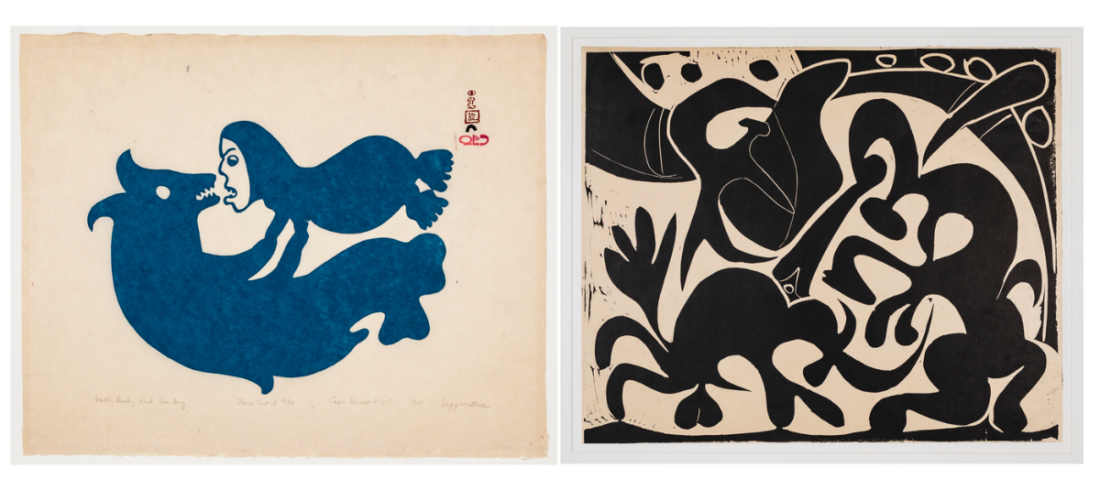
Left: Egevadluq Ragee, Water Baby and Sea Dog (1961). Right: Pablo Picasso, Picador (1959). Collection of Remai Modern | Carey Shaw
Printmaking, modernism and how culture shapes how we see art
At first glance, World ◎ View at Remai Modern looks like a printmaking exhibition. Clean lines, graphic compositions, ink pressed into paper. But spend more than a few minutes in the gallery and it becomes clear that what’s on display isn’t just a medium — it’s a worldview.
The exhibition brings together works from Kinngait (Cape Dorset) artists alongside prints by Pablo Picasso, an unlikely pairing that could feel forced if it weren’t handled with such quiet confidence. Instead of flattening differences, World ◎ View leans into them. It asks what it means to see — and to share ways of seeing — across geography, culture and time. Not just how images look, but how they’re built from entirely different relationships to land, memory and community.
At the centre of the exhibition is Kinngait Studios, the longest-running print studio in Canada. Since the late 1950s, artists there have used printmaking not just as a technique but as a means of circulation — a way to move images, stories and knowledge from the Arctic to the rest of the country and beyond. That movement matters. These prints were never meant to stay still. They were made to travel, to be seen elsewhere, to carry something with them.
That history shifts how the work reads in the gallery. Printmaking, in this context, isn’t just aesthetic. It’s infrastructural. It’s tied to economics, to access, to the realities of how Inuit artists have had to navigate southern art markets. There’s a tension embedded in that — between sharing and being consumed, between visibility and misinterpretation. You can feel that tension sitting just beneath the surface of even the most visually straightforward works.
You see it in the work of Pitseolak Ashoona and Pitaloosie Saila, where scenes of everyday life — hunting, building, resting — are rendered with a kind of narrative density that resists the idea of the Arctic as empty or remote. These images push back against that persistent southern gaze that treats the North as blank space. Instead, they insist on fullness. On activity. On continuity.
What’s striking is how much is held in a single frame. A figure sewing isn’t just a figure sewing — it’s labour, knowledge, survival, care. A hunting scene isn’t just an image of subsistence — it’s a relationship to land that’s ongoing, reciprocal and deeply specific. The works don’t explain themselves, but they don’t need to. They assume a world that already exists.
That refusal to separate the real from the imagined might be the most striking throughline in the exhibition. In works by Shuvinai Ashoona, figures morph, environments bend and scale collapses. A landscape might contain multiple temporalities at once. A body might not stay contained. These images can feel disorienting at first, especially if you’re trying to read them through a Western framework that wants clear categories — real versus surreal, past versus present, human versus animal.
But those categories don’t quite apply here. The images aren’t breaking rules so much as operating under different ones. They reflect a worldview where transformation isn’t unusual and where boundaries are more fluid than fixed. The longer you look, the less strange they feel, and the more your own expectations start to feel like the thing being challenged.
Placed in dialogue with Picasso, those differences sharpen rather than blur. His prints revolve around mythology, sexuality and the human figure, often fragmented or distorted. There’s an immediate visual affinity — bold lines, flattened space, repetition through print. But the similarities don’t run very deep.
Where Picasso’s work often feels like an inward excavation of the self, the Kinngait works feel outward-facing, relational. They’re about networks — between people, land, animals and stories. Even when they depict a single figure, that figure is never conceptually isolated. There’s always something extending beyond the frame, something implied.
That contrast is hard to ignore, and it raises a bigger question about how art history has been structured. Why has one of these traditions been framed as central to modernism, while the other has been categorized separately, often as ethnographic or cultural rather than contemporary? The exhibition doesn’t spell that out, but it doesn’t have to. The juxtaposition does the work.
There’s also something quietly radical in how time is handled throughout the show. It spans decades, from early printmaking in the 1960s to more recent works, but it doesn’t feel like a linear progression. There’s no sense of moving neatly from past to present. Instead, it feels cyclical. Images echo each other. Themes return. Certain visual strategies reappear across generations, not as repetition but as continuation.
That sense of continuity pushes back against the idea that innovation always has to look like rupture. At Kinngait, change often looks like expansion — artists building on shared techniques, reworking familiar forms, introducing new imagery without abandoning what came before. It’s a different model of artistic evolution, one that values accumulation over replacement.
For viewers unfamiliar with Inuit art, it’s easy to underestimate how experimental these works are. There’s a lingering assumption that Indigenous art is static, tied to tradition in a way that resists change. But walking through this exhibition makes that assumption feel increasingly untenable. The works are full of risk. Of play. Of formal experimentation.
You see it in the shifts in visual language — from more grounded, narrative scenes to images that lean into abstraction, hybridity and speculative forms. But even that shift isn’t clean. It overlaps. A single artist might move between modes, or combine them within the same piece. Tradition and experimentation aren’t opposites here. They’re intertwined.
That complexity mirrors the broader context the exhibition sits within. There’s an ongoing effort within Canadian institutions to rethink how Indigenous art is presented — to move away from framing it as separate or supplemental. World ◎ View feels like part of that process, though it doesn’t present itself as a solution. If anything, it exposes how much work there still is to do.
The exhibition also resists the urge to over-explain. There’s no heavy-handed narrative guiding you from one conclusion to the next. Instead, you’re left to sit with the works, to make connections, to notice patterns. That can feel uncomfortable. It asks more of the viewer than passive looking.
But that discomfort is productive. It forces you to confront how much you bring into the gallery with you — your assumptions, your frameworks, your habits of interpretation. And it asks whether those frameworks are actually useful for what you’re looking at.
By the time you’ve moved through the space, “view” starts to feel like a more complicated word. It’s not just about sight. It’s about perspective — who defines it, whose perspectives are circulated and how those perspectives shift once they leave their original context. Seeing isn’t neutral. It’s shaped by where you’re standing.
Printmaking becomes a kind of metaphor for that process. Images are reproduced, distributed, and recontextualized. They move through different hands, different audiences, different interpretations. Something is always gained in that movement — reach, recognition, new meanings. But something is also at risk of being flattened or misunderstood.
World ◎ View doesn’t try to resolve that tension. It holds it in place.
By the time you leave, the exhibition lingers less as a collection of individual works and more as a set of questions that don’t quite settle. What does it mean to encounter a worldview that isn’t your own? How do you look without trying to translate everything into something familiar? And what responsibilities come with being a viewer, especially in a space shaped by histories of extraction and reinterpretation?
It’s easy to walk into a gallery expecting clarity, maybe even a kind of closure. This exhibition offers something less comfortable but more lasting — a shift in how you look, and a growing awareness of everything that shapes that act.
Leave a Reply