
THE UNIVERSITY OF SASKATCHEWAN’S MAIN CAMPUS IS SITUATED ON TREATY 6 TERRITORY AND THE HOMELAND OF THE MÉTIS.
THE UNIVERSITY OF SASKATCHEWAN’S MAIN CAMPUS IS SITUATED ON TREATY 6 TERRITORY AND THE HOMELAND OF THE MÉTIS.
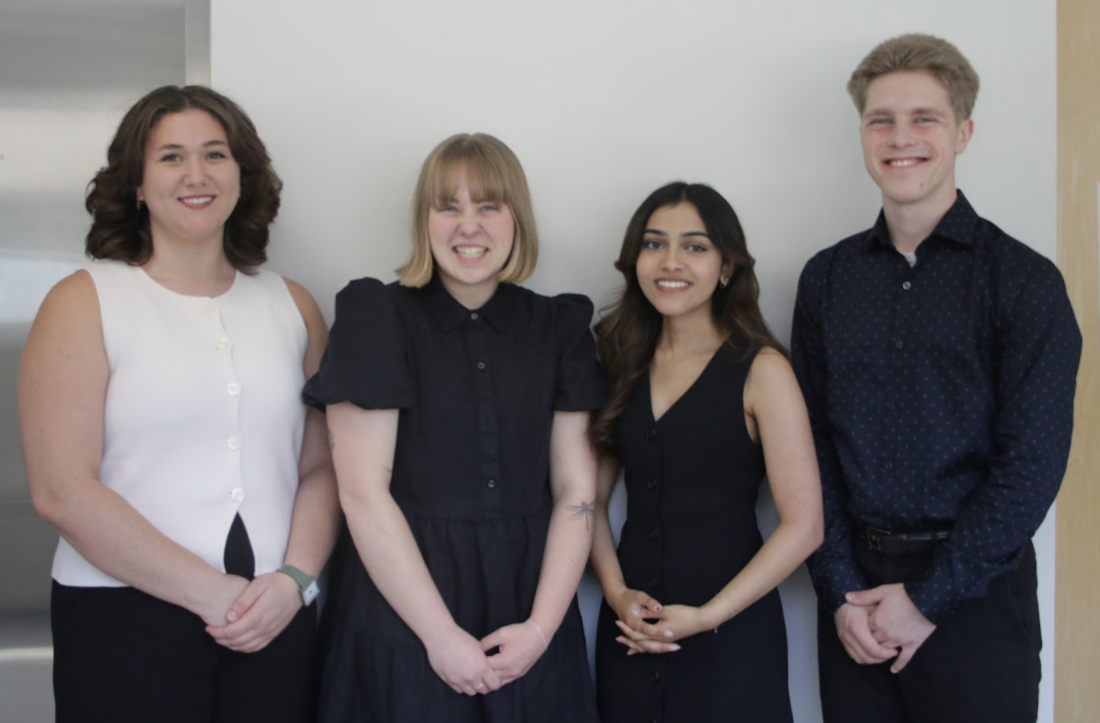
As the USSU execs wrap up the year, they look back on favourite parts of their job and what they’ve learned, and discuss what they plan to do in the future
The 2025-2026 USSU Executive Committee was made up of President Emma Wintermute, Vice-President Operations and Finance Owen Deis, Vice-President Academic Affairs Norah Jacob and Vice-President Student Affairs Emily Hubick. The executives’ last day of work in their roles is April 30.
Looking back on their roles
When asked how the year has gone and their favourite aspect of their role, each executive highlighted the importance of connections and relationships built during their time on the USSU.
Deis said, “It’s been a pretty good year. All things considered, I don’t think there has been a job where I’ve been more happy to come here to work, work[ing] with these excellent colleagues, in addition to our senior managers [and] fellow staff.”
He continues: “I think for my position, it’s been a very strong year. We’ve got more campus groups ratified than we’ve had in a long time. We’re at 184 as of today … Over the past year, we’ve approved over $90,000 in grant funding for campus groups, excluding sustainability funding … [Also,] the budget passed unanimously.”
Hubick added that “This has been probably the best year ever, [it was an] absolute honour and privilege to work with [the other USSU execs] … We had so many events and so much fantastic student engagement … [It]was really nice to interact with so many different students and see what’s going on on campus and what we could help with, what we could deal with and what we wouldn’t have seen otherwise. It’s been so much fun. It wasn’t exactly what I thought it would be, but it’s exactly what I came into this position wanting, that interaction with students and seeing people and meeting people and getting to know more about our campus community and all of the beautiful things happening on campus.”
Wintermute echoed the sentiments of being grateful to work with each other, and said that “I definitely speak for me, but I feel like everyone has a similar sense of how much we’ve gotten to grow in these positions as people, and that has been really impactful for me. I think that the spaces and kind of conversations that we’ve been exposed to have been very shifting in terms of becoming a better person [and] a better human. I am personally proud of the community that we grew and the critical conversations that we had. I know we didn’t always get them right, [but] the fact that we were open to having those spaces and facilitating those dialogues is something that I think is really meaningful.”
She adds that: “I hope that the student body feels that we brought a courageous approach to student governance, and I’m forever grateful for the trust that folks gave us in representing students and undergrads. It’s been an absolute incredible experience — the highs, the lows, everything in between. Wouldn’t take it back, ever.”
Jacob said that she also “thinks that [the role] fundamentally [changes] you as a person. I think that we’re all better communicators now than when we started … And I think that we’ve all become more open-minded individuals [and] learned a lot more. We’ve been so much better at [understanding] the nuances of the university and how it all works.”
Since her role focuses a lot on academic misconduct cases, Jacob says, “You don’t want to talk to me ever, essentially — but I’m very grateful for those conversations because I think that it gave me a really good standpoint to understand the struggles that students are going through, and that can be really different areas. There can be issues about what constitutes misconduct, what information is given to students by their professors, how professors are working and the navigation that students go through … Our senior manager, Jason, always says, as long as you leave this job better than the way you found it, you [have] successfully completed your year. And I think that we’ve all done that without a doubt.”
Reflecting on the General Academic Assembly
The General Academic Assembly (GAA) was held on April 2 in Convocation Hall. Under the University of Saskatchewan Act 1995, the GAA is required to be held annually to allow “the president to present a report respecting the state of the university and any other matters that the president considers appropriate.”
USask also notes that the GAA is composed of “the president, vice-presidents, registrar, deans and directors employed by the university or an affiliated or federated college, all full-time faculty members and a number of USask students. The President is Chair and quorum is 150 members.”
By a number of USask students, this means elected student representatives. The GAA has not reached quorum for several years, and without quorum, motions cannot be passed.
The only motion proposed for the 2026 quorum was to “End all direct and indirect investments and partnerships with entities that produce weapons and munitions (in full or in part) prohibited by treaties to which Canada is a party and which are used in military operations which breach international law or which are used to violate international humanitarian law,” proposed by professor Colleen Bell and seconded by professor Maurice Labelle.
The full motion can be found under Governing Bodies, General Academic Assembly on the USask website.
Although the motion was unable to be passed without quorum, President Vince Bruni-Bossio did say that he would take the motion to the board of governors without it needing to be passed.
Deis said that “I’m happy to see Vince and Dee (USask’s Chief Financial Officer) as administrators taking it back to the board without a motion having been [passed]. They weren’t required to do that. I think that is progress that we would not have had before Vince took over.”
Wintermute agreed and added, “I think that it’s not uncommon for the GAA not to make quorum. That’s pretty consistent with the last decade. I think it’s unfortunate, because it’s an opportunity for faculty and students to get out there. I know that the student part is particularly complicated because it’s limited to elected students, and obviously, April is just a bad month for students to have to do anything. So it would be nice to see some more faculty get out there.”
“I think echoing Owen that the fact that that motion had been intended to be brought forward is an important conversation that campus is having,” Wintermute continues. “I think that the fact that Dee and Vince handled it in that way was a great demonstration of the fact that there is an awareness that this conversation needs to be had. There’s no way to separate students from the world and the world from the university. Those things are all wrapped up and messy and rightfully deserve to have a platform.”
Lobbying Document
Earlier this year, the USSU executives prepared ‘Invest in Us,’ the 2025-2026 Advanced Education Lobbying Document with 10 recommendations to the provincial government, including eliminating Saskatchewan student loan interest, increasing the availability of scholarships, grants and bursaries for Indigenous and international students, promoting and supporting reviews of sexual violence prevention policies at postsecondary institutions every three years, among others.
The document is not specific to USask and is meant to address issues present in universities across Saskatchewan. The USSU presented the document to the Ministry of Education and is currently in discussions with the provincial government.
Deis explains, “There’s a lot. But generally it’s to improve the well-being of our students here on campus [and] across the province.” Any students interested in viewing the document can find it on the ussu.ca website.
Advice for incoming executives
The incoming USSU Executive Committee, composed of President Abtin Safaeian, Vice-President Operations and Finance Elmer Vincent, Vice-President Academic Affairs Ashley Mendez Rosales and Vice-President Student Affairs Azul Gonzalez Avila will begin working this Spring.
When asked what their number one piece of advice was for the student entering their role, Hubick said, “Talk to everybody. Talk to everybody you can all of the time, go out, be present, go to events as much as you can within reason, of course and have a work-life balance, but just talk to people. There are so many things that I found out this year and projects that I was able to start on and things that I never would have known about [by] talking to people and meeting people and going to events and interacting.”
Deis said that since his role involved diverse responsibilities, “You’ve got campus groups, you’ve got finance, you have transit, you have policies — if anything, keep up. It’s tough, it’s not gonna be easy. Be organized. It’s [about] being on top of things, being on time [and] knowing what’s going on. [And] frankly, the best advice is take care of yourself as well. It’s a hectic role.”
Wintermute said that “Something that I had on a sticky note on my desk all year is ‘if you can’t critically question yourself, you can’t critically question the world around you.’ So in my position I’ve had the privilege to interact with the university, I asked [myself] to reflect on what I’m doing, why I’m doing it, what my reasoning is, where I’m coming from, whose voice I’m carrying with me as I’m doing that, whose voice maybe am I leaving out, and to think through that before I go any step further. I think that’s been something that I try, personally, to really lean into in my day-to-day life and especially in this role, because you are navigating so many complex relationships and often really fragile relationships all at the same time.”
Jacob responded, “I would say that you need to make sure that you live up to your values. I think that in a lot of ways, the position of VP Academic is surrounded by a lot of negativity. You’re working with students who are in really bad situations … and it’s very easy to be in a zone where you want to cut yourself off from the sadness and the hurt and the anger that people are feeling. But I think it’s really important that you don’t do that, [and instead] that you face that and recognize that you’re here to be an empathetic person [and] to be that support pillar that people can lean on.”

Leave a Reply