
THE UNIVERSITY OF SASKATCHEWAN’S MAIN CAMPUS IS SITUATED ON TREATY 6 TERRITORY AND THE HOMELAND OF THE MÉTIS.
THE UNIVERSITY OF SASKATCHEWAN’S MAIN CAMPUS IS SITUATED ON TREATY 6 TERRITORY AND THE HOMELAND OF THE MÉTIS.
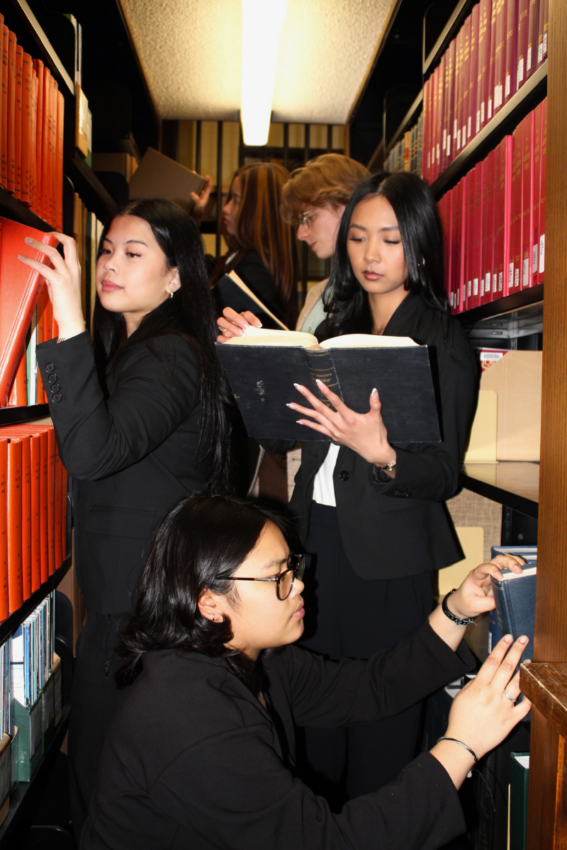
After eight years of hiatus, USask’s MUN Club is putting their name on the map.
What does it take to revive a club? In the case of the USask Model United Nations (MUN), one month and a lot of determination.
Merely three months ago, USask MUN was a club that had been inactive for eight years due to “insufficient interest”. The club lost club ratification status in 2018 and effectively disbanded. This January, in only a few short weeks, President Paula Orata and the USask MUN executive team breathed it back to life. Within a single month, the club went from applying for club ratification status to competing out of province alongside dozens of other universities.
In its first two weeks as a ratified club, nearly 80 students signed up, and an executive team was put together. Tasked with finding funding and providing lesson plans to members of the club, the executive team was given two weeks before USask MUN attended their first conference–the Alberta Intercollegiate Model United Nations (AIMUN) Conference — sending 20 delegates to MacEwan University in Edmonton. There, two of USask’s delegates, Seth Loeppky and Stacy Kim, received Outstanding Delegate awards at their first-ever conference.
One week later, 14 delegates hopped on a plane to the Concordia Model United Nations (ConMUN) Conference hosted by Concordia University in Montreal.
The club meets weekly on Mondays, which they have dubbed colloquially as “MUNdays.”
Orata’s idea came from independently attending Model UN and Model NATO conferences at other universities. “I realized that almost every single student attending came from a university with either a Model UN club or a Model NATO club. I approached Dr. Gaal, and I said, ‘Well, why don’t we have a Model UN club?’ He said, ‘We used to have one, but it dies off every eight years or so, but you can always start it again if you want’. Dr. Gaal is one of our faculty advisors now, [and] now we have a Model UN club of almost 100 people.”
But what is Model UN? In short, the environment simulates operations within the UN, in all its diplomatic, public speaking, collaborative, bureaucratic glory. Members, also known as delegates, are assigned countries or diplomatic roles that they roleplay within a diplomatic environment. Their goal? To solve global issues by working with other delegates without sacrificing the interests of their assigned countries.
In packed rooms, delegates engage in debate and proposals, writing papers that hopefully solve all the global issues which the actual UN have yet to solve.
According to Orata, “the purpose of Model UN is to open the door of networking and travel and meeting people from peer institutions, and to come together and come up with solutions that will simulate solutions that will affect how we approach issues in our world.”
Orata believes Model UN’s value transcends the General Assembly setting. “We needed something to bridge the academic theory that we learn in our classes with practical, hands-on application, and that’s what Model UN provides.”
Though networking and collaboration are one part of the puzzle, delegates also compete against each other. In their suits and lanyards, delegates are scored on skills like public speaking, writing, networking and even their diplomacy and ability to follow parliamentary procedure.
Beyond competing, Vice President Kayhan Yazdani believes in a unique value that the club provides to USask’s campus, closing a gap that he has noticed between West and East coast institutions.
“For me, it’s all about political engagement.” Yazdani noticed Ontario and Quebec universities had highly politically involved student populations, no matter their major. “I found that these eastern delegations that were being sent from other provinces have students from multiple backgrounds. I met a master’s student in chemical engineering. His name was Raphael. He was a great guy, and he was one of the best speakers that I think I saw at this conference.”
Yazdani is clear on his mission for the club. “I wanted to bring some of that expertise back to USask, to be able to shape a more politically engaged environment and a more open and inclusive environment.”
Aiming for a well-rounded club, Orata makes it known that USask MUN is not limited to students aspiring for a political career. “Our club is open to any student from any college at the university, because it’s really not just about Model UN, but building skills that will help people in their everyday lives, like speech skills, writing resolutions, writing their speeches and just being in front of a room of people and being comfortable talking in front of them.”
Although seemingly intimidating, according to Orata, the hardest part is just getting started. “It might seem daunting at first, but once people come in, they get comfortable with the procedure and learn the basics of it. It’s really easy after people learn the basics.”
She highlights the heart of Model UN conferences: the friends you make along the way. “It’s really easy to get them hooked onto Model UN and realize how much fun it actually can be, because it’s not just about attending conferences and being all so serious, but people have fun at our delegate socials in the evenings, discussing with other with peers from different institutions outside of moderated caucuses, like [at] ConMUN in Montreal, we met students from UCLA, from West Point, from UVic, from McGill, [from] U of R … It puts USask on the map, because it gives our students opportunities to see other students from different universities.”
Yazdani adds, “I find that people are honestly more inclined to be engaged with these types of activities once they really open the space for the first time … I think that Model UN represents a very opportunistic environment in which we give people the floor to be able to voice what they aren’t necessarily confident enough to voice in their day-to-day lives.”
Senior Head Delegate Loeppky believes the club plays to his strengths as a student in Political Studies. “It’s been an opportunity to talk about and represent the issues that I care most deeply about, whether that’s inequality or human rights violations or freedom of speech. These are things that are personally important to me, and it’s been an opportunity for me to vent and to expand and really articulate these issues, not only to myself, but to others.”
Even without Model UN experience, brand new members like Ilia Rezaei have found that the club gives practical experience outside the classroom. “It helps us use the class resources that were taught by our professors, and actually [use] them to integrate it into a real-world situation.”
Member Eric Dodge gets candid when it comes to the biggest hurdle he’s encountered since joining the club. “Public speaking. I’ve never done public speaking before. So at ConMUN, I did my first hour of public speaking. But I feel like through Model UN I’ve become a way better public speaker already.”
“I mean, I want to develop these skills like diplomacy.” There’s another side of the coin for Dodge, “and I mean, going and hanging out with friends and doing things with your friends is also just a lot of fun.”
Club Secretary and Social Media Manager Mia Szabo echoes this sentiment of connection and travel. “I think the opportunity to just build community is really great, and it allows our delegates to experience different people from different places, which USask doesn’t always get to do.”
Junior Head Delegate Mika Soroño, with three years of Model UN conferences under her belt, looks for more than LinkedIn connections when in conference halls among hundreds of other delegates. “They have similar goals, similar values. I think that seeing that there are other people just like you gives you more motivation, especially since you’re put in a room with people who have maybe achieved more than you, that puts — not necessarily pressure — but definitely more incentive for you to be just like them, to strive just like them. So I think, on a personal note, Model UN is definitely an engaging environment.”
Yazdani, a seasoned Model UN delegate, still finds something new in the environment with every conference. “I think that for as long as I’ve been doing it, what surprises me most is the fact that I still learn every time I’m a part of the space. I find that even with the experience I have from high school and kind of my early undergraduate years, I find that even meeting people who have never done it before, the way that they prepare, the way that they give speeches, I feel like it always renews my abilities. It always renews my commitment to these spaces. My commitment as Vice President especially makes me adapt to be able to fill the environment in a way that creates a platform for these students.”
Despite being a new club, Orata explains that Model UN has a lot on its horizon. “We’re really excited. Next year, we want to take our delegation to the National Model United Nations Conference in New York, and also a Model UN conference in Barcelona, as well as some here in Canada. We’re especially excited about our own Model UN conference.”
Model UN is gearing up to host their very own conference at USask this upcoming Fall Semester, planning to invite other institutions and opening more doors for its delegates.
“We’ll be hosting it here in Saskatoon, which will give our USask students an opportunity to participate in Model UN without having to take on the cost of travel, which is the biggest cost in attending Model UN conferences.”
Orata hopes for longevity in the club’s future. “Hopefully, doing that will open the door to more students and to keep the spirit of Model UN alive at the University of Saskatchewan, and also, because we want to carry this on for the coming years, and so our club just doesn’t die off in another eight years.”
Yazdani has his own visions for the club and its members. “We’re kind of trying to push the club for excellence. The idea [is] that we want to be able to push higher for awards, and be able to push not just to participate, but to compete.”
President Orata has learned a lot since her whirlwind of a semester. “As President, I think my role has really made me look at myself and think about the way that I interact with the people around me, for example, the executive team. I’ve really learned to delegate and ensure that everyone—”
Soroño interrupts with a “Point of information?”
She commandeers the microphone, continuing: “Our president actually takes on too much, so I think she doesn’t give herself that much [credit]. I think that since the club started in January, and she’s taken us to Edmonton and Montreal, I think that’s something that’s really great and nothing short of amazing.”
Though their calendar has been packed, this is only the beginning for the club. The success they have found in the last two months is no small feat, truly proving that nothing is impossible with a bit of teamwork and diplomacy.
Leave a Reply