
THE UNIVERSITY OF SASKATCHEWAN’S MAIN CAMPUS IS SITUATED ON TREATY 6 TERRITORY AND THE HOMELAND OF THE MÉTIS.
THE UNIVERSITY OF SASKATCHEWAN’S MAIN CAMPUS IS SITUATED ON TREATY 6 TERRITORY AND THE HOMELAND OF THE MÉTIS.
Duckweed and Deconstructing the Politics of Attention
At PAVED Arts, where visual media and experimentation often collide, Latent Swamp by Kelly Jaclynn Andres is both its newest installation and latest proposition: what if the smallest, most overlooked forms of life held the most expansive possibilities for rethinking our relationships to the environment?
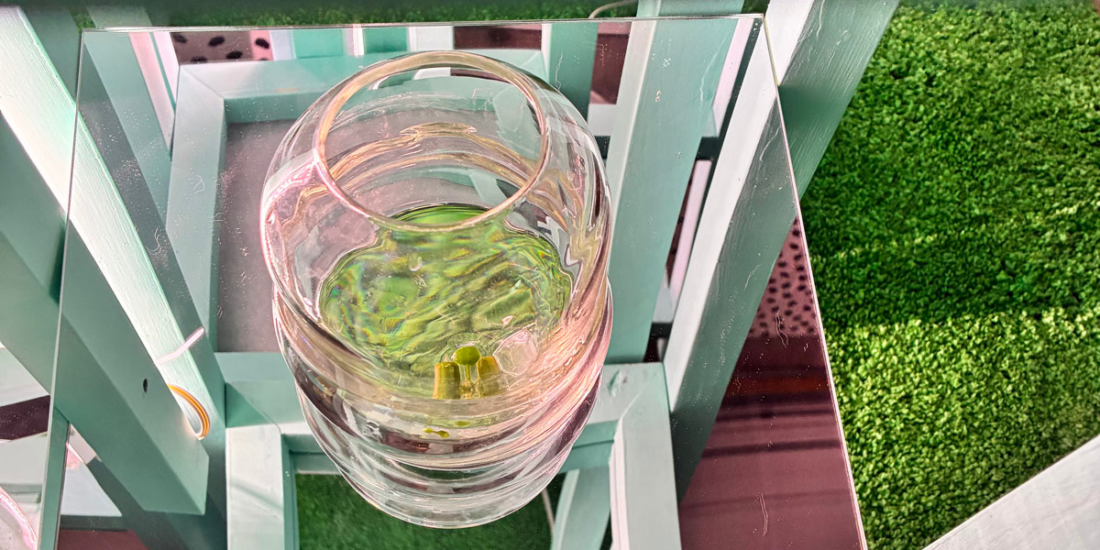
At the centre of the exhibition is duckweed. While it appears to be nothing more than an unassuming aquatic plant — often dismissed as pond scum — Andres reframes it as something much more complex: a living system capable of transformation and communication.
The installation is a speculative wetland. It’s an amalgamation of both biological and technological life, through Andres’s utilization of human participation, machine learning and living systems to create the work.
Trained as an interdisciplinary artist with a PhD from Concordia University, Andres’s broader practice consistently engages with what she calls “multispecies” relationships — collaborations between humans and non-human entities like plants, fungi and microorganisms. Rather than treating nature as a passive subject, she positions it as an active participant in meaning-making. Her installations are often alive, unstable and evolving, blurring the boundaries between art object and ecological process.
Latent Swamp continues this trajectory, but with a specificity that feels especially urgent in our current era. Duckweed, in its ability to absorb toxins and purify water, becomes something of a symbol of resilience in an era of environmental degradation. Yet Andres resists the temptation to romanticize. The swamp, after all, is not only a site of renewal — it’s also a site of decay, ambiguity and entanglement.
The installation uses water as a material and as a metaphor. Inside a bioremediation lightroom, duckweed filters water reused for cyanotype printing, folding image-making back into ecological cycles. Edible water-lentil treats invite visitors to encounter the swamp through ingestion, extending the circuit from data to metabolism.
Latent Swamp resists the comfort of the picture as an image that frames, resolves and reassures. Instead, it proposes image-making as a form of response-ability: an entangled practice in which images participate in the world’s becoming, clouding perception, redistributing agency and asking what it means to see from within a living system rather than above it.
What makes Latent Swamp particularly compelling is its sensory and conceptual layering. Andres is known for creating immersive environments — soundscapes, tactile materials and bio-responsive elements that encourage viewers to engage with their bodies as much as their intellect. While the specifics of the installation may shift depending on its configuration, the underlying approach remains consistent: knowledge is not delivered, but encountered. The viewer is not positioned as an observer standing outside the work, but as a participant entangled within it.
This entanglement extends to the exhibition’s conceptual framework. By centring duckweed, Andres draws attention to the ways in which value is assigned — or denied — within ecological and cultural systems. Why do we overlook certain forms of life while elevating others? What does it mean to care for something that is small, diffuse and difficult to individualize? In a culture that often prioritizes visibility, scale and spectacle, Latent Swamp offers a counterpoint: a slow, distributed and relational mode of attention.
There is also an implicit critique of anthropocentrism running through the work. Andres’s practice, informed by fields like environmental humanities and critical plant studies, challenges the assumption that humans occupy a central or superior position within ecological networks. Instead, she proposes a more horizontal framework, where agency is shared across species and systems.
This reframing of the narrative requires not just a change in perspective, but a reorientation of values — away from control and extraction, and toward reciprocity and co-existence.
Experiencing Latent Swamp is something of an exercise in unlearning. The installation invites its audience to linger in contemplation. The swamp is not something to be drained or simplified; it is a place to be inhabited, even if that habitation is uncomfortable. This discomfort is productive. It opens up space for new ways of thinking about environmental responsibility — not as a set of solutions to be implemented, but as a set of relationships to be navigated.
On a personal level, the exhibition prompts a reconsideration of what counts as meaningful engagement with environmental issues. It is easy to think of sustainability in terms of large-scale interventions — policy changes, technological innovations, global movements.
While these are undoubtedly important, Latent Swamp shifts the focus to something more intimate and immediate. It suggests that attention itself is a form of care. To notice duckweed — to take it seriously and consider its capacities and its role within a larger system — is to begin reconfiguring one’s relationship to the environment.
This emphasis on attention resonates beyond the gallery. In a world saturated with information and urgency, there is a tendency to prioritize what is loud, visible and easily digestible. Andres’s work pushes against this tendency, advocating for a slower, more attentive mode of engagement. It asks us to consider what we might be missing when we move too quickly, and what might become possible if we allowed ourselves to dwell in complexity.
Ultimately, Latent Swamp is less about providing answers than about cultivating a particular kind of awareness. It does not tell us what to think about environmental crises, but rather how to think — and how to feel — within them. By foregrounding the small, the overlooked and the interconnected, Andres creates a space where new forms of understanding can emerge.
Intrigued? Want to get your hands wet in duckweed for yourself?
Join Andres on April 23 at PAVED Arts to take part in the water lentil trials. Participants will have the opportunity to taste test samples of water lentil, take part in conversations about perception, sustainability and the future of food, and reflect on how cultural narratives, ecology and place-based knowledge inform what is considered edible.
Leave a Reply