
THE UNIVERSITY OF SASKATCHEWAN’S MAIN CAMPUS IS SITUATED ON TREATY 6 TERRITORY AND THE HOMELAND OF THE MÉTIS.
THE UNIVERSITY OF SASKATCHEWAN’S MAIN CAMPUS IS SITUATED ON TREATY 6 TERRITORY AND THE HOMELAND OF THE MÉTIS.
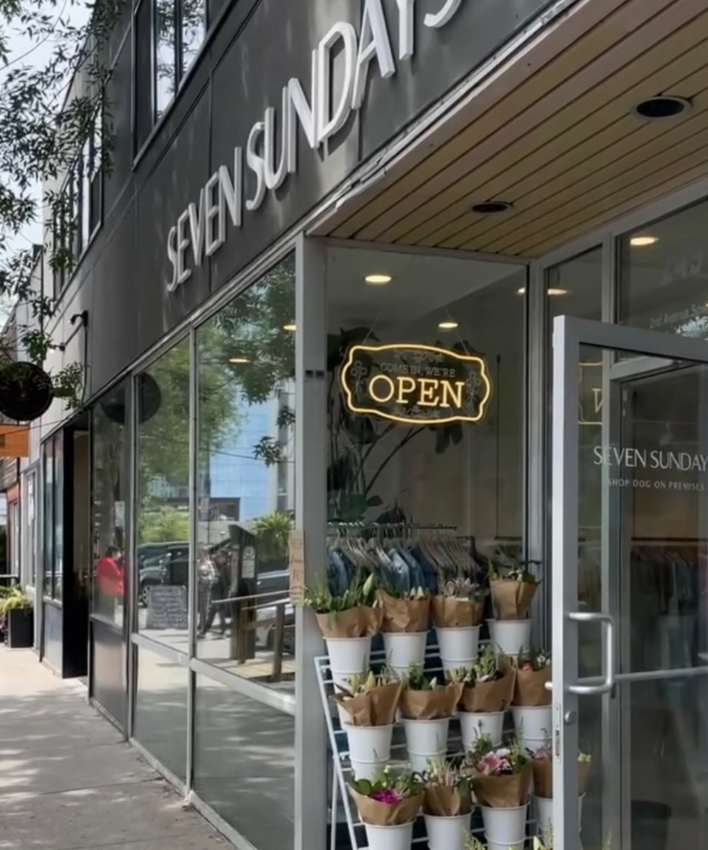
Seven Sundays’ lack of accountability for harming the most vulnerable populations in Saskatoon.
On March 13, the vintage store Seven Sundays, located in the heart of Saskatoon, posted a video on their TikTok captioned “POV you’re an empath that works retail downtown”.
A woman wrapped in a blanket appears on screen and starts grabbing merchandise as an employee hovers over her. Investigative, Law & Order adjacent music plays in the background as the video shows the woman trying to place socks and toques in her jacket.
The text then transitions to a “Please and thanks count”, with the number increasing as a staff member repeatedly asks the woman to return the items and informs her that the police have been called. One staff member commented that they had never laughed so hard while editing a TikTok.
This video goes on for mere seconds, meant to be seen as a comedic watch as people doomscroll through social media. To Seven Sundays’ displeasure, the video did not send the audience into fits of laughter; rather, it sparked the ire of the masses.
The backlash has been loud and critical of the decision to film and post someone in a vulnerable state.
Shortly after the TikTok began garnering criticism, the business posted a six-slide statement on Instagram defending the video. While they garnered over 1700 likes on the statement, support in the comment section seemed few and far between.
The original video was quietly removed on March 18, with the Instagram statement and a video response from Seven Sundays co-owner Sam Murphy taken down in the days that followed.
In their Instagram explanation, Seven Sundays claimed that they built the store in the vision of bringing together their community and wished to show their audience how these situations can “[…] be handled with patience and empathy, regardless of how scared [they] are, or how much danger [they’re] in.”
In a video on his personal Instagram, Murphy says, “There was nothing but compassion, care and patience displayed in that video.”
Rather than backing down and taking the time to listen to the concerns of their audience, Seven Sundays fought back against what they claimed in their statement to be a “loud minority of individuals who seek not to improve our community, but instead choose to virtue signal […] and bully or shame anyone who does not fully agree with their worldview […]”.
On the fourth page of their now deleted post, they publicize that Seven Sundays has reinvested $300,000 into the local community and state that they have created nearly 20 jobs. The post chose not to indicate which organizations they support or the general causes they have donated money to, explaining that it felt “disingenuous … [they] prefer to let [their] actions speak for themselves.”
Regardless of what Seven Sundays has done in the community, their TikTok and subsequent response displayed a lack of empathy.
I will not assume what the woman wrapped in the blanket is going through, but with the rise in insensitivity around the city for people without housing, going through mental health issues and addiction issues, it is undeniable that the video Seven Sundays posted only furthered harmful ideas about what people who are struggling look like.
At the end of the day, these people are human beings who deserve the singular shred of autonomy and decency to not be pointed and laughed at.
Not only is there an issue of autonomy with posting someone in a vulnerable state, but their response also promotes the idea that people who are struggling with homelessness are inherently dangerous, exacerbating the challenges these communities already face.
When people assume an already marginalized group is unsafe to be around, constantly carrying weapons and is a source of harassment, they are less likely to support important organizations providing essential services to these groups, such as Prairie Harm Reduction or Saskatoon Interval House. Homeless shelters, while not perfect solutions to housing instability, provide some form of support in a broken system.
In 2024, community members pushed back against the Wellness Centre in the Fairhaven neighbourhood, claiming it created an unsafe environment. However, statistics from the Saskatoon Police Service and Saskatoon Fire Department showed there was little correlation with an increase in violent crime. While property crime spiked to double the typical rate when the shelter opened in 2022, it was dropping to normal levels in 2024.
Members of the community said the statistics did not paint the full picture, and they still felt uneasy; one alleged crime was still occurring, but they had simply stopped reporting it and advocated for the shelter’s closure. Even when crime statistics are unchanged, this sense of unease pushes people to reject shelters in residential communities.
A review article in Health & Social Care in the Community identified community integration as a cornerstone of assisting individuals facing housing insecurity. Community integration is not only about physically being present in residential communities, but also socially and psychologically.
The acceptance of people who are unhoused into communities is part of the solution to the roots of the problems Seven Sundays identifies in their statement; however, they actively worked against this with the framing of the video and their response. People cannot be helped without the compassion of others and without places where they can build healthy relationships.
In the Instagram post, Seven Sundays states that ignoring issues “perpetuates the same cycles generation after generation.” This vaguely worded statement, which pinpoints theft as a generational cycle, arguably carries racist overtones towards the Indigenous community — 83 per cent of Saskatoon’s unhoused population is Indigenous — and also uses passive language that does not identify the systematic perpetrators of these cycles.
Seven Sundays has made it clear that their ideas of community only encompass those within their vicinity; only those in their line of sight should have access to the spaces they have created. Out of ignorance, discomfort, or a lack of compassion, they refuse to look towards those who have been relegated to the margins of their stories.
Their statements, especially when viewed alongside their previous social media posts and campaigns, hint at a fairly narrow vision of the future — one that is white, thin, and able-bodied. People of colour and diverse body types are rarely featured on their Instagram, with the only recent instance being in the background of their USask By the Pound sale post.
Profiting from marginalized bodies — in this case, by getting likes on TikTok from posting a marginalized individual nonconsensually — while refusing to platform them in any meaningful way is indicative of the type of community Seven Sundays wants to build. The colour of the hand doesn’t matter as long as it’s holding out money.
The ignorance towards marginalized voices is further highlighted by their unwavering support of the police, who play a key role in enforcing the harmful cycles mentioned in the statement.
The statement holds the Saskatoon Police Service in high regard, failing to recognize that law enforcement is reactive and not proactive. The reality is that police clear encampments and remove those who are struggling out of spaces at the whims of those who have higher socioeconomic (and oftentimes racial) status.
The police cannot address the root causes of homelessness or drug addiction in our society, and are only enabled to act upon the consequences of these issues, pushing those who are struggling out of neighbourhoods and out of sight.
The Instagram post, as well as the owners themselves, repeatedly claim they care about solving these issues while not engaging with proven methods of de-escalation and community support.
Moving forward, Seven Sundays has signified its unwillingness to train its employees in harm reduction strategies and naloxone administration. One comment recommends that Seven Sundays provide Naloxone training to employees; Murphy himself replied, saying, “naloxone administration feels like a bandaid solution we are seeking to address at the root.”
A comment encouraging Murphy to go to Unhoused, Not Unseen – A Call to Action at TCU Place was liked by his personal Instagram account. In his response video, he says he “will embrace the opportunity to learn.”
Some comments Murphy liked expressed critiques and offered resources; other statements in support of the video received a red heart. One that said they supported the original video “100%”. Another liked comment joked that Murphy’s wife probably forced him to post an apology video.
A comment on the Seven Sundays Instagram post admonishes the public for “defending criminals” and how homelessness and addiction do not give people permission to “commit whatever crimes [they] desire without consequence.” This comment was pinned by their Instagram. This ensured that it was the very first comment seen under their post, before it was quietly unpinned after a few days.
The Seven Sundays brand, as well as Murphy, has been repeatedly giving mixed messages regarding their response to this situation. They liked one comment calling people “druggies”, while also liking comments that encourage accountability and forward resources for helping the homeless.
Em Oyen, a USask student, took matters into their own hands and decided to sit down with Seven Sundays on March 18 to start the conversation that the business desperately claimed it wanted. After being blocked, unblocked, followed and having her comments deleted, she was still open to meeting with Murphy. The TikTok was taken down following their conversation. After their discussion, Oyen sent an email hoping to set up another meeting so they could continue the conversation and connect the Seven Sundays team with training and resources to better handle these issues. She is still awaiting a response.
When asked if they think that Seven Sundays can make a comeback, Oyen said: “I wish I could say ‘yes’ confidently.” Elaborating on her stance, Oyen believes that the community needs to think more critically about who they support. “Our dollars speak so loudly, our money is power, and I wish a lot of people would recognize that.”
In the wake of this controversy, attention has been drawn to other small businesses, especially those in the downtown Saskatoon area.
An up-and-coming plus-size vintage store, Think n Thrift, posted a statement on its Instagram a few days after Seven Sundays’ initial post. They outlined their responsibility as a business in assisting the most vulnerable populations in Saskatoon and declared that they would be carrying Naloxone on site, along with other essentials such as socks, mitts and menstrual products. Their store has recently opened in Drinkle Mall on 3rd Avenue South and will be accepting donations of these items.
Another small business in the downtown area, which requested to remain anonymous for the sake of staff safety, said that they have provided de-escalation training. They emphasized that small businesses should not have to carry the burden of these systems, but also recognize their role as members of the community in providing aid.
The most poignant moment for me in the video was when the woman handed back the socks she had taken. Socks are among the highest-demand items in homeless shelters; a basic human comfort becomes a prized possession for those facing emergencies, mental health challenges or simply unfortunate circumstances.
Instead of being met with compassion and care, the woman in the blanket was dehumanized and othered when she was posted online with satirical editing. She is not a criminal – the law is fallible, and the line between criminal and not is pushed around by those with the right amount of money and a certain skin tone. She got the short end of the stick in a system that was built with holes the size of humans.
True empathy is not saying “Please and Thank you” while nonconsensually posting someone for an audience of nearly 2000 followers. True empathy looks like showing up for your community and not cherry-picking who gets to be a part of it.
Channelling support and funding into local organizations is the most immediate way to aid marginalized populations in Saskatoon. Saskatoon Interval House, the YWCA and the STC Emergency Wellness Centre all provide emergency housing and counselling to those who are in need. Prairie Harm Reduction, which provides naloxone and safe drug disposal are currently looking for donations, which can be done through their website.

Leave a Reply