
THE UNIVERSITY OF SASKATCHEWAN’S MAIN CAMPUS IS SITUATED ON TREATY 6 TERRITORY AND THE HOMELAND OF THE MÉTIS.
THE UNIVERSITY OF SASKATCHEWAN’S MAIN CAMPUS IS SITUATED ON TREATY 6 TERRITORY AND THE HOMELAND OF THE MÉTIS.
You are not alone, Charli XCX, for I too think I’m going to die in this house.
Spoilers ahead for “Wuthering Heights”
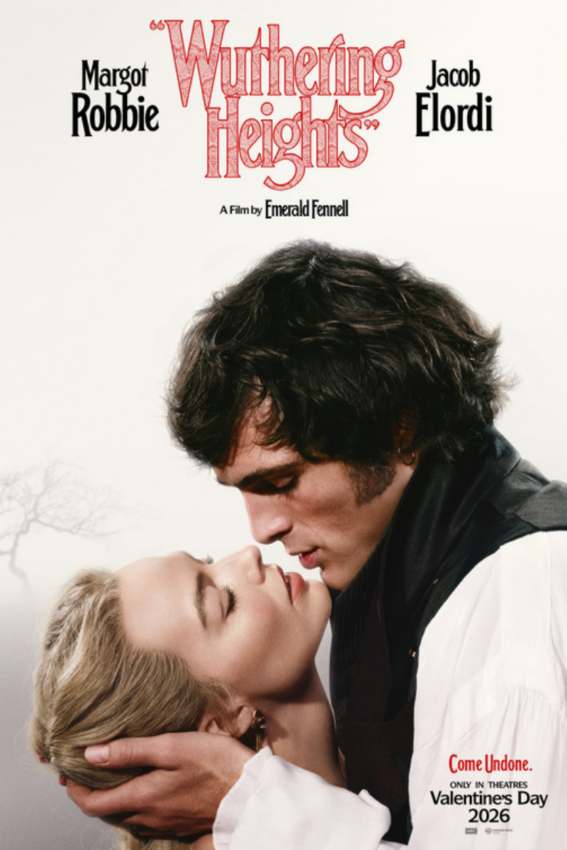
If you’ve had the pleasure of reading Emily Brönte’s gothic tragedy, Wuthering Heights, and the displeasure of owning technology this year, I’m sure you can predict where this may be going. Produced and directed by Emerald Fennell, starring Margot Robbie as Catherine Earnshaw and Jacob Elordi as Heathcliff, the newest book-to-screen adaptation of the classic novel “Wuthering Heights” hit screens around the world last month, on Feb. 14.
Since its release, the film has been subject to widespread, heated global criticism. From casting decisions to book inaccuracies, it seems as though many audience members and film critics alike are thoroughly unimpressed, calling it infantilizing, smooth-brained and lacklustre.
Despite the roaring fire of online backlash, I actually approached this film with relative excitement. While I was not thrilled with the casting decisions, and the picture I had seen of the infamous “skin room” kind of freaked me out, I was still optimistic. As a fan of the novel and having enjoyed Fennell’s previous films, Promising Young Woman and Saltburn, I thought I would walk away with the same feelings of slight discomfort and unease that her work tends to evoke.
Fennell is known for her edgy and salacious approach to filmmaking. Her work has been criticized for its reliance on shock value and for being unnecessarily provocative. I figured that if I could handle the endings of her other works — both famously controversial and jarring — a film adaptation of a book I knew well couldn’t really surprise me.
I fear I was mistaken.
Before I delve into my criticisms, which have already been volleyed across the internet by anyone with a platform, I should say that it was not as horrible as you might think. The film was of incredibly high quality, the acting was well done and the stylization was unique and intriguing. This isn’t your average film adaptation. It created an entirely new version of a world we once knew, flipped on its head.
If you haven’t read the book and have no interest in doing so, you’ll probably enjoy this adaptation. If you’re a proponent of “booktok” and into charged dark romance novels, you might really dig this. If you’re just a fan of beautiful people looking beautiful, you’ll love it. Robbie and Elordi work hard to make sure of that.
As skeptical as I was about Charli XCX being hired to produce the film’s soundtrack, I must admit that the music was incredibly evocative and in line with the sentiment being pushed by Fennel’s direction. It’s atmospheric, haunting and immersive. It tells the story of this version of Heathcliff and Cathy remarkably well — almost too well. Some critics even expressed that they felt the film was undeserving of a soundtrack so good, but to me, that lent itself to the feeling of dread I have always associated with Brönte’s novel.
But the music and theming cannot save the film, unfortunately. Nor can they hide the misdeeds of Fennell’s interpretation from the analytical gaze of those who revered Brönte’s work.
It becomes clear very quickly — almost immediately — that the film does not misunderstand the novel accidentally. It misunderstands it on purpose. It identifies intensity and eroticism as the defining features of Brontë’s work and then amplifies them until they drown out everything else inside it. The problem here is that the original work is not just intense and erotic. It is controlled. It is restrained. It is a product of its time, structured in a way that forces you to do the work of interpretation and sit inside ambiguity without being told exactly how to resolve it.
Fennell’s film does not trust that process.
Instead, it consistently turns nuance into outright declaration. Subtext becomes text in bold. Allusion becomes an explicit image. Anything that might have required patience or interpretation is pulled forward, clarified, highlighted and underlined. It is not just an aesthetic choice. It feels like an assumption about the audience that, without constant reinforcement, without things being made obvious, the meaning will be lost on the mindless masses.
There is a kind of infantilization in that assumption. As if the only way to engage a contemporary audience is to show everything and leave nothing implied. It is a strange approach to a novel that has withstood the test of time precisely because of what it does not say.
This is most obvious in the film’s fixation on shock. There are moments that feel engineered less to deepen the story and more to generate reaction, scenes that push toward the erotic or the confrontational in ways that feel disconnected from the novel’s emotional logic. The infamous “skin room” sequence is probably the clearest example.
That impulse extends to the film’s treatment of the central relationship. Catherine and Heathcliff are presented as all-consuming and almost elemental in their connection. But the film rarely gives you the context needed to understand why. Their bond is asserted repeatedly through proximity, through touch, through visual intensity, but it is not developed. It is shown, not built.
In the novel, their relationship is inseparable from their environment, from class, from exclusion, from the ways they are shaped and limited by the world around them. It is not just that they love each other. It is that they are formed in relation to one another under specific conditions. Their souls are quite literally made from the same stuff. Remove those conditions, and the relationship becomes abstract.
That abstraction is at the heart of the film’s broader misreading. By stripping away the social framework of the novel and minimizing the importance of class, inheritance and time, Fennell isolates the emotional core of the story in a way that ultimately weakens the film. The feelings are still there, but they are no longer anchored to anything, now floating in space, hoping to be caught by a stray net.
One of the largest departures from the novel that baffled and honestly offended me most is what the film has done to Isabella Linton. In the novel, Isabella is naive, romantic and, above all, painfully human. She is drawn to Heathcliff not because she has some latent desire for degradation, but because she just does not understand what he is.
Her tragedy is rooted in misrecognition. She mistakes cruelty for passion, intensity for depth and by the time she realizes the truth, she is trapped in a violent marriage she cannot easily escape. Brontë does not frame her as foolish so much as sheltered, someone whose understanding of love has been shaped by distance and fantasy rather than experience.
The horror of her storyline lies in that slow realization: Isabella is not entering a dark romance; she is entering a prison. The violence she endures, including Heathcliff’s cruelty toward her dog, is not a symbolic spectacle. It is meant to strip away any lingering illusion about who he is. It reminds the reader that Heathcliff’s capacity for harm is not poetic or aesthetic. It is real, and it extends to the vulnerable without hesitation.
Fennell’s adaptation takes that arc and flattens it into something far more unsettling, and not in the way the film seems to intend. Isabella is no longer a sheltered girl who misjudges Heathcliff. She is reimagined as someone who actively gravitates toward degradation, someone who appears to invite the very violence that defines her storyline.
The shift is subtle in presentation but significant in implication. By turning Isabella into a character who performs her own objectification, the film removes the structural power imbalance that made her story tragic in the first place. It becomes less about coercion and entrapment and more about personal choice, which is a strange, almost cynical reframing of abuse.
The most jarring example of this is the film’s inversion of the dog scene. Where the novel uses Heathcliff’s violence toward an animal to underscore his cruelty, the film transforms Isabella into something that seeks proximity to that violence, even mimicking it. It is a choice that feels designed to shock, but it ultimately empties the narrative of its emotional stakes.
What was once a critique of romantic delusion becomes something closer to spectacle, reducing Isabella from a victim shaped by her circumstances into a participant in her own degradation. It is not only a misreading of the character, but a fundamental misunderstanding of what made her story matter in the first place.
The casting of Elordi as Heathcliff also fits pretty neatly into this pattern of simplification and misunderstanding. It is not just that the casting deviates from the novel’s descriptions. It is that it removes a layer of meaning that the film does not replace with anything else.
Heathcliff’s racial ambiguity in the novel is not incidental. He is described in ways that mark him as dark, foreign and other throughout the book. That otherness shapes his position in the household, his treatment, his sense of self. It is part of the structure that produces both his suffering and his capacity for cruelty.
In this adaptation, that ambiguity is effectively erased. Heathcliff is still an outsider, but in a way that feels ungrounded. His marginalization is suggested rather than embodied. Without that visible difference, the social dynamics that surround him become harder to read. His anger loses context. It becomes less about a system and more about an individual.
There is also a broader cultural pattern that makes this decision more uncomfortable. Historically, racialized men have often been cast as dangerous, violent or morally suspect, while White actors are given the space to be complex, tragic or sympathetic. Within that context, taking a character who occupies a racialized outsider position and rendering him as White, while still centering his abusive and volatile behaviour, shifts how that behaviour is read.
It detaches cruelty from context. It turns something that was shaped by social conditions into something that feels more inherent, more personal. And at the same time, it avoids engaging with the racial dynamics that would make that cruelty more difficult to interpret.
And in doing so, it underestimates its audience. It assumes that meaning needs to be made visible to be understood, that subtlety is a barrier rather than a strength. But Wuthering Heights has endured precisely because it resists that kind of clarity. It demands interpretation. It leaves space.
Fennell’s adaptation fills that space completely.
There is, paradoxically, something less engaging about a film that gives you everything. Without ambiguity, there is nothing to return to, nothing to reconsider. The film is immediate, but it is not lasting. It provokes reaction, but not reflection.
And that is what feels most at odds with the source material. Not the changes themselves, but the philosophy behind them. Wuthering Heights is a novel that trusts its reader, that allows for contradiction and discomfort. A novel that understands that what is unsaid can carry as much weight as what is spoken.
This film does not trust you in that way. It shows you everything. It tells you what it means. It insists on how it, and you, should feel.
And in doing so, it loses the very thing it is trying so hard to capture.

Leave a Reply