
THE UNIVERSITY OF SASKATCHEWAN’S MAIN CAMPUS IS SITUATED ON TREATY 6 TERRITORY AND THE HOMELAND OF THE MÉTIS.
THE UNIVERSITY OF SASKATCHEWAN’S MAIN CAMPUS IS SITUATED ON TREATY 6 TERRITORY AND THE HOMELAND OF THE MÉTIS.
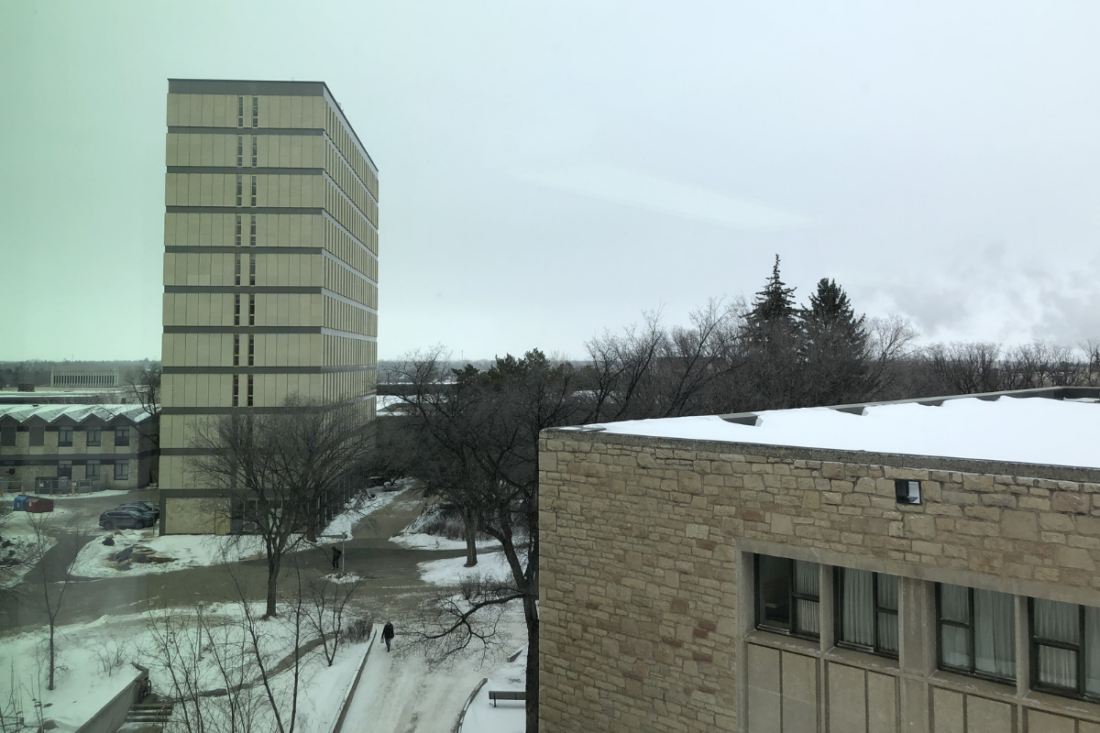
How faculty numbers have changed at USask’s largest college, the effects it has on students, and where it leaves professors
Arts and Science is the largest college at USask, comprising over 10,459 students in the 2024/2025 year, according to the university. It offers dozens of degree programs and certificates, and has seen stable student enrollment each year.
Despite enrollment numbers remaining relatively stable for the past 10 years, class sizes in the faculty seem to feel bigger every year. This begs the question: are Arts and Science faculty numbers remaining proportional? And if they aren’t, what does this mean for the quality of education USask students are receiving?
The Sheaf asked the university for compiled data on faculty headcount in the College from 2016 to 2026. The university did not provide any list or dataset of the college’s faculty numbers by department; instead, it pointed to the Arts and Science website to count each department’s faculty members individually.
The USask website shows that in 2016, there were 295 full-time equivalent (FTE) faculty, and in 2026, there were 348.7 FTE faculty. Full-time equivalent means the number of full-time employees based on total number of hours worked. For example, one 1.0 FTE typically means 40 hours per week, regardless of how many employees it takes to reach 40 hours cumulatively.
The Sheaf also received the total number of union members from the University of Saskatchewan Faculty Association, broken down by department. The total number of members from this dataset was 294 in 2016 and 292 in 2026, which further makes the total number of faculty hard to discern.
Regardless, it is important to note that neither figure necessarily reflects the actual teaching capacity of the college. It is important to note that every department’s situation is different, and that hard numbers do not reflect actual teaching capacity.
To account for nuances and offer a chance for professors to offer personal takes on this issue, The Sheaf decided to contact all 18 departments in the college, as well as the three departments in the School of the Arts. Each department was contacted for information on faculty headcounts over the last ten years, and asked if they had seen a noticeable change.
Of the 12 department heads and program coordinators who replied, ten had confirmed a noticeable decline in faculty and teaching capacity since 2016.
For example, while Physics and Engineering Physics has seen an increase from 19 faculty members in 2016 to a total of 21 in 2026, this number doesn’t reflect the department’s actual teaching capacity. According to a message from the department, “Currently, one faculty member is projected to retire this year, one has 50 per cent appointment, one on 30 per cent appointment and one is seconded to the College of Engineering as Dean. So our actual teaching capacity has declined compared to 2016.”
This point is further reinforced by a comment from the Department of Political Studies, which says that “In most academic years, one or more faculty members are on sabbatical, directly affecting course offerings. In 2026–27, the Department will have one faculty retiring, another on full sabbatical and another on a half sabbatical. In essence, although the nominal complement will be seven full-time faculty members, the effective teaching complement will be approximately five and one-half.”
For some departments, new positions are being added, but they are the result of outside programs, rather than an increase in funds from the university. A comment from the Department of Psychology confirms that the provincial government’s Ministry of Advanced Education is supporting its operations in the area of clinical psychology via the Health Human Resources Action Plan expansion initiative, as part of the province’s Action Plan to Recruit, Train, Incentivize and Retain Health Professionals.
Professors noted that faculty loss is typically attributed to retirement, death or the move to administrative positions. There has been a general consensus among the responses that professors are indeed feeling the weight of these losses without their replacement.
For example, a comment from the Department of Computer Science noted the fact that “undergraduate enrolments [in Computer Science] have more than doubled over the past ten years and the number of faculty positions in our department has declined.”
Another comment from the Department of Biology sees a similar story: “Over the last five years, enrolment has steadily increased from 400 undergrad majors and 60 graduate students to 540 undergrad majors and about 80 graduate students, while faculty complement has decreased from 24 regular faculty to the 18 plus one number … We definitely notice.”
Although the faculty-to-student ratio may be the most noticeable obstacle, professors note that this decline impacts almost every area of teaching.
A comment from the Department of English says that it has “doubled the size of our first-year classes” since 2002. This leads to faculty having to teach “100-student first-year classes with the help of graduate students to lead smaller tutorial groups,” which means less professor-student interaction.
The Department of Political Studies adds that it “lacks teaching and research capacity in several critical fields. Most notably, it no longer has expertise in Canadian studies — at the local, provincial, national or international levels — a field in which it once held a strong national reputation.”
The department is also lacking critical resources for delivering its certificates, such as the Certificate in Indigenous Governance and Politics and the Politics and Law Certificate, and is now considering having to pause these programs due to the lack of courses and faculty.
Another implication of the loss of faculty is the effect it has on a department’s graduate programs. A comment by the Department of Chemistry says that the decline of faculty “impacts our ability to supervise enough graduate students who also act as TAs in our undergraduate labs, which affects undergraduate student enrolments in those classes that have a lab component.”
The Department of Political Studies sees a similar problem, saying that its graduate program has suffered from the decline in faculty. The department relies on split courses of the 400/800 level that contain both undergraduate and graduate students, “which limits the depth and uniqueness of graduate-level instruction. As well, undergraduate students who transition into the Political Studies Department’s graduate program often have already completed the required graduate courses at the undergraduate level as a result of the cross-listing, thereby limiting the options available to them at the graduate level.”
A lack of professors available to each department not only leads to an increased workload because of an abundance of undergrads, but also impacts the attention that graduate students are expected to receive from professors, as well as reduces the amount of faculty attention given to individual graduate students.
Student enrollment in graduate programs at USask has, in fact, declined in the college over time, going from a total of 1,002 graduate students in 2016/2017 to 907 in 2024/2025.
While further research would be needed to confirm whether a lack of attention and graduate-specific instruction is a potential causation for this decline, it can certainly be inferred that the lack of teaching capacity is not helping enrollment in grad programs.
The precariousness of faculty positions is also a major concern for departments in the coming years. Another concern raised by professors is the projected retirements in the near future. A comment from the Department of Geological Sciences says the department anticipates a loss of eight faculty members (44 per cent of their total) to retirement over the next seven years.
The Department of Political Studies, in addition, employs one Lecturer Without Term to offset the loss of available faculty, who teaches seven courses annually compared to the usual four courses for regular faculty. The department added that “the precarious nature of this position, however, renders the unit vulnerable and its operations unsustainable. It also places this highly valued colleague in a persistently precarious position.”
The reliance on sessional lecturers is one strategy in helping to alleviate teaching load for departments, but this often isn’t enough. A comment from the Department of Economics confirms that sessional support from the college has replaced some of the lost full-time faculty, but not completely, and the department has still seen a significant decline of 51 undergraduate classes being taught in 2018/19 to 38 classes being taught in the current 2025/26 year.
Why is it significant that Arts and Science faculty aren’t being replaced? What about other colleges? While more research ought to be devoted to measuring faculty numbers across all colleges, Arts and Science is in a relatively unique position. Students from almost all colleges are required to take Arts and Science courses, while Arts and Science students are not required to take courses from other colleges. This means Arts and Science courses are in more demand university-wide, but it is difficult to keep up if faculty aren’t being replaced.
Combined with the recent decrease in international student enrollment, as well as the growing concern among students and faculty of highly paid administrative positions, the college is put in a difficult position.
With fewer faculty, departments are usually forced to rely on sessional lecturers and larger class sizes to keep up. Studies on the effects of larger class sizes have generally shown that they negatively affect students. In a 2021 study of U.K. students in higher education from the Journal of Economic Education, researchers find that overall, “larger classes are associated with significantly lower grades” and “this impact would be more pronounced in STEM than in non-STEM subjects.”
Alongside this, a 2023 article in The Sheaf pointed out the precarious and underpaid work that sessional lecturers have to do. The article estimated that teaching a load of four classes per academic year would only earn a sessional lecturer roughly $28,000 annually. The band-aid solution of overreliance on sessional lecturers to keep up with faculty decline thus doesn’t help to fix the larger problem that departments are facing.
A note from the Department of English echoes what many departments have said about this issue, and it’s worth quoting in full. “If there’s one thing I’d like to tell your readers, it’s that my colleagues in the English Department, faculty and sessionals alike, are very hard-working and care about our teaching. We all want to be able to give each student more individual attention, we all want to teach more engaging classes, we all want students to benefit from our expertise. We’re not happy about shrinking faculty numbers and increasing workloads, either.”
Listening to faculty experiences is critical in moving forward. Further studies should also inquire about the impact these numbers and experiences have on students’ quality of education. If the university doesn’t come up with a solution soon, it is likely to get worse.

Leave a Reply