
THE UNIVERSITY OF SASKATCHEWAN’S MAIN CAMPUS IS SITUATED ON TREATY 6 TERRITORY AND THE HOMELAND OF THE MÉTIS.
THE UNIVERSITY OF SASKATCHEWAN’S MAIN CAMPUS IS SITUATED ON TREATY 6 TERRITORY AND THE HOMELAND OF THE MÉTIS.
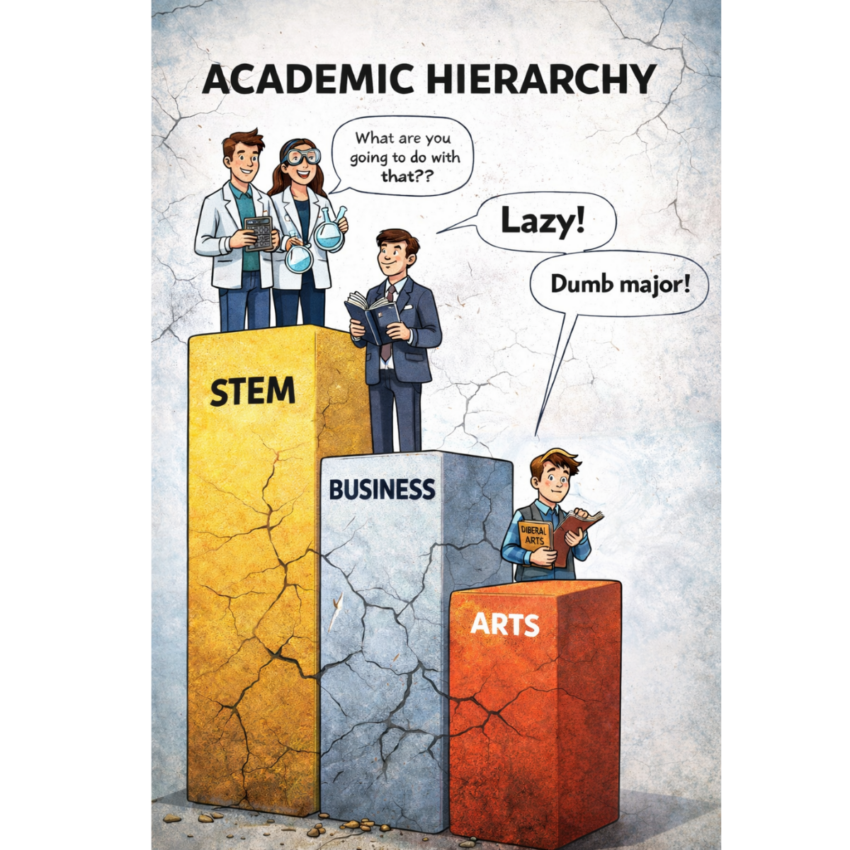
The idea that major choice equals academic merit is a fallacy and it’s rotting the university community from inside out.
During office hours, a professor once called my major — political science — a “dumb major.”
I knew he didn’t mean any disrespect. He was a kind, helpful person and the comment was just a joke that slipped out. However, his Freudian slip pointed to something larger: an unspoken hierarchy of majors that exists across higher education.
This hierarchy is everywhere, though no one admits it. It lives in the questions relatives ask at dinner, “what are you going to do with that degree?”. It lurks on TikTok, where STEM students mock other majors — comparing their workloads to “colouring within the lines.” It shapes who gets respect and who gets dismissed before they’ve even spoken.
At the top sit the STEM majors: engineering, physics, chemistry, math. They are the apex predators of academia, fawned over for their rigorous workload and difficult course material. People’s faces light up as soon as they hear someone is in math or science, majors seen as embodying academic excellence itself.
Just below them are the softer sciences: biology, psychology, geology. Still respectable, but not quite royalty.
Business and economics majors land in the middle. While they are the butt of jokes, they also enjoy considerable privilege, namely the freedom to look down on the lowermost majors on the hierarchy — the liberal arts.
The stereotypes are relentless. Liberal arts majors are lazy. They’re dumb. They can’t handle real academic work. For conservatives, the indictment goes further: they are all the above, as well as brainwashed “communists” pursuing basket-weaving degrees of no value to society. The message is clear: you are what you study, and if you study the wrong thing, you are worth less.
I hear these judgments constantly. Sometimes, when I tell someone I’m a political science major, I watch their face shrivel in disgust — before their social awareness kicks in and the expression dissolves. They catch themselves, but the damage is already done. I have seen that look too many times to mistake it.
I have learned to ignore these reactions. I know my major is not a measure of my abilities. It is a mental shortcut people use to size me up — and a flawed one at that.
I know plenty of students in STEM fields who fail to live up to the “smart and hard-working” stereotypes with their degree. They fail classes, skip lectures and put in zero effort.
Meanwhile, some of the smartest people I know chose to study fields considered “lesser than” — the arts. They are high-achieving, well-rounded students, with as many awards in academics and extracurriculars as the “average STEM major.” They chose the liberal arts out of genuine interest, not prestige or employment prospects — a fact that some people simply cannot fathom.
I study political science because I find it deeply enriching. It gives me a fuller understanding of issues like climate change and immigration. It teaches me how to think about governance, justice and what we owe one another. These are not abstract distractions. They are the questions that determine how we live together.
While engineers learn to build bridges and run complex code, liberal arts majors explore the normative questions that science often bypasses. Whether we should develop AI, what kind of future we’re building and who gets left behind. These fields are equally valuable — dare I say, indispensable. A society composed only of STEM majors risks becoming the dystopian techno-fascist states imagined in Brave New World or 1984.
Yet, despite their value, many liberal arts students carry a quiet shame. They hesitate before answering the “what’s your major” question. They brace themselves for the pause, the smirk, the well-meaning but cutting “Oh, what are you going to do with that?” They have internalized the hierarchy, even as they know it is built on shaky ground.
That is the real cost of judging students by their majors. It doesn’t just shape funding or fuel TikTok jokes. It seeps into people’s sense of themselves. It makes them doubt their own minds. It convinces them they are not enough.
We can do better. A major is just a category — not a metric on anyone’s abilities. Intellectual diversity isn’t a ranking system; it’s a sign that there are many ways to be smart, many ways to contribute, many ways to matter.
Until then, I will keep watching faces shrivel and dissolve. I will keep watching people catch themselves mid-sneer. I will keep reminding myself — and anyone who will listen — that a degree does not define a person. The person defines the degree.
We are not our majors. We are what we do with them.
Leave a Reply