
THE UNIVERSITY OF SASKATCHEWAN’S MAIN CAMPUS IS SITUATED ON TREATY 6 TERRITORY AND THE HOMELAND OF THE MÉTIS.
THE UNIVERSITY OF SASKATCHEWAN’S MAIN CAMPUS IS SITUATED ON TREATY 6 TERRITORY AND THE HOMELAND OF THE MÉTIS.
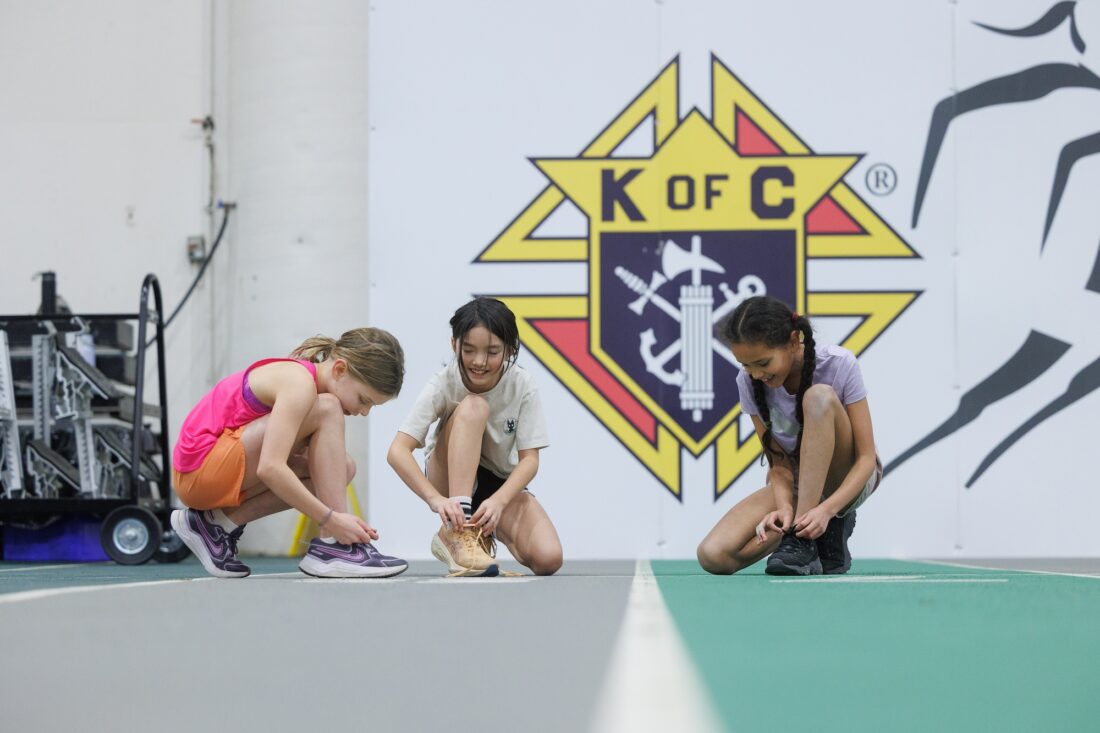
Inside one of Saskatchewan’s longest-running sporting traditions and the generations it continues to bring together.
January evenings in Saskatoon are usually cold and quiet, but the Saskatoon Field House was anything but during the Saskatchewan Indoor Games. Over several days, the venue hosted elementary school relay teams, high school and collegiate athletes and international competitors, all sharing the same track in one of the province’s longest-running sporting traditions.
Marking its 59th year, the Knights of Columbus Saskatchewan Indoor Games brought together more than 1,600 elementary students, hundreds of student-athletes and over 600 amateur and international competitors from across Canada and beyond. Intercity relays kicked off the event, followed by high-level competition in events ranging from sprints and hurdles to throws and jumps. The format, which blends youth and elite competition in the same meet, has become the defining feature of the Games and a major reason for their longevity.
For Gil Wist, president of the Games’ planning committee, that mix is intentional. A University of Saskatchewan graduate and retired teacher, Wist has been involved with the Knights of Columbus for over 15 years and has chaired the Games for nearly a decade. He says the event has endured because of a consistent focus on youth. “I think just the basic principle of working with people, working with our youth, and that’s the main reason why we got involved is because of the youth,” Wist said. “And adding in the international aspect has been able to combine youth and the elite athletes, and that principle has always worked all over the years.
The Saskatchewan Indoor Games began in 1985 and have run continuously ever since. Over the decades, the scale has grown, but the core philosophy has stayed the same: create a space where young athletes can compete, feel supported and see what is possible. Elementary students race in packed relays early in the event, often with family members filling the stands, while elite athletes prepare just meters away. For many students, it is their first exposure to a large-scale sporting event, and the experience can be formative.
Wist said the impact of the Games is most visible in the atmosphere created by the elementary relay events. “It’s just the atmosphere there on Thursday night,” he said. “Minus 35 outside, and let me tell you, it was plus 35 inside. The atmosphere was just electric.”
He explained that the evening cycles through age groups, beginning with the under-13 categories. “You’re talking 10, 11, 12-year-old students that are here,” Wist said. “The whole night, the place is full, and the noise level in there is just … very high, and that’s because of the energy level.”
That energy, he noted, is reinforced by the relay format itself. “Because it’s relays, they’re there with their teammates, and they’re cheering each other on and patting each other on the back and working together,” Wist said. “That stays with them.” Many students, he added, carry that experience forward by joining school teams or local track clubs.
This year’s event also featured an international invitational meet, bringing world-class athletes to Saskatoon. Among them was Canadian shot putter Sarah Mitton, the reigning world indoor champion, who won the women’s shot put with a 20.22-metre throw; a feat which organizers noted placed her as the #1 shot put performance in the world at the time of the meet. Another was Nigerian sprinter Usheoritse Itsekiri, who took first in the men’s 60-metre dash with a time of 6.69 seconds, narrowly edging out Canadian Eliezer Adjibi.
For Wist, the significance of having elite athletes present goes beyond results. One moment from this year’s Games stood out in particular. After Mitton’s shot put victory, the announcer attempted to bring her over for an interview, but the scene unfolded differently. “He couldn’t get near her because there [were] so many kids gathered around her and chatting with her,” Wist recalls. “She was signing autographs, and the interview just never happened.” The interaction, he suggested, reflected one of the Games’ most valuable qualities: elite athletes becoming directly accessible to younger participants.
Another moment that stayed with Wist came during the elementary relays. While announcing a race, he noticed a runner far behind the rest of the field, a young boy with Down syndrome, completing his leg well after the others had finished. The crowd’s reaction grew as he approached the line. “The crowd notices, and they start clapping, and it gets louder and louder and louder as he makes his way to the finish line,” Wist recalled. For Wist, it was a reminder that the Games are not only about competition, but about inclusion and shared experience.
The Saskatchewan Indoor Games are one of the few events in Canada that successfully blend elementary, secondary, post-secondary and international competition at this scale. That structure also brings tangible benefits to the city. Athletes, families and volunteers travel from across the province, filling hotels and restaurants over the course of the weekend. “It gives us in the track and field world a name [and]… it’s helping our businesses as well.”
Behind the scenes, the Games rely on a substantial volunteer base, largely composed of members of the Knights of Columbus. More than 100 volunteers supported this year’s event, many of whom have been involved for decades. Wist described their presence as one of the most visible features of the meet. “I look out, and I see all of our volunteers, and they’re wearing these red vests,” he said. “You can just look one over here, one up here, one over here, and they’re involved.” Volunteers travel from councils across Saskatchewan, including Regina and Prince
Albert, and assist with everything from event operations to athlete coordination. Without that support, Wist emphasized, staging the Games would be extremely difficult.
As the event approaches its 60th anniversary, Wist acknowledged a growing challenge. “We’re coming up to year 60 … our organizing committee is getting older,” he said. “We need to start bringing in some new, younger people to keep it going.” Despite that reality, he remains optimistic about the Games’ future, pointing to their long-standing impact on athletes, the city and the broader track and field community.
For the athletes who return year after year, the Field House becomes a familiar space. Some of the elementary students who once ran relays now compete in high school events. A few eventually find themselves racing in the invitational meet, lining up alongside the same elite athletes they once watched from the stands. That continuity, Wist says, is part of the event’s quiet success.
As the final races conclude and the Field House begins to empty, the impact of the Saskatchewan Indoor Games is not measured solely in medals or times. It’s found in the confidence of a young runner finishing their first race, the pride of a volunteer who has given decades to the event, and the shared experience of thousands of people brought together by sport.
For nearly six decades, the Saskatchewan Indoor Games have shown that track and field can be more than competition. It can be a place where generations meet, where role models are close enough to shake hands with, and where young athletes learn, sometimes for the first time, that they belong on the track.

Leave a Reply