
THE UNIVERSITY OF SASKATCHEWAN’S MAIN CAMPUS IS SITUATED ON TREATY 6 TERRITORY AND THE HOMELAND OF THE MÉTIS.
THE UNIVERSITY OF SASKATCHEWAN’S MAIN CAMPUS IS SITUATED ON TREATY 6 TERRITORY AND THE HOMELAND OF THE MÉTIS.
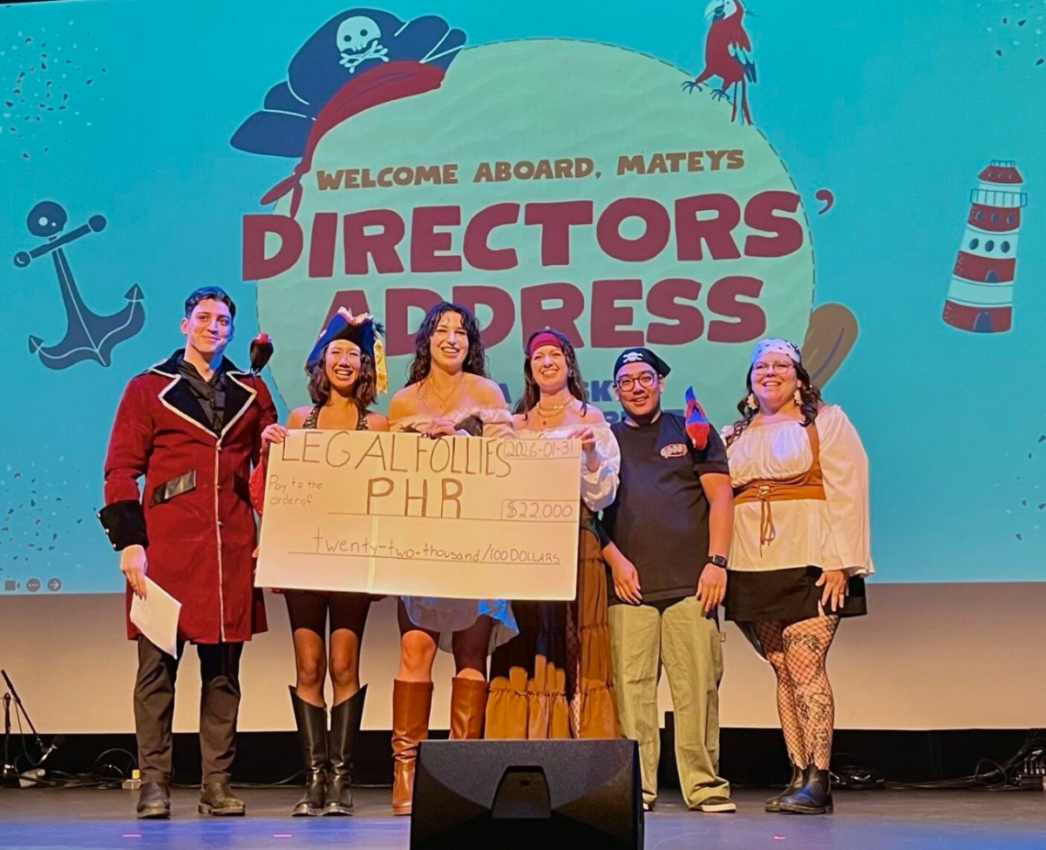
The 57th annual Legal Follies transformed the Broadway Theatre into a celebration of student talent, tradition and $22,000 in charitable impact.
The lights were dim, and the crowd buzzed with excitement. It was time for the 57th annual return of Legal Follies on Jan. 30 and 31, one of the most anticipated events at the University of Saskatchewan College of Law. The Broadway Theatre had been transformed into a pirate-themed atmosphere, where law students would showcase their creativity, laugh at each other’s antics and simultaneously raise money for charity.
This talent show composed entirely of law students was a celebration of community, compassion and purpose. Legal Follies raised a total of $22,000 for Prairie Harm Reduction, a Saskatoon nonprofit that provides harm reduction services, housing support and community-based care for individuals and families affected by substance use.
“[Legal Follies] brings students together for a fun night of entertainment, featuring performances by our school band, The Dissent, along with stand-up comedy and dance performances, all while raising funds for a good cause,” said second-year law student Tadjana Dela Cruz. “The event highlights our college’s strong sense of community and the students’ commitment to giving back.”
Although what unfolded on stage appeared effortless, Legal Follies was months in the making. A law student-production team composed of directors, committee chairs and volunteers navigated the logistics of putting on this show. In the meantime, other law students were squeezing in rehearsals between their academic commitments. It is because of all these students’ time, hard work and passion that this year’s show was as remarkable as it was. Dare I say, surpassing last year’s diligent efforts.
The two directors, or should I say captains, of the Legal Follies 2026 voyage were none other than Jetta Bilsky and Taylor Ernst, who are both in their final year of law school.
“Directing a show that has been running for 57 years carries a different kind of weight,” Bilsky reflected. “In the planning stages, it felt less like creating something from scratch and more like stepping into a long-standing tradition and asking, how do we honour this while making it our own?”
As Ernst described it, the journey involved “a lot of hours, late-night text messages and emails, making mistakes and fixing them and questions.” Yet beneath all of this was something deeply personal.
“Follies does not run on obligation. It runs on commitment, creativity and people choosing to give their time in the middle of an already overwhelming semester,” Bilsky shared.
She described watching law students from all three years collaborate as one of the most powerful aspects of the process, noting that “Follies becomes a bridge between classes. It reminds us that we are part of something larger than our individual year or our individual workload.”
For Ernst, the experience was equally sentimental. “Follies is my favourite event of the year, so being able to put this event together and help the first years and second years make some of the incredible memories I made over the last few years is really special,” she said.
Directing this tradition of fun also meant facilitating care throughout. “Creating a safe space means checking in with people, making sure humour never crosses a line and ensuring everyone feels respected on stage,” Bilsky noted.
With the directors carrying the legacy of Legal Follies forward, the Publicity Committee ensured people knew it was coming, and it was clear that the energy started long before opening night.
Alyssa Abrametz, now in her third year of law school and her third year on the Publicity Committee, has watched that excitement build year after year. “Every year, the Publicity Committee’s goal is to spread the word about Legal Follies and encourage students to buy tickets,” she explained.
The day before Legal Follies, while performers ran through dress rehearsal, the Publicity Committee transformed the Broadway Theatre with balloons and decorations.
As the head of the Publicity Committee this year, Abrametz designed posters for social media to help spread the word. However, according to her, the most effective marketing strategy was far less technical.
“I think that word of mouth is really key for this,” Abrametz said. “In first year, I remember hearing that Legal Follies is one of the best events of the year. I think that the first years get excited for the show when they see how excited the upper years are for it.”
While the momentum was being built, the Finance Committee ensured that the momentum sustained itself into meaningful impact. Third-year law student Frank Chou, serving his second year as the finance chair, oversaw the financial aspects of sponsorships and donations.
“Some of the things that go into budgeting for a show like Follies include reaching out to law firms for donations and to the College of Law and the Law Students’ Association for funding to help offset theatre rental expenses,” Chou explained.
All organizational and law firm donations go directly to the chosen charity, making ticket sales very critical. “The only way for us to cover the cost of theatre rental, insurance, decorations and students’ act reimbursements is through ticket sales,” he said. Once expenses are covered, the remaining funds are donated.
However, there was additional pressure this year. The theatre rental costs rose by more than $1,000, and funding from the Law Students’ Association was reduced due to budget constraints. At one point, increasing ticket prices was considered.
“Increasing the ticket price by $2.50 could potentially generate an additional couple of hundred dollars in donations. But it might also [have led] to a drop in attendance due to the increase,” Chou said.
The decision was made to keep the ticket prices the same, and it paid off. Ticket sales reached an all-time high, with 63 more tickets sold than last year, according to Chou.
Increased ticket sales carry the show only so far. Once the theatre was full and the show began, a different kind of choreography took over. Since it was done right, the audience never got to see fully how much goes into putting on the show.
Second-year law students Janay Kent and Reece Santos co-chaired the Backstage Committee this year, splitting the role after Santos witnessed firsthand “just how many moving parts there are to making this show happen on show day.”
Santos oversaw the visuals and background for the show, while Kent managed coordination of the acts, props and equipment and ran the show from behind the scenes.
“It takes a lot of coordination, clear communication and people who are willing to adapt quickly,” Kent explained. There may be rehearsals and cue sheets in place, but as she noted, “you also have to be ready for that plan to change at any moment.”
For Santos, the work extended into the digital realm. He spent roughly 30 hours building the on-screen presentation, including timing cues, music, videos and effects. His dedication extended with last minute requests to alter the presentation, and he was always happy to oblige.
Santos emphasized that the effort put into the show was not just from him and Kent. He offered special recognition to fellow volunteers Jacey Mitchell, Austin Wipp and Jordan Abustan for their contributions behind the scenes as well.
Much of the backstage work is invisible by design. “A lot of issues get fixed before anyone even knows there was a problem,” Kent said.
Backstage success is measured by what the audience never sees, and that quiet satisfaction runs deeply.
“It’s really rewarding to watch the show come together and know you played a role in making it happen. You don’t get the applause, but you get to see everything working because of the effort backstage,” Kent reflected when asked what the most rewarding part was of being backstage instead of on stage.
“I played hockey my entire life, and for a long time I understood that the spotlight is only so big,” Santos reflected when asked the same. “I like to let the diamonds shine, but I’m there to aim the light.”
In many ways, being backstage embodies the spirit of Legal Follies itself. Students balancing demanding coursework still carve out time to contribute to something larger than themselves.
By the time opening night arrived, the logistics were secured, the theatre transformed and the finances were sorted. The groundwork had been laid, and it was time for the stage to come alive.
Guiding the audience through two nights of pirate-themed chaos were hosts Adi Faigelman and Amy Constant. One of them was a seasoned Follies veteran, while the other was stepping into the tradition for the first time. Long before opening night, preparation was already underway.
“We do practice a lot,” Faigelman explained, noting that the two had been exchanging ideas and editing scripts for months leading up to the dress rehearsal.
Crafting the tone required intentional thought, particularly when considering two very different audiences.
“We had to have two different scripts, one for the parents’ night and one for the student night,” Faigelman shared. The challenge was being appropriately funny, but he also worried about simply not being funny. It is safe to say that Faigelman had nothing to worry about in this regard.
Balancing inside jokes for students with broader humour for faculty and families meant constantly recalibrating. The flexibility to adjust and adapt on the spot according to how the audience was reacting proved essential. On the second night, Faigelman shared that nerves led to a few skipped lines and spontaneous improvisations.
“I would need to recover and get to the next cue,” Faigelman reflected. However, it was those moments that often became opportunities, especially when unexpected events during acts created space for even sharper remarks made by the hosts.
“It felt great to get good reactions to my jokes,” Faigelman said. “I was worried they were only funny to me and [Constant], so to know that others liked them is very validating.”
Beyond the punchlines, what lingered most was the energy in the room. When asked about the one memory that will stick with him, Faigelman went on to say, “[It will have to be] just the joy I got from seeing the work of everyone reflected in cheers from the crowd.”
Although it was Faigelman’s first Legal Follies, his charisma and stage presence allowed him to excel as one of the hosts. It is clear that he and Constant put a lot of effort into their roles, since the theatre was erupting with continuous laughter. This duo’s natural banter elevated the entire performance.
While the hosts heightened the energy in the theatre, those in the acts were a seamless extension of the atmosphere.
Among them was first-year law student Danielle Skinner, who brought something entirely new to the stage with her baton twirling.
Skinner’s act blended one-baton, two-baton and three-baton techniques with dance and acrobatics, including aerial tosses and contact work that demanded both precision and athleticism.
Rather than starting from scratch, Skinner leaned into years of training and muscle memory. “This is my final year of competitive baton twirling, so a lot of the preparation came from years of training and muscle memory,” she explained.
Her biggest challenge was the space on stage. Baton twirling is highly dependent on ceiling height and spatial awareness. “I usually train in a gym with high ceilings,” she noted, acknowledging that she was prepared to adapt her performance to whatever the Broadway Theatre allowed.
From the moment her routine began, it was clear the risk paid off.
“I feel really proud of how it went. Everything came together the way I hoped it would, and the crowd’s energy was even better than I expected,” Skinner reflected afterward.
For Skinner, performing something she genuinely loved and feeling that appreciation reflected at her was joyous. “Feeling the audience respond to the routine, especially through cheers and applause, made the experience even more exciting and enjoyable.”
If Legal Follies is about challenging expectations, Skinner’s act did exactly that. She hoped the audience would see baton twirling as “unique, exciting and captivating.”
As the opening act of the event, her impressive antics set the bar, or should I say baton, high for what was to come after.
Next up was the Law Games dance, which leaned fully into collective energy.
Choreographed by second-year law student Jordan Kucharski, the Wild West–themed routine first debuted at Law Games in Quebec City earlier this term. Although she had known since last spring that she would be leading the dance, the assigned era was not revealed until mid-November, which was leading up to finals.
Balancing choreography with exam preparation, Kucharski dedicated 20-30 hours to finalizing music, formations and instructional videos in the week leading up to the trip.
In Quebec, rehearsals were squeezed between competitive events and social obligations, often in tight hotel spaces. A fun little routine ended up becoming a stressful experience for everyone involved, according to Kucharski.
However, Legal Follies allowed for a different experience.
“Actually having the time and space to work on it this time has been a game changer,” Kucharski said.
Everyone was able to have a lot more fun and was more confident. “The energy from our group coming off stage at Follies versus at Law Games was really the best feeling,” she reflected when asked about how she felt the performance went.
The whole point of the Law Games dance number was never about achieving perfection. “It’s not meant to be serious, it’s not meant to be technical, my goal in putting it together really was just that it would be fun and enjoyable to watch!”
It was clear that the students on stage dancing away in their western-inspired routine emulated the spirit of Legal Follies, and it was just as fun watching them showcase that.
With the choreography cleared and the music faded, the gears shifted into a comedic routine.
Third-year law student Brandon Johnson took on that challenge with a ten-minute solo standup set titled What Would You Do? Built around a true and deliberately uncomfortable story, the act invited the audience into a scenario where timing, restraint and silence were as important as the punchlines.
Johnson had been working on the material since shortly after Halloween, treating it with the same discipline as moot preparation. Originally far longer, the set was cut nearly in half only weeks before the show.
It was clear from Johnson’s performance how diligent he must have been with the preparation of his routine, from writing it out to memorizing it in its entirety. However, when it comes to live comedy, it is never as static as simply publicly speaking.
“Friday and Saturday felt like two different shows,” Johnson reflected when asked about how he felt his routine went. “Saturday had a louder, high-energy crowd, which is part of the spirit of Follies, but it also highlighted how vulnerable standup can be. It didn’t go exactly as planned, but I’m proud of the risk and the experience.”
Throughout the set, frequent heckling and interruptions shifted the rhythm of the room, transforming what had been carefully timed pauses into moments of unpredictability. Rather than retreating, Johnson leaned into the challenge. He had rehearsed under deliberately distracting conditions, preparing himself to respond or adjust when needed.
In that sense, the interruptions became part of the performance itself. It showcased how standup is uniquely exposed, dependent not only on preparation but on audience dynamics.
Looking back, Johnson was candid about the learning curve. “Next time, I would write for laughs before cleverness,” he said.
Perhaps it was that vulnerability that made the set unforgettable.
The energy rose once again, but this time it was due to this next act’s rhythm. Second-year law student Veronica Goyeneche took the stage alongside her student-not-actually-in-law dance partner with a high-energy salsa performance that immediately shifted the atmosphere. Fast-paced, joyful and fearless, the routine blended sharp technique with competition-style tricks that kept the audience fully engaged.
Salsa, Goyeneche explained, felt like the natural choice. “It’s fast, upbeat and full of energy, and I wanted the audience to feel that,” she shared. “I also wanted it to look like we are having fun on stage, because that’s honestly how I feel whenever I dance salsa.”
Although neither performer grew up formally training in the style, their shared enthusiasm and chemistry translated into a routine that felt polished and intentional.
As working students, rehearsal time was limited and often improvised. Without consistent access to mirrors or studio space, they relied on repetition, recording themselves and constant communication.
Even so, Goyeneche described the process as smoother than expected, crediting her partner’s ability to understand and build on her vision. Their preparation paid off as it was one of the fan-favourites within the event.
“I was surprised I could still hit the tricks the way I did, especially with how nervous I felt,” she reflected afterward. “I kind of surprised myself, which I’ll take as a win.”
However, the most memorable moment for Goyeneche was hearing her friends cheer her on. “My friend Kayla [Gardiner] came both Friday and Saturday, she was screaming both nights, by the way, and honestly, I still can’t believe she can be that loud. I was really nervous going into it, but the support was definitely louder than my nerves.”
What Legal Follies does best is transforming nerves into joy and effort into shared celebration, which Goyeneche contributed to significantly.
If the salsa set the theatre alight, the next performance invited it to slow down.
In her self-described “Year 8” as the career development director at the College of Law, Shari Thompson returned to the Follies stage with a heartfelt rendition of “Gravity” by Sarah McLachlan.
Each year, Thompson and a close friend make a tradition of attending a concert together and choosing a song that resonates deeply enough to carry onto the Follies stage. This year, it was “Gravity”. This is a song that explores the evolving relationship between a mother and daughter, as distance and independence grow when the daughter heads off to university.
Preparation looked different from many of the other acts. Much of her rehearsal happened alone, in her vehicle, singing along during daily commutes to work.
She later connected with USask Law alumnus Joel Seaman to accompany her on guitar, adjusting her ear from piano, which is her musical background, to a different instrumental foundation.
With work responsibilities intensifying during recruit season and Career Forum, time was limited, but Thomson stayed intentional in her preparation. That intention translated into a stage presence that the audience could not look away from.
As Thompson sang under the bright lights, unable to see the audience, the energy shifted into a connection with the crowd. On Saturday night, phones lit the theatre as audience members swayed along with their flashlights raised. This small but powerful gesture was a testament to the inclusive atmosphere Thompson’s singing had created.
As the final notes of “Gravity” faded, the tempo shifted once again.
Second-year law student Kaelan Leslie took the stage in a very different fashion, this time bringing Scottish Highland dance to the Broadway Theatre. She performed to “Shut Up and Dance” by the Red Hot Chilli Pipers, blending classical technique with a modern and energetic twist.
Highland dance is often associated with a strict tradition that an older audience may appreciate more. However, Leslie chose music that felt both rooted and accessible, allowing the audience to recognize the melody while still appreciating the precision of the choreography.
Dance is not simply a hobby for Leslie. She trains and teaches regularly, balancing practices between Calgary and Saskatoon while completing law school. “Dance keeps me sane, active and grounded,” she shared when asked how she manages this with the rest of her responsibilities. Bringing Highland dance to Follies was less about trying something new and more about sharing something that has always been a part of her identity.
Unlike some acts that required weeks of restructuring, Leslie approached the performance with quiet confidence. Having competed across Canada and in Scotland over the summer, she trusted her preparation. The first full run of the routine took place under the Follies spotlight, and it was effortless.
Afterward, she described the experience simply and sincerely. “I absolutely adored performing at Follies; it felt like a huge success.” Performing for classmates and professors added a layer of excitement, and she noted how special it feels when someone in the audience has a personal connection to Highland dance or piping.
More than anything, her hope was that fellow students would see that it is possible to carry personal passions alongside the demands of law school. Leslie’s impressive performance was a reminder that one’s identity must continue even in academic pursuits.
In the follow-up act, third-year law students Abrametz and Alkida Luca brought humour to the evolution of law school style in their act, Motion to Slay. The performance traced the transformation many students know all too well. First-year students arrive bright and polished. By second year, sleep takes priority over presentation. By third year, comfort wins. Those who are headed to big law have oversized suits as their inevitable appearance.
The concept was born from brainstorming sessions between Abrametz and Luca, who worked together to shape both the script and the overall tone. The act also relied heavily on their classmates. Friends were recruited to model each stage of law school fashion, and according to Abrametz, they “excitedly did.”
What made the act particularly engaging was the creative freedom given to participants. “We let them have creative freedom for their outfits, and they did amazing,” Abrametz shared. That individuality translated into an act that felt both relatable and playful.
After the show, Abrametz reflected that the act “went even better than planned” and credited the group for fully bringing the idea to life.
More than anything, the duo hoped the audience would see themselves in the parody and leave with a few laughs about the different stages of law school.
Right before the intermission, there was one more act that is one of the staples of Legal Follies, and it is the Ladies’ Kickline.
Now a longstanding tradition within the College of Law, the Ladies’ Kickline brings together women from all three years, along with faculty, to close the night with confidence and energy. This year’s routine followed a familiar formula. A themed opening set to Britney Spears transitioned into the signature kickline finale set to AC/DC, blending nostalgia with bold choreography.
Second-year law student and co-organizer of the Ladies’ Kickline, Skyler Gagne, described the preparation as a collective effort supported heavily by alumna Jordyn Nachtegaele, who returned to choreograph the routine. “She choreographs all of the numbers, posts videos of the choreography for the group to review and teaches us the numbers at practice,” she explained.
Practices were held on Sundays, and although the timeline was tight due to Legal Follies being scheduled earlier this year, the group remained focused on building confidence and cohesion.
The other biggest challenge, besides the limited time to rehearse, was ensuring that everyone felt comfortable. “I know the choreo is outside a few of the girls’ comfort zone, so making sure they’re actually having fun and feel okay with what they’re doing is really so important,” said Kucharski, who also helped organize the Ladies’ Kickline, in addition to her Wild West number.
This required discipline and trust within the process. The performance the ladies put on was watched in awe by the audience, making Gagne and Kucharski’s challenges worth the hassle.
“I feel great about it. We had so much fun, and I received so many compliments from the audience and other acts about how we did,” Kucharski reflected afterward.
Friday night brought strong reactions, but Saturday exceeded expectations. “The best part of doing kickline is the reaction from the crowd. Friday night was great, but Saturday was next level,” she shared.
At one point, the cheering grew so loud that Kucharski nearly missed her cue returning to the stage because she could not hear the music.
A standout moment came when Professor Jamesy Patrick made a surprise appearance, drawing what Kucharski described as an “absolutely insane” reaction from the crowd. By the end of Saturday’s show, the audience rose to their feet in a standing ovation.
Beyond the choreography, what makes the Ladies Kickline special is the community it fosters. “Kickline is such an incredible opportunity to get to know girls from the college I previously may not have interacted with much,” Kucharski reflected.
For many who grew up dancing competitively, it offers a chance to return to something that once defined them. “It feels so amazing to get the opportunity to dance again,” she added.
The intermission was followed by one of the more recent traditions at Legal Follies: the Dating Game, a College of Law parody act that blends improv, inside jokes within the College and just enough chaos to keep the audience involved.
The act was created last year by Bilsky, who drew inspiration from a dating game segment she saw on RuPaul’s Drag Race Allstars. “I just thought it was hilarious,” Bilsky explained. “Mainly, I just copied what the dating game show actually looks like and recreated it. I basically just did it again this year.”
This year’s concept expanded into two versions. On Friday, Bilsky hosted the bachelor edition, and on Saturday, she became the bachelorette, while second-year law student Tyler Slaney took over as host.
The format followed the familiar dating game structure. Three mystery contestants answered questions in three rounds, hoping their responses would win the bachelor’s or bachelorette’s final pick.
Both Bilsky and Slaney emphasized that what looked effortless on stage required significant planning behind the scenes. Bilsky said most of her work for Friday night involved “recruiting people to partake, writing the questions and the scripts, vetting the contestant answers, and then making and finding the props.”
Slaney similarly described “a lot of writing and planning” for Saturday night. This included “writing the questions [Bilsky] will ask her suitors, writing my own script as the host, planning out my cupid costume.”
Slaney noted that casting was unexpectedly difficult. “Sometimes a prime bachelor suddenly stops being a bachelor and has to be replaced,” he said, adding that the lineup shifted more than once.
Although much work went into this segment, it was the unpredictability that became part of the appeal when watching.
For Bilsky, the highlight was the audience itself. “The best part was how responsive the audience was. You could feel when something landed,” she said
Slaney described Saturday’s crowd as equally intense. “The crowd was so overwhelmingly engaged, shouting support for specific bachelors and slandering others, laughing and shouting and booing at the top of their lungs,” he recalled.
In his view, the engagement was immediate. “The crowd was thunderous, erupting from the first moment I introduced our LSA president, Jetta Bilsky, as the bachelorette,” he said.
For Slaney, part of the fun was building small theatrical details around the script. He noted that dressing as Cupid and adding “the Secret Service” to keep the bachelors in check helped elevate the act.
In a show defined by surprise, The Dating Game worked because it invited the audience into the joke. It was unique since the answers were not rehearsed, and the outcome was decided in the moment. It made the entire theatre part of the act, which is a tradition that deserves to carry on for years to come.
Another returning act brought precision back to the Legal Follies stage.
Third-year law student Jill Klassen performed alongside her dance partner and fellow third-year law classmate Laura Chartier in a choreographed routine that incorporated chairs as props. The piece, which they began preparing in October, was built on their previous dance training and a shared creative vision.
Starting early allowed them to balance rehearsals with exams, holidays and the demands of the school year without feeling rushed. The rehearsal process, Klassen said, is always one of the best parts. “[Chartier] and I get along really well, so I always look forward to getting to create and dance with her,” she shared.
Incorporating chairs into the choreography added complexity and, at times, unintended humour. “Using a chair as a prop can be dangerous at times, and we’ve definitely ended up with some funny moments and even some bruises,” she admitted
Despite the time management challenges that come with rehearsing between classes and assignments, the performance itself exceeded expectations. “I feel amazing about the performance. Everything went better than we could have planned,” Klassen reflected.
As with many acts, audience reaction made the moment. “The audience reactions are always the best part about being on stage. I can always hear my friends cheering us on, and that makes the performance so much more fun,” she said.
For Klassen, Legal Follies continues to live up to expectations year after year. “It’s such a fun experience, and I would highly encourage any law student to perform during their time in law school. The support you get from your peers is unmatched,” she shared.
In addition to directing this year’s production, Ernst stepped into the spotlight herself.
Ernst performed “Make You Feel My Love,” a song she chose for deeply personal reasons. With over twenty years of performance experience, including international appearances and nightly shows at the Calgary Stampede’s Grandstand, singing is something she once did on a much larger stage before stepping away at the start of law school.
Legal Follies became an opportunity to return to that part of herself.
“My friends had never heard me sing before,” she explained, noting that they had been asking since her first year in law school.
The song selection was intentional. It is her parents’ favourite, and performing it was her way of acknowledging their encouragement and support throughout her life.
When Ernst stepped on that stage, it was evident why her friends had been asking her to sing for the last three years. Her singing blew the crowd away as they watched in awe. After her mesmerizing performance, the audience erupted in applause.
One of Ernst’s favourite moments came when the audience began singing along. “It always makes me happy to know that people are connecting to the song and enjoying themselves,” she reflected.
As both a director and performer, this year carried added weight. “This was a very cathartic experience, and I am so glad that I performed,” she shared, describing it as her final Follies before graduation.
She noted that this year felt like a compilation of her many Follies memories and a reminder of her desire to ensure that future classes have the same opportunity to create meaningful experiences of their own.
For Ernst, the performance was a full-circle moment. For others, her performance was one of the most moving moments of the event.
There are acts at Legal Follies, and then there are the Hallmeyers, who were next up.
Selected in secrecy and revealed only when the time is right, the Hallmeyers remain one of the College’s most elusive traditions. Three students from each year are quietly recruited and sworn into a brotherhood defined by spectacle and just enough risk to keep the audience entertained while holding its breath.
Once again, despite rumour and speculation, the details of their initiation remained tightly guarded. Perhaps next year will bring better luck for those attempting to uncover it.
Preparation begins long before the stage lights warm the theatre. Recruitment, Slaney explained, is “both a science and an art.” It is not about technical perfection. It is about finding people willing to “be the butt of their own joke in front of a sold-out theatre and keep charm and parody at the forefront of our performance.”
When asked about any pre-show rituals the group may partake in, Slaney remained deliberately ominous. One might assume that, as this year’s Hallmeyers captain, he would have the authority to reveal at least a few secrets.
“I truly wish that I could share with the world all the fun, secretive, pre-show antics in which the Hallmeyers indulge,” he admitted. “The unfortunate reality is that if I divulged to the media any of our guarded traditions, the name of our favourite bar where we have our meetings or even the brand of coconut oil we slather all over each other, the others would have my head.”
The mythology, it seems, is carefully preserved.
Rehearsals began in September and ran three times a week, condensed further by the earlier Follies schedule this year. With the help of returning alumni and countless hours of practice, the group rose to the occasion.
When asked to describe the act in three words, Slaney chose “absurd, hilarious [and] electric.” Judging by the reaction in the theatre, the performance delivered on each.
Despite the spectacle, Slaney hoped the audience would not take them too seriously and would recognize that they do not take themselves too seriously either. Their humour lay in parody. “We’re what if Chippendales [were] nine average dudes trying their best,” he said.
“The Hallmeyers borrow and embrace dance styles that are deeply connected to movements across culture, including drag, burlesque, go-go and cab. We hope that the crowd sees what we do as embracing those styles and letting you laugh at just how short we can fall when we boldly try to bridge the gap between us and the pros through the power of friendship and Fireball whiskey.”
If their rituals remain guarded for eternity, that secrecy may be the very thing that keeps the legend alive.
The last act was a staple within Legal Follies, and that is The Dissent.
A resident rock band at the College of Law, The Dissent has become a Follies mainstay for over a decade. Third-year law student Jared Graham, who plays guitar, said he has met former members who played with the band going back to at least 2013, and described it as “something passed down through generations of law students.”
This year’s band included second-year law students Lucas Brown on bass, Jaylyn Kim on piano and Joy Olusanya on vocals. First-year law students in the band were Lauren Hope on vocals, Jackson Perryman on guitar and James Kumaran on drums.
Graham noted that for some members, Follies was familiar, but for others it was their first time performing on that stage. Brown and Kim had played in the band with him last year, while Olusanya, Hope and Kumaran were making their Follies debut. For Perryman, it was an even bigger deal, as it was his first time performing anywhere. Graham said he planned to focus on making him comfortable because Perryman is “super talented,” and he did not want nerves to take over.
“For The Dissent, we started planning back in the summer,” Graham explained.
Auditions ran through September and October, the lineup was chosen in October, and the group began meeting in November to talk through songs and ideas. They paused in December due to finals, then returned in January for rehearsals one to two times per week, often lasting three or four hours.
“Sometimes that meant practices early Sunday mornings, or random Tuesday afternoons,” he said.
Despite the time commitment, Graham described the rehearsal process as genuinely enjoyable. “This is my third year playing with the band, and no shade to any of the previous iterations that I’ve been part of, but I think this is the most talented version I’ve played with,” he said. “We’ve had a lot of moments just being impressed at how fast everyone has fit together.”
On show nights, Graham’s pre-show routine meant arriving early to “scope out the stage,” say hello to the sound and stage crew and visualize the performance. “Make sure I still know how to play everything,” he said. “Nothing too crazy.”
After the weekend, Graham was unequivocal about how it went. The audience reaction, he said, made the experience feel surreal.
“I just loved feeling the love from the crowd. I think for the most part I keep to myself at school, so just hearing people yell my name is kind [of] surreal,” he shared. “Getting that kind of support from my classmates is so surreal, and I’ll be forever grateful.”
Graham also embraced the reality that live performance is never perfect. “Did everything go perfectly? Not at all, but I wouldn’t change a single thing,” he reflected. “I think little mistakes and stuff are part of the beauty of live performance. No two performances are the same, and I think that’s just beautiful.”
For Graham, Follies continues to exceed expectations, especially in a venue like the Broadway Theatre. “Broadway Theatre is such an excellent venue, getting to perform there is an absolute treat,” he said, noting that this was his last year performing at Follies and that the experience has surpassed expectations every year.
A tradition carried forward, year after year, The Dissent is always a wonderful closing act to Legal Follies.
Second-year law student Jayden Blumhagen perhaps captured the broader significance of the night best. “Follies has been one of my favourite parts of being a USask law student, and by far my favourite event. The community of the event and the chance to highlight the unique talents of our classmates is great. I particularly love The Dissent. It’s really great to see how, even though the lineup changes from year to year, the talent remains constant as new musically gifted students step in.”
In many ways, her words echo that Legal Follies consistently proves the spirit remains constant.
Legal Follies would not be possible without the generosity of its sponsors, whose support allows the College of Law to transform a theatre into a space of laughter and purpose year after year. From Platinum to Bronze sponsors, each contribution helped ensure that all designated funds went directly to Prairie Harm Reduction.
This year, that impact totaled $22,000.
For Ernst, the cheque presentation on Saturday night stood out above all else. “We put all of this on for charity, and this year, that charity was Prairie Harm Reduction. In an economy that is very uncertain, it warms my heart to see so many law firms, companies and individuals donating their hard-earned money to support this local non-profit,” she reflected.
Bilsky described the experience as “proud and a little emotional,” noting that raising funds for charity made the entire production feel “bigger than applause or punchlines.”
For her, Follies is a tradition that must be carried forward by each new class.
Gratitude also extends to the Broadway Theatre, whose stage continues to host one of the College’s most beloved traditions. It is also extended to the sound technicians, lighting crew, backstage volunteers and committee members whose work made the event occur smoothly.
Students, professors, alumni, friends and family gathered around for talent and humour. Traditions were preserved, while new memories were made. Thanks to it all, $22,000 will now support life-saving work in Saskatoon.
Legal Follies may be composed of spectacles and satirical acts, but above all, it is a community.
See you all again next year.
Leave a Reply