
THE UNIVERSITY OF SASKATCHEWAN’S MAIN CAMPUS IS SITUATED ON TREATY 6 TERRITORY AND THE HOMELAND OF THE MÉTIS.
THE UNIVERSITY OF SASKATCHEWAN’S MAIN CAMPUS IS SITUATED ON TREATY 6 TERRITORY AND THE HOMELAND OF THE MÉTIS.
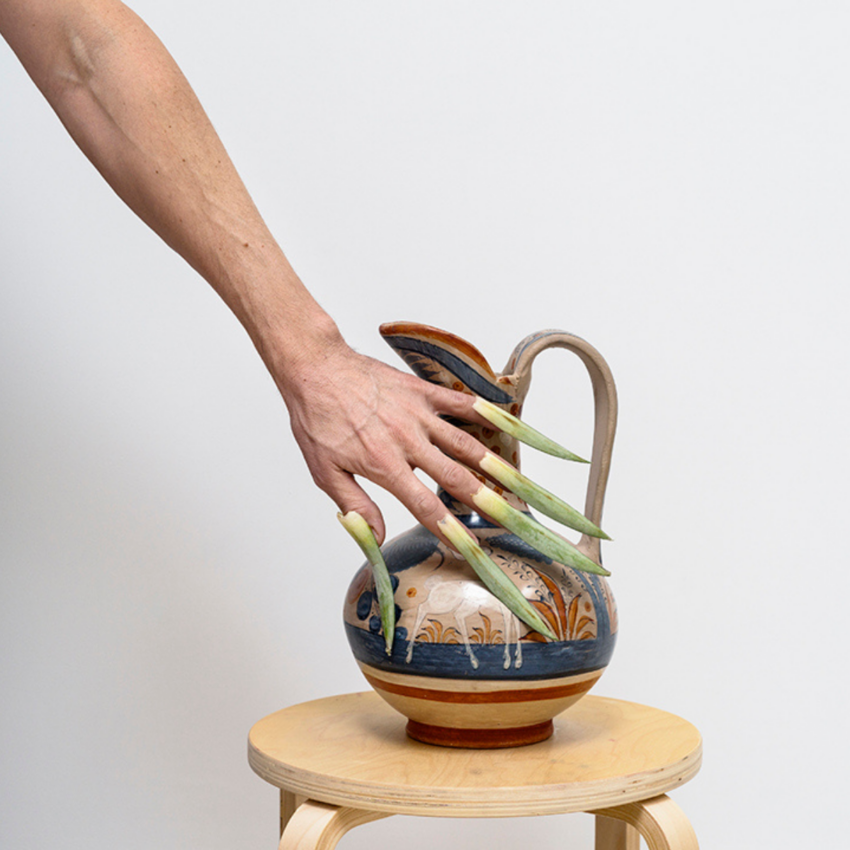
Meera Margaret Singh’s latest exhibition allows audiences to follow family histories through still lifes and physical objects
In What We Hold, now on view at the College Art Gallery at the University of Saskatchewan, Toronto-based artist Meera Margaret Singh turns her attention to the quiet emotional lives of objects. Through a series of photographic still lifes and sculptural arrangements, the exhibition asks a deceptively simple question: what do we carry with us, and why?
The answer, Singh suggests, lies not in grand gestures but in the everyday. Books, shells, rocks, vessels, plants, and inherited keepsakes populate the gallery space, arranged with deliberate care. These objects are drawn largely from the artist’s own family history, yet the exhibition resists autobiography in a narrow sense. Instead, What We Hold treats objects as stand-ins for people and experiences, using material culture to trace relationships shaped by love, loss, migration, and time.
Curated by Noa Bronstein, the exhibition is part of a national tour and arrives in Saskatoon following presentations at institutions including Gallery TPW and Evergreen Cultural Centre. Its placement within a university gallery context feels especially fitting. Singh’s work is deeply informed by research and theory, but its emotional pull is immediate and accessible. Visitors do not need specialized knowledge to recognize the feeling of attachment embedded in a worn book or a carefully kept stone.
Photography plays a central role in the exhibition, though not in the conventional sense of portraiture. In many of Singh’s images, people are absent or only partially visible: a hand enters the frame, an arm reaches toward an object, a body is implied rather than shown. This restraint shifts attention away from individual identity and toward what remains when bodies are no longer present. The photographs become portraits by proxy, suggesting that objects can carry traces of the people who touched, kept, or passed them on.
This idea is reinforced by Singh’s interest in the photograph itself as a material object. Rather than treating photography as a purely visual medium, her work emphasizes tactility and intimacy. The images feel held rather than merely viewed, echoing the exhibition’s broader concern with touch, care, and preservation. In this way, What We Hold aligns with contemporary conversations about how images function as emotional artifacts, not just records of the past.
One of the exhibition’s recurring themes is inheritance, framed not as a legal or financial transaction but as an emotional and ethical one. What do we choose to keep from those who came before us? What responsibilities come with holding these things? Singh does not offer clear answers. Instead, she creates a space where viewers can reflect on their own relationships to inherited objects, family memory, and the weight of personal history.
That reflection is particularly resonant in a cultural moment marked by constant circulation and disposability. In contrast to the speed of digital life, What We Hold insists on slowness. The objects in the gallery bear signs of time: wear, patina, careful repair. They ask to be looked at closely, considered not for their market value or aesthetic perfection but for the stories they quietly contain.
The exhibition also gestures toward intergenerational connection. In one photographic work, Birds of a Feather (2023), Singh and her son hold bird masks to their faces, facing one another rather than the camera. The image suggests play, care, and mutual recognition, while also hinting at how identity is shaped relationally. It is a tender moment that encapsulates much of what the exhibition is doing: exploring how meaning is formed between people, often through shared objects and gestures.
Singh’s background in anthropology and photography, as well as her role as an Associate Professor at OCAD University, informs the intellectual rigor of the work. Yet What We Hold never feels didactic. Its power lies in its restraint. The exhibition trusts viewers to bring their own experiences into the space, to recognize themselves in the quiet accumulation of things.
Trinkets occupy a quiet but crucial role in What We Hold. Small, often overlooked, they sit at the intersection of intimacy and history. Anthropologically, trinkets have always mattered: amulets buried with the dead, beads traded across continents, charms carried for luck or protection. These objects rarely survive because of their material value. They survive because someone decided they were worth keeping. Singh’s attention to modest, personal items places her work squarely within this long human tradition, where meaning is embedded not in grandeur but in repetition, care, and touch.
From an anthropological perspective, trinkets function as evidence of how people once lived, loved, feared, and hoped. Long after names and faces disappear, small objects remain to suggest patterns of belief and attachment. Singh’s arrangements echo this logic. Her objects feel less like aesthetic choices than artifacts — fragments of lived systems of value. They imply that human history is not only written through monuments and archives, but through what individuals choose to tuck away in drawers, pockets, and shelves.
Seen through this lens, What We Hold quietly invites a comparison with the present moment. Today’s trinkets look different, but the impulse remains the same. Collectible figurines like Labubus or Sonny Angels — whimsical, mass-produced, and deeply personal — circulate widely, traded and displayed with care. They are often dismissed as frivolous or childish, yet their popularity suggests something more enduring: a desire for comfort, identity, and belonging in object form. Like the shells, stones, and keepsakes in Singh’s work, these contemporary objects are held close not because they are rare, but because they feel meaningful.
If history continues far enough — if future artists, archaeologists, or cultural historians sift through the remains of our time — it is not difficult to imagine these figurines resurfacing as clues. A Sonny Angel tucked into a bookshelf, a Labubu carefully preserved in its box, might one day be read as evidence of how people sought softness, play, and companionship in an era defined by speed and precarity. What we now see as trends could later be understood as emotional artifacts, revealing how individuals navigated uncertainty through collecting, displaying, and caring for small objects.
Singh’s work does not romanticize this process, nor does it mock it. Instead, What We Hold situates the act of keeping within a longer human continuum. It suggests that the line between artifact and trinket is always temporary, drawn by time and perspective. What matters is not whether an object was meant to last, but whether it was loved, held, and carried forward.
In this way, the exhibition subtly reframes how we think about material culture today. It asks us to consider which objects might speak for us when we no longer can, and what they might say about the values we lived by. Singh reminds us that history often survives in miniature — in the small, sentimental things that resist disposal. To hold something, the exhibition suggests, is already to imagine a future reader.
At the College Art Gallery, the exhibition unfolds with a sense of openness, allowing objects and images to breathe. Rather than overwhelming the viewer, the installation invites contemplation. The result is a show that lingers long after leaving the gallery, not because it demands attention, but because it mirrors something deeply familiar.
Ultimately, What We Hold is less about objects than about relationships — between people, across generations, and through time. Singh reminds us that the things we keep are never neutral. They carry memory, care, and responsibility. In holding them, we are also held by the histories they contain.
The exhibit will be on display until April 24. Bring your keychains with you.

Leave a Reply