
THE UNIVERSITY OF SASKATCHEWAN’S MAIN CAMPUS IS SITUATED ON TREATY 6 TERRITORY AND THE HOMELAND OF THE MÉTIS.
THE UNIVERSITY OF SASKATCHEWAN’S MAIN CAMPUS IS SITUATED ON TREATY 6 TERRITORY AND THE HOMELAND OF THE MÉTIS.
USSU executives talk roles, achievements and future plans, and address recent online criticisms in an interview meant to get a glimpse of what the union has been up to since being elected.
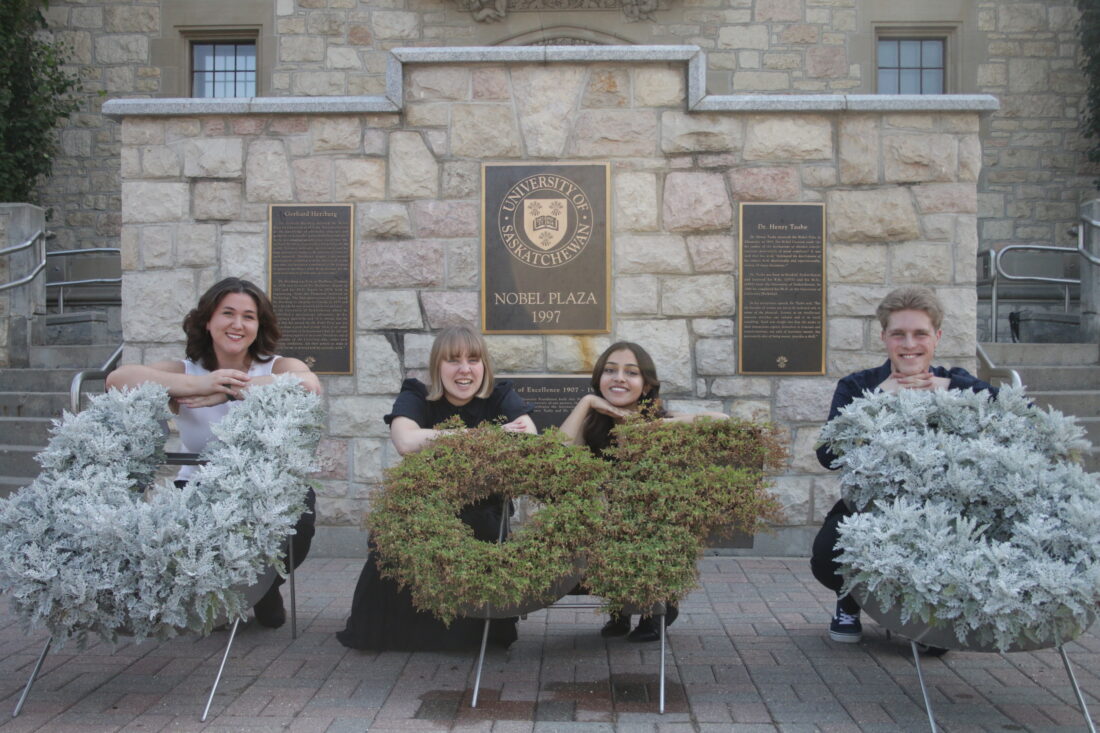
The Sheaf had a chance to catch up with all four executives of the University of Saskatchewan Students’ Union (USSU) at the end of January. The USSU Executive is made up of President Emma Wintermute, who is pursuing a Double Honours degree in Gender, Sexualities and Social Justice Studies and History; Vice-President Operations and Finance Owen Deis, enrolled in an Honours degree in History; Vice-President Academic Affairs Norah Jacob, a Psychology major with a minor in Math; and Vice-President Student Affairs Emily Hubick, who is pursuing a bachelor’s of Biomedical Science, majoring in Cellular, Physiological and Pharmacological Sciences.
An Overview of Executive Roles
When asked about what the union generally does and has been doing since September, Wintermute replied that the president’s role is made up of three main characteristics: “an advocate, a navigator and a support.”
Wintermute explains that “I definitely learned that [navigating the university] is much more complex and entangled when I started this job than I anticipated, and supporting not only students through that navigation, [but other executives] in that navigation, and then as an advocate because there are a lot of things that fall through the cracks at the university that people become desensitized or accustomed to [because] they’re operating in an institution … [It’s] having to continue to help wake people up to say that this is an issue, this is a problem [and] it needs to be addressed, here’s why, [and] let’s work on trying to figure this out. And then that cycle goes over again.”
Hubick’s role as VP of student affairs focuses on fulfilling the non-academic aspect of university life. “A big part of my role is planning events and trying to get [a variety] of events, [like] ones that are specific to international students, or sustainability, accessibility … A lot of my personal role is [also] direct student support.”
Hubick explains that inquiries from students range from “accessibility concerns, to parking, to people wanting to put up posters. So it’s kind of all over the place — and we’ve had a lot of projects and a lot of cases coming up over the year that have been month-long endeavours and then ones that just [require] one email to figure out.”
Jacob explains that her role as VP academic affairs “is all about relationships at three levels. I have relationships with students where I work with them on individual academic grievances and cases. These can be really short — sometimes it can be for a misconduct case … or it can be something a little more long-term like an appeal or something related to expulsion or suspension.”
“Secondarily, I work a lot with the university’s student support staff. That [includes] academic advisors, Student Affairs and Outreach, Student Wellness [and] ISSAC. [Thirdly,] the group that I probably talk to the most is university administration, so this is Vice Provost [Academic], academic deans, anyone in a student-focused administrative role … This is where long-standing policy about learning, teaching, pedagogy can really change as well as policy regarding students.”
Deis says that his job as VP of operations and finance includes a number of different roles. “I oversee all the campus groups, so it’s give or take 170 different groups [ranging from] a handful of people and thousands of people, depending on which college or constituency. I am their first point of support for finances, insurance, advertising, pretty much anything a group can think of … I’m also responsible for our relationship with Saskatoon transit, managing the bus pass [and overseeing] student fees for the USSU and our annual budget.”
Ongoing Projects
One of Wintermute’s main projects this year has been working to update the university’s sexual violence policy. “The Sexual Violence Policy at the University is 10 years out of date, which for a U15 is terrible.” U15 refers to a member university of U15 Canada, a coalition of 15 of Canada’s most prominent research institutions, including USask. “Most U15s comparable to us have a standard where every three to five years they update that policy. They make a point to review it or they are mandated by the provincial government to review [the policy]. We don’t have that mandate here, and our board of governors [has] not taken upon themselves in the last 10 years to review that document.”
When asked about how a sexual violence policy can go so long without being updated, Wintermute said, “That’s the downfall of an institution, is that there [are] a lot of policies, a lot of procedures, a lot of committees and people change positions or roles and then it just gets forgotten. Someone really pioneers it and champions it, and then that person leaves, and then there’s no follow-up built into [the] structure. I would imagine at the university level that’s what happened. Or, which I hope is not the case, could be [that] societally we have these big moments, like #MeToo, and there’s this big brush of support and everyone rallies behind something, and then that stops … I think it’s also an uncomfortable topic for a lot of people and the language has changed a lot over the years, so people just tend to shy away from it, not wanting to mess up. But then, inadvertently, you go 10 years without having the policy updated.”
Another of Wintermute’s goals was to create a closer connection to the Prince Albert campus. “PA students have never had a member of Student Council representing them, despite the fact that they pay our fees and they are University of Saskatchewan students. So we have a counsellor this year for PA [and] we meet regularly with their administrator.”
Alongside updating policy around sexual violence and creating a closer partnership with the PA campus, Wintermute explains that another project she has been working on is having more discussions with USask’s Indigenous students. Wintermute says that the USSU relationship with Indigenous students “[has] been a really fractured relationship … I’m a white girl — so I’m not going to say we’ve made inroads, because I don’t know how people define that for themselves, but I’m happy that we have a functioning Indigenous student advisory committee that meets monthly [and] I meet every month with the Office of the Vice-Provost of Indigenous Engagement … I think that’s been something that I hoped to see some movement on this year, and I have felt really grateful for the kinds of conversations that I’ve been brought into as a result.”
Besides being engaged in policy work at the university level, Hubick explained how the USSU keeps students engaged by hosting a number of events each month. Although attendance for school events was low throughout the pandemic, Hubick notes that the USSU has seen a steady increase in attendance throughout the year. “I think this year I’ve seen a lot [more], not only in the attendance at events, but just in general interactions on campus that just seem like we’re moving closer and closer together and things are getting back to where they used to be in terms of social gatherings and things like that.”
When questioned about how the USSU navigates its relationship with the university, Jacob pointed out that it is a slow and complex process. “A lot of the stuff we do [is] very long-term projects at an academic level. The university moves at a glacial [pace]. It is notoriously a slow process, and anything academically essentially comes from the bottom. It goes through the department, through the college, all the way up to admin, through a committee, through University Council, and it has to come all the way back down … [It’s] recognizing where students fit in that portfolio, and if they don’t fit, creating a space where they are able to work in and a lot of that means changing policy or creating new policy.”
Jacob also notes the inevitable constraint of time that each USSU executive faces. “You’re only here for a year, and in one year, there’s only so much you can do. What I found really important is to make sure … you put it into an agenda that maybe is not going to go through until October 2026, but it’s in there, and somebody will have to look at it.”
Addressing Transparency
When Deis was asked about the longstanding student concern of student fees that fund the USSU, his reply was frank: “I think we’re always going to get that [question] … I don’t have a good answer to getting rid of that challenge, [but] a goal of mine at least is to make students more aware of where their money is going, why it’s needed.”
Jacob adds that “It’s unfortunate that a lot of our work can be behind the scenes, and I do think that’s a fundamental flaw with us that we’re just not able to fully explain what we do. A lot of the stuff is so confidential that I’m not allowed to talk about it … Something I do hope students know is that we are full-time. We [did] try to make an initiative over [the] summer to fully publicize what we were doing every single day of the week … The only reason we didn’t keep it up throughout this year [is because] it’s a bit too spontaneous right now … I could start off the week with five meetings, and then I end up with 25 meetings.”
Wintermute says that “It’s good that students keep engaging and pushing the union, as much as those conversations are always hard to have, they need to be had. For every student that puts forth a question [or] comment about something that pushes the union to do more work. And so I think that push-pull is very important …And I don’t think [we have] ever seen that criticism or push as bad. It’s been more of a fuel to keep going. It can get frustrating when admin pushes you back, or this thing doesn’t happen, or [when] we are one student voice or vote on a committee of 20 other people. And so it can get isolating. I think having students still be engaging and encouraging that we want to see more, [or ask] why does this happen. That pushes us to want to continue to fulfill outcomes for students.”
“[I want] students to know that their concerns matter to us,” Jacob adds. “There was a conversation about two years ago regarding executives’ classes, [and] there was a response to that. Now our classes are publicized [and] our credit units are available on the website for everyone to see. And that’s the same thing here. If there’s anything that students think we can do to make us more transparent to the public, we are absolutely ready to hear that and to make headway on that. We want people to know that their concerns do [get] noticed.”
“I think the four of us have made a real effort to not create this weird kind of barrier that we’re not students,” Wintermute says. “We want to make sure everyone knows we are undergrads. We don’t want there to be this perceived hierarchy … There might be an ivory tower in the terms of the [university] administration, but we definitely don’t want to [make students] feel like we’re in an ivory tower here at the USSU. We’re just students. We’re one of you, paid by you and that means you can ask questions you want [and] hopefully we are able to answer them.”
Elections
Despite there being some vocal critics of the USSU, voter turnout and Annual General Meeting (AGM) attendance in the past few years have not been substantial. Although there were 21,267 undergraduate students enrolled in the 2024/2025 year, only 2,205 students voted in the last USSU election, putting that at a voter turnout of roughly 10 per cent across all colleges.
When asked about how the USSU is working to improve student election turnout, Hubick said that the union was in the process of interviewing for a student elections coordinator. “We had a student [who] would coordinate volunteers and go out around campus and engage with students. We had tables, they were down in the tunnel, out at our meet and greet type event. They were a neutral party to be around campus during that time, encouraging students to vote and get interested in the elections and to make it a lot more accessible and easy.”
The USSU is also looking to get PA students interested in voting, alongside more collaboration between them and the main campus. The executives also explained that there is an effort to get candidates from multiple colleges for more diversity of backgrounds on the USSU executive.
Regarding Recent Criticism of the Boycott, Divestment & Sanctions Post
On Jan. 27, the USSU issued a statement on social media in support of a divestment campaign in solidarity with what the United Nations commission of inquiry has condemned as a genocide of Palestinians by Israel. The decision for posting this letter was made on November 20th of 2025, as a motion at the AGM. The statement received mixed reactions online, with some criticizing the union for not issuing a statement on the recent state crackdowns on protestors in Iran, and others criticizing the union for posting this message on International Holocaust Remembrance Day.
Wintermute explains that “In the header of that letter, you’ll see that it was something that the membership voted on at the AGM for the USSU to author and publish. The reason the letter came out in January and not immediately following the AGM was [because] we have a process that we go through. Following the AGM, it was written and received by the four of us within a week of the AGM, [as] it was definitely a top priority item. And then it goes to the advocacy committee within our student council, [and] I chair that committee. So the advocacy committee, which is composed of a couple student counsellors, take the time to review the letter. And then it was finals season, so we had the break … We came back in January, it was brought to council, council had no problems [and] did not wish to make any edits … It was sent to the Board of Governors and the university [admin], as mandated by that AGM resolution. And then we wanted to make a recap of the AGM … and once that video was made and edited and posted, then we posted the letter. So that was the context behind [it].”
“In terms of the content of that letter,” Wintermute continues, “[it] is a very important statement that needed to be made to the university with everything going on in the world, and it was not in any way an attempt to silence any of the other horrific and violent and genocidal events that are going on in the world.”
The USSU posted a response online the day after the letter was posted, which addressed criticism that the union was favouring one cause over another, writing that “the USSU is committed to amplifying the voices of all students and standing in solidarity with those impacted by the events and violence taking place globally.”
Wintermute says that “We’re never going to only be here for one kind of student or one kind of voice or one kind of perspective. We’re here to represent everyone … I think it’s important for that feedback to come through [and] for students to [say] ‘we don’t feel visible right now and we’re hurting’ … because we need to know that so that we can try to help and correct [that] because we make mistakes too … [and] there will never be a lack of things that we could not be getting on board for, but I think what’s important is that folks know that we are not intentionally being silent about anything, and that was the hope for clarification in that [new] post was to say that we are here. We hear you speaking out. We’re here to support and we don’t want anyone to feel polarized or alienated or isolated and that wasn’t the intent of the letter, and we’re sorry that’s how that felt in terms of everything going on in the world, but we’re not sorry for writing the letter for Palestine, because that was what we, the membership, wanted to see, and that is what we wanted to deliver. And we would write another one for anything else –– if that’s what students want to see, that is our job.”
When asked specifically about whether the date of the letter posted was a coincidence with the International Day of Holocaust Remembrance, the USSU executives confirmed that it was. “It just happened because that’s when our social media coordinator was able to edit the recap video,” Wintermute says. “The coincidence is unfortunate, but that letter is not to say that we are anti-Jewish … We are pro-Jewish students and pro-Palestinian students at the same time. That’s not mutually exclusive.”
Looking Forward
When asked about what plans the executives wanted to accomplish in the next few months, Wintermute and Hubick pointed to updating the Sexual Violence Policy. Deis said that next year’s budget is set to arrive at the end of the winter term. “The important part that I want to focus on this year is being in the tunnel, being on social media, being online and telling students ‘here’s the budget, this is what we’re doing, this is what we’re changing, these are your fees, this is why they have to increase’ … We don’t increase a fee without reason.”
Jacob said that she is working on setting up for the USSU symposium, drafting a new Accessibility Plan for students and overseeing the nominations that students have given to their professors for Teaching Excellence Awards. The 2026 USSU Symposium is accepting submissions until Feb. 16 and will take place on Feb. 25.
In her closing remarks, Jacob said that “Especially considering [that] elections are coming up, if students aren’t seeing something they want from us in the next three months, we encourage them to run. There is always room for growth in a student’s union … if [students] aren’t seeing what they want [let] us know.”
Wintermute adds that “[Universities are] known for [their] displays of advocacy … Students are one of the most impactful [and] powerful groups. That is true across history. In any place, when students show up, they’re a very important cohort of people. We’re accountable to students at the end of the day. And I know that’s something that we’ve really harped on, but I think [I speak] for all of us when I say that we’re never intending it to be something where it’s like, ‘if you don’t like what we’re doing you can change it.’ You can talk to us, and we will change what we are doing to respond to what students need.”
The USSU general elections are expected to take place in the next few months. If students have any concerns or questions for the USSU executives, they are encouraged to reach out via email or in person at the USSU desk in Place Riel.
Leave a Reply