
THE UNIVERSITY OF SASKATCHEWAN’S MAIN CAMPUS IS SITUATED ON TREATY 6 TERRITORY AND THE HOMELAND OF THE MÉTIS.
THE UNIVERSITY OF SASKATCHEWAN’S MAIN CAMPUS IS SITUATED ON TREATY 6 TERRITORY AND THE HOMELAND OF THE MÉTIS.
A Different Take on Intentional Listening and the Vinyl Revival
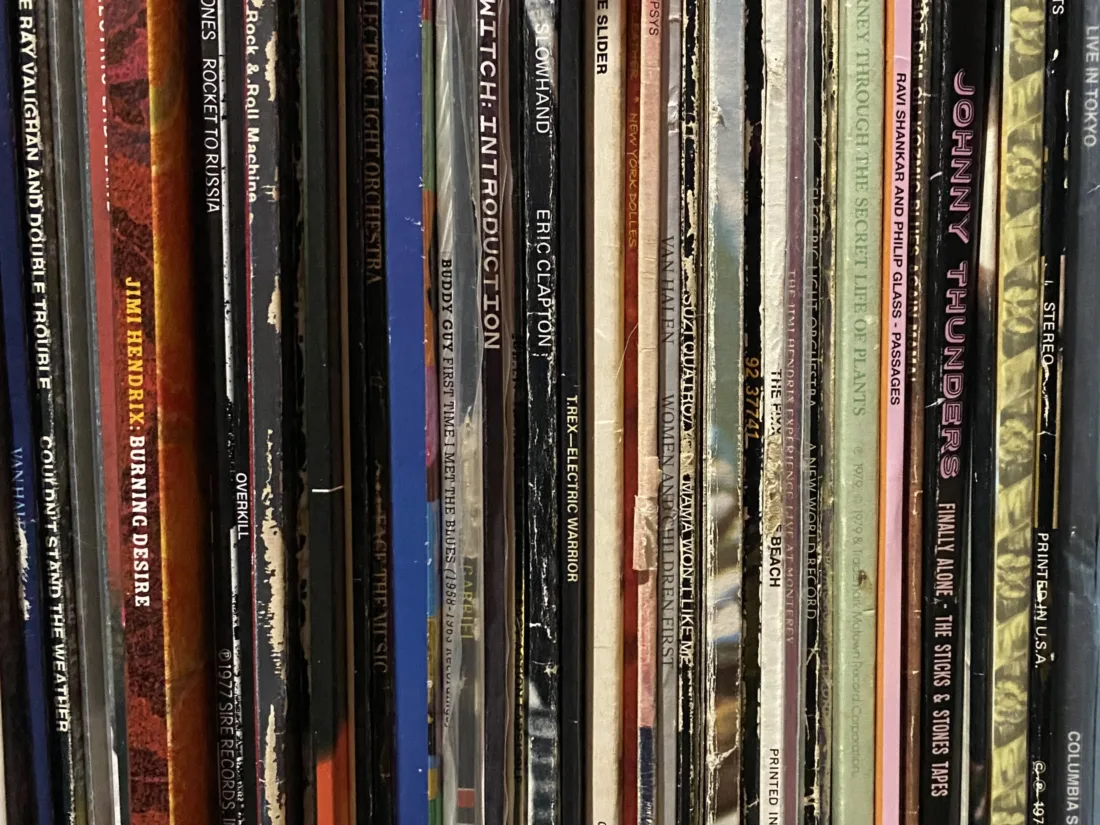
The front page of The Sheaf Publishing Society’s January 2026 issue is home to an article titled “Spinning Back to Ourselves: Why Vinyl’s return matters for university students and our mental health,” authored by Katherine Walcer. The article is passionate and very well articulated. It makes a compelling argument for how listening to vinyl LPs could be a boon for university students, as it offers an intentional and ritualistic way to connect with ourselves and our interests, free from digital distraction. I commend Walcer for writing this article and recommend that you take time out of your busy day to read it. It speaks to the moment and how important it is for young people to fight against being controlled, monitored and drained by digital environments that are negative for their mental health.
I can’t help but recognize, however, some personal disagreements with premises articulated therein. My disagreements with the article are as follows: It conflates vinyl listening with intentional listening, and it doesn’t see the idea of intentional listening to its true conclusion. I would like to offer a friendly and spirited rebuttal to The Sheaf readers with the hope of providing a slightly diverging perspective on intentional music listening and its benefits for university students.
I’d like to start by doubling down on what I think is the most important aspect of Walcer’s article, namely the benefits of intentional listening. Social media environments are built by making choices for the user based on how an algorithm thinks the user behaves. This creates a space where users are fed more content than they find, and leads to an eventual disillusionment and identity crisis. The user has a hard time distinguishing between what the algorithm thinks they like and what they actually enjoy. Walcer deftly identifies and, correctly, points to intentional listening as the cure, musically speaking. By choosing to buy a record, taking it home and listening to it, you are making a conscious choice to dictate your time on your own terms. I think that is an altogether positive thing.
The problem lies in the purchasing of the record itself. A look back to 1984 reveals that pop records of the time cost roughly $10 pre-tax. If you adjust this figure for inflation, it shows that a Canadian music listener was paying what amounts to about $26 today for a vinyl copy of Purple Rain 42 years ago. Now, as popular as Prince might still be, Walcer points to a few examples of albums that have become the Gen Z “vinyl staples”: Arctic Monkeys’ AM and Taylor Swift’s Midnights. Looking at the catalogue of the large Canadian LP retailer Sunrise, we find that both AM and Midnights are selling for $42.99 pre-tax in 2026, a 65 per cent price markup from the 1984 pop counterpart.
Walcer claims at the end of her article that the vinyl revival is a “revival of ourselves” as music listeners, but I believe it has very little to do with the vinyl: the real revival is in intentional listening, no matter the format.
It is true that the LP format lends itself better to intentional listening than CDs, given that there are no skips, no fast forwards and no pausing. Saying that you need a vinyl copy of an album to intentionally listen to it, however, has the unintended side-effect of putting the experience behind a paywall — a paywall that has been marked up 65 per cent over the last half-century. That is also to say nothing of the barrier to entry for LPs. An entry-level turntable that won’t mangle your records can cost up to $300, and then you still need speakers or headphones. It’s a lot to ask of young people in our economy who want to reclaim their habits.
I believe that the act that matters is sitting down and listening to music without distraction. Whether that’s via CD, MP3, vinyl, cassette, gramophone, whatever it may be, you’ll get the benefits of ritual and disconnection. I think that all the warmth of vinyl is lovely and indeed very human, but amounts to an expensive quirk of the medium. Cassettes, for instance, are rife with warping, warmth and humanity (see their penchant for random self-destruction) and are generally available for a fraction of the price.
While intentional listening is a fantastic thing, the real benefits come when we decide to forgo modern music listening habits completely. If you want to really reap the benefits of having a taste in music, and moreover listening to music in general, I recommend cancelling your streaming service of choice. This is a choice I made in mid-2025, and I can guarantee you that if you are a music lover, no matter how annoying it might initially be, the benefits are innumerable.
I’ve found that, now that I don’t use Spotify, every piece of music I listen to feels more imbued with a sense of purpose. I see myself in all the music I listen to, whether MP3, CD or LP, because there is no algorithm dictating anything for me, and I’ve chosen everything myself. Sure, I don’t get to send people links to songs they might enjoy, but the feeling of telling somebody about a piece of music that I took time out of my day to enjoy is far more gratifying.
This disconnect from Spotify is actually what led me to start looking at the vinyl industry as a cash-grab because it becomes completely unrealistic to spend $42.99 CAD (or more!) on every record you want to hear but don’t already own. It also means that I can enjoy intentional listening anywhere, not only in my basement next to my turntable. I can say that this has done wonders for my mental health, and I hope that everybody who reads this and is serious about wanting to reclaim ownership over their taste gives it thought.
Maybe I’m splitting hairs here, and maybe it isn’t that serious. That said, I think that this article, as a response to Walcer’s piece, is in the spirit of what both of us are trying to communicate about intentionally appreciating things. I think the fastest-acting cure to the sort of general malaise that social media and algorithms engender is choosing where to spend your attention. Purposefully taking time out of your day to do something and thereby reclaiming your agency in a world that seems to thrive on you throwing away your attention for someone’s bottom line.
So go buy that record if you’ve got the cash, but remember that even if you don’t, you can still appreciate all the benefits of caring about what you listen to, read or watch; it just takes a little discomfort. Katherine Walcer, if you’re reading this, I look forward to your next article. For what it’s worth, I recommend checking out Ryuichi Sakamoto’s final piano album, Opus, as I’ve been spending a lot of time with it recently. If you’re interested in the vinyl copy, though, I would wait until the used prices go down a bit.
Leave a Reply