
THE UNIVERSITY OF SASKATCHEWAN’S MAIN CAMPUS IS SITUATED ON TREATY 6 TERRITORY AND THE HOMELAND OF THE MÉTIS.
THE UNIVERSITY OF SASKATCHEWAN’S MAIN CAMPUS IS SITUATED ON TREATY 6 TERRITORY AND THE HOMELAND OF THE MÉTIS.
Interviews with Enactus executives on how this student-led entrepreneur group is giving back to the community practically and sustainably.
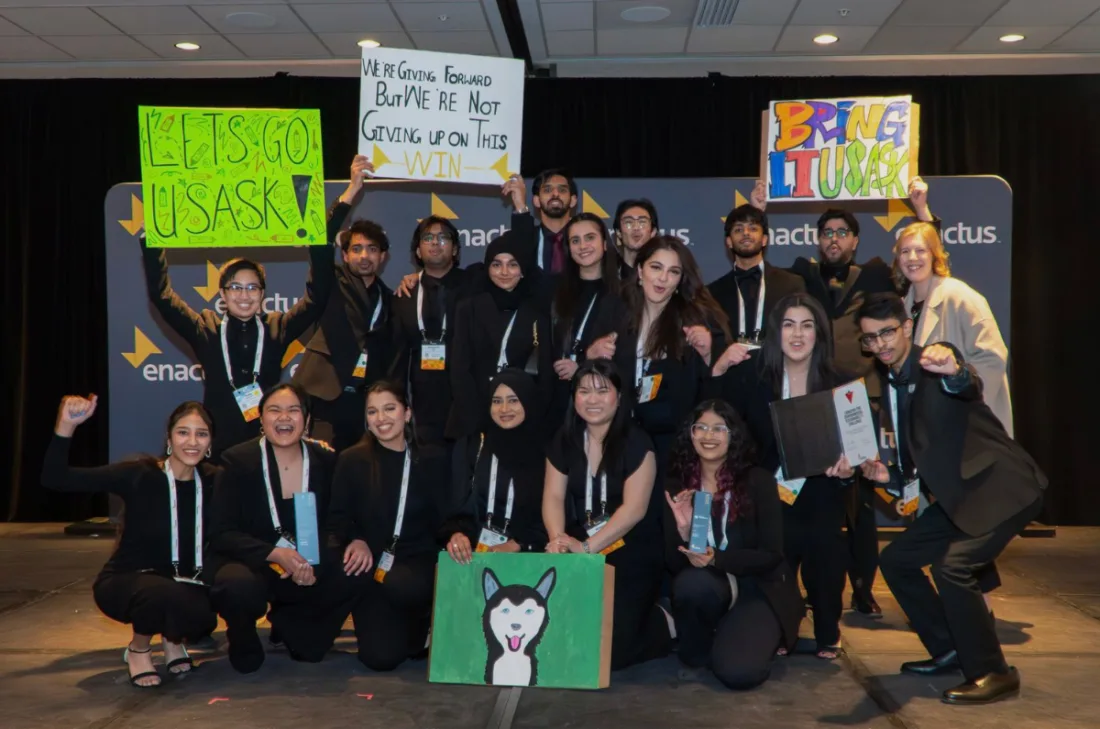
Enactus is a worldwide non-profit that operates through student-led volunteerism on campuses, focusing on creating sustainable practices and the application of business skills to address issues in the community. While Enactus is business-oriented and generally more attuned to students in the Edwards School of Business, it accepts members from any college.
Sauyna Vohra, a second-year Psychology student and President of Enactus USask, and Marium Baig, a third-year Management student and the group’s Vice-President of Marketing, sat down with The Sheaf to talk about the group’s three main projects: Re-colour, Build-A-Business and Giving FWRd.
Re-colour
Re-colour is one of the group’s projects that focuses on reducing waste by recycling used crayons. Used crayons are donated from restaurants around the city and then are melted down by volunteers during the group’s meetings and cast in a mould to create new ones. The group sells kits of crayons that are reinvested into other projects and also donates crayons to local daycares.
Baig explains that “Every Thursday [during] our meetings, we’re actually melting and peeling crayons. We peel them, put them in our pot, stir them, they melt, then we pour them into our moulds. We wait about 20 to 30 minutes, [then] it’s ready for packaging.” Vohra adds that “We [also] make recycled paper out of the peels [because] we don’t want to waste anything.”
Build-A-Business
Build-A-Business is Enactus’ four-week program that partners with another nonprofit, SaskAbilities, that teaches business skills to individuals with intellectual disabilities. The program includes three workshops devoted to the introduction to entrepreneurship, budgeting and marketing, respectively. As Baig explains, this project “focuses on empowerment, confidence building and accessibility … A lot of these people have great ideas, but they just don’t know how to get started … We give them the knowledge, skills and [tools] to actually start their project.”
“We also try to provide them with financial grants,” Vohra adds. “Last year, it was $1,000 we provided.” SaskAbilities acts as a mediator between Enactus and the individuals with disabilities, because each individuals’ needs are different. “SaskAbilities helps us bridge that gap and tells us the participants’ needs, and that’s how we cater our presentation.”
Giving FWRd
Giving FWRd (Food Waste Reduction) aims to reduce food waste by making meals out of food found in grocery stores that are nearing their expiration date.
Baig explains that “we take large amounts of food that are often discarded because they’re near the expiry date, and then we make it into food. We [also] include menstrual kits. We’re partnered with the Saskatoon Food Bank, where we receive all the pads and tampons, [and] we’re also partnered with Shoppers, where we get discounted items to make hygiene kits as well that [get] distributed to people in need.”
Baig continues that “Last year, we decided that we wanted to incorporate Indigenous culture into Giving FWRd, so we had an Indigenous chef [who] came out from a company called CHEP and he made an Indigenous soup.”
Vohra and Baig explain that they’re partnered with Mustard Seed, a nonprofit organization that feeds and shelters unhoused individuals in communities. Vohra says that “We make the meals and then [they] go directly to Mustard Seed, and then they just hand out the food to the people that are living there … We also do clothing donations as well. Our members, friends and family bring clothes, and [then] we send [them] to Mustard Seed as well.”
Baig says that she first wanted to get involved with Enactus in her first year. “I just wanted to make friends and do something, so my first position was a photographer for the club … The first event I attended was Giving FWRd, and so I took photos for that event, and I think we were doing so much that it kind of connected to me. And so the next year, I applied for the Project Manager of Giving FWRd, and I worked on making the project better. That’s how we got menstrual kits and hygiene kits, because I added that into our project … I really wanted to be part of Enactus because I know that we are helping the community and I wanted to do something that [would] actually help people.”
Personal Experiences
Enactus USask also participates in regional and national competitions with other Enactus campus groups across Canada annually. Members who have put in the most volunteer hours are selected to attend the regionals or nationals competitions each year. The competition involves a presentation of the projects each group has been working on and is graded on innovation and impact. “We tell them [how] many years these projects have been running for, and the average amount of work has been put into it,” Vohra says.
“One thing we’ve heard in all our competitions whenever we go is that Re-Colour is so innovative,” Vohra continues. “It was one of our students at USask who was in a restaurant having a family dinner, and they saw that [the crayons] her cousins were using got thrown away, [even though] the crayons were hardly used.”
When asked about their favourite memories of being involved in Enactus, Vohra and Baig pointed to their time spent with other members. Baig said that “Our nationals trip last year, when we went to Calgary, was probably one of the most memorable, because we had [a lot of] fun … We spent a lot of time together as a team, we were doing a lot of team bonding, and we did really good in the competition.”
For Vohra, “My best memory would have been in December of last year, when we decided to have a Christmas card night. So in one of our Re-colour workshops, we had Christmas cards and each one of the team members [was] writing cards for each other. It was super sweet.”
When asked about why someone should join Enactus, Baig said that “I think that it’s a good opportunity for students to create a real impact while you’re still in university. You gain leadership experience, teamwork skills, and [it’s all] hands-on. You’re getting business knowledge that goes far beyond what our classrooms teach, and it’s about [causes] you care about. If you care about sustainability, if you care about social justice, entrepreneurship or community service, you come together, and you turn those ideas into action.”
“We want to create as big of an impact as we can in the community and for the world,” Vohra added. “Whether it comes to sustainability, community service or just helping people out in any way, [either] mentally or physically, the more people we have, the more impact we can make … That’s [a] reason [we want] more people to join.”
She adds that “What we are aiming at as an organization is to bring sustainability as an everyday concept into the community … It’s like brushing your teeth. You know that you have to do it every morning and every night. That’s how we want the coming generation to see sustainability. They should understand that protecting the environment is something that is not just your responsibility or duty –– it’s just an everyday thing.”
Students who are interested in volunteering with Enactus are encouraged to reach out to the USask club @enactussask on Instagram for more information.

Leave a Reply