
THE UNIVERSITY OF SASKATCHEWAN’S MAIN CAMPUS IS SITUATED ON TREATY 6 TERRITORY AND THE HOMELAND OF THE MÉTIS.
THE UNIVERSITY OF SASKATCHEWAN’S MAIN CAMPUS IS SITUATED ON TREATY 6 TERRITORY AND THE HOMELAND OF THE MÉTIS.
My Contributions to Updating USask’s Coat of Arms Entry
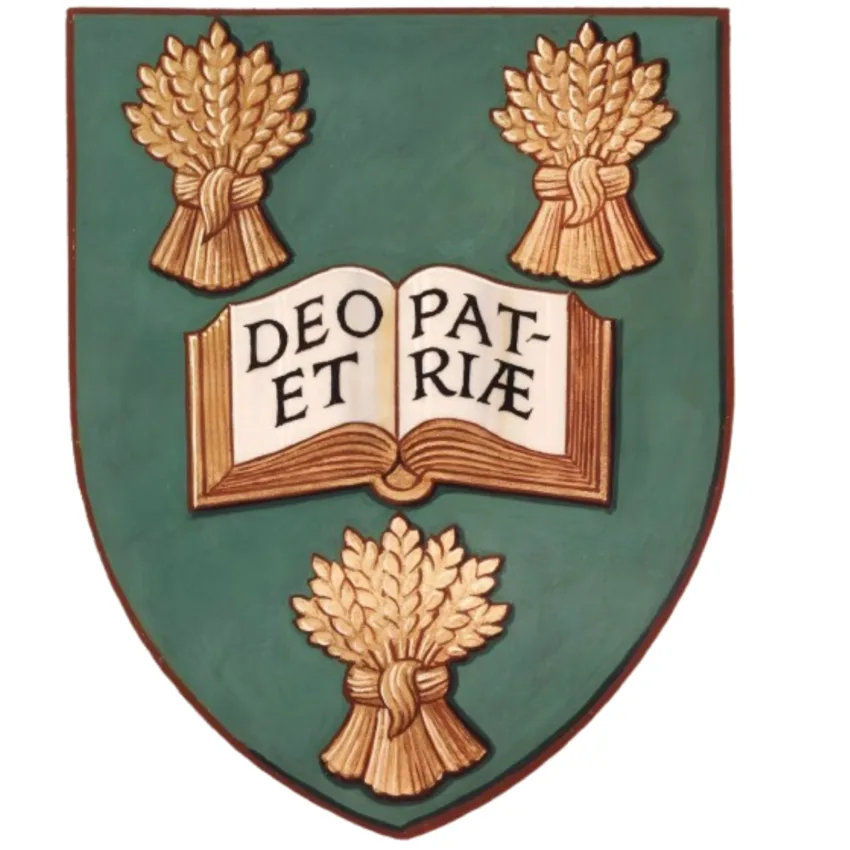
In 1908, the University of Saskatchewan designed the first version of the coat of arms that all USask students have come to know and love. The original purpose of the design was to create a seal for authenticating the university’s important documents. The seal included a shield within a ring bearing the university’s Latin name, Universitas Saskatchewanensis, and the institution’s founding date in Roman numerals, MCMVII — 1907.
The shield that was chosen was based on the well-known Arms of Oxford University, with a few modifications. Oxford blue became Saskatchewan green, and Oxford’s three crowns became garbs of wheat. Like Oxford, the university’s motto — Deo et Patriæ [God and Country] — was inscribed prominently upon the book.
This design of the coat of arms was used without authorization until 1978, when it was brought to the university’s attention that heraldic emblems borne without royal approval are “assumed,” and thus technically illegitimate.
Realizing that such behaviour was unbecoming for an institution of higher education, the university’s Board of Governors applied to the English College of Arms for a grant of heraldic emblems based on the design already in use.
The petition was approved by England’s Earl Marshal in 1978 who then issued his warrant to the kings of arms to begin the process of scrivening, painting and gilding the letters patent that would formally grant the university its emblems on a sheet of vellum. The patent was then signed and sealed by the kings of arms in wax skippets hanging from the document. Once they were finished, the letters patent were presented to the university.
In 1993, the arms’ registration with the Canadian Heraldic Authority (CHA) were authorised by Canada’s deputy herald chancellor on the recommendation of the chief herald. The CHA is a uniquely Canadian institution established in 1988. Its creation — the first of its kind among the Commonwealth realms outside of the United Kingdom — removed the necessity for Canadian individuals and institutions desiring coats of arms to apply to England’s College of Arms or Scotland’s Court of the Lord Lyon. The CHA is formally headed by the governor general, though in practice it is their secretary, in their capacity as herald chancellor, who administers the institution, with the chief herald providing day-to-day administration. The CHA is largely funded by the fees paid by petitioners for their grants of arms.
As a heraldry enthusiast (yes, we exist, and yes, we are a riot at parties), I did some research into the university’s coat of arms entry in the Public Register of Arms, Flags and Badges of Canada. I was disappointed to discover that there was very little listed under the entry; only the formal written description, called the blazon — “Vert an open book Argent inscribed DEO ET PATRIAE in letters Sable between three garbs sheaves Or” had been recorded. If you’re wondering why they couldn’t just say “on a green background, a white open book with DEO ET PATRIAE written on it in black letters between three gold wheat sheaves”, welcome to the ancient tradition of heraldry, where the vocabulary hasn’t changed much since the 14th century.
Remembering that I had previously obtained photocopies of the original letters patent granting the arms from the university’s archives, it occurred to me that it might be possible to have the university’s entry updated.
My quest to get this information on the Public Register began by contacting the Canadian Heraldic Authority, which is a department of the Office of the Secretary to the Governor General of Canada.
I submitted an inquiry to the CHA, providing the images I had obtained and a message expressing my hope that the university’s entry could be updated with them. I also provided the symbolism of the various elements of the coat of arms, which had also come from the archives, as this information was also absent from the existing entry.
Within a short time, I was contacted by the Miramichi Herald, one of seven heralds at the Canadian Heraldic Authority — all of whom are named after one of Canada’s many mighty rivers. If you ask me, it has to be one of the coolest job titles in the federal government. Who wants to be a policy analyst when you can be the ‘Miramichi Herald’? Heralds are officers of arms who are responsible for the administration of heraldic matters, including the registration, approval, confirmation and creation of heraldic emblems.
The herald was interested in updating the entry but emphasized the need to obtain permission from the armiger; in this case, the university. Thus, my quest continued with the university’s administration.
The herald informed me that her office would begin contacting the university, but that I could also help to identify the proper contact person to expedite the process of obtaining permission. I reached out to the university’s media relations department, who doubtlessly were surprised to receive such an odd request. They seemed willing to help but required more details about the information that would be shared with the heraldic authority.
I provided the relevant information and some information about the Public Register. I also emphasized that many, if not most, other Canadian universities already have their arms in the register, and that these included McGill, Alberta, Toronto, British Columbia, Calgary and Regina. It turns out that nothing moves the administration quite like the fear of looking less cool than the University of Regina.
After some time, I received a reply from the media relations department that the matter had passed into the hands of the university secretary — one of the highest-ranking university officials after the chancellor and vice-chancellor — for the final decision. I was excited to receive this message and was cautiously optimistic, but I understood that there was a decent chance that permission would be denied.
More time passed, and I was eventually forwarded an email by the media relations department regarding communication between the university secretary and the heraldic authority. It turned out the authority had reached the secretary before me, although I like to think that my inquiry through the media department reminded the secretary of the request.
The email revealed that the authority informed the secretary that “a University of Saskatchewan student” (yours truly) had reached out to them and that the authority was requesting permission to use the images I had obtained from the archives to use in the register.
The email indicated that the secretary had been in communication with the university’s archivist and that they had concluded that the request was of importance to both the university and to Canada as a whole, and that permission was granted to the Canadian Heraldic Authority to use the material on the register.
As of writing this article, the heralds and their assistants have updated the university’s entry on the register to include the image I provided to them, as well as a description of the symbolism of the arms. It can be seen on the Public Register’s website at gg.ca/en/heraldry/public-register/project/198.
I had a lot of fun with this project, and I am extremely pleased with the result.
I would like to give a very special thank you to the university secretary, the University Library Special Collections staff, the university’s media relations department, the Miramichi Herald and all of the wonderful people at the Canadian Heraldic Authority for considering my request and their willingness to help me preserve and document this piece of Canada’s heraldic history.

Leave a Reply