
THE UNIVERSITY OF SASKATCHEWAN’S MAIN CAMPUS IS SITUATED ON TREATY 6 TERRITORY AND THE HOMELAND OF THE MÉTIS.
THE UNIVERSITY OF SASKATCHEWAN’S MAIN CAMPUS IS SITUATED ON TREATY 6 TERRITORY AND THE HOMELAND OF THE MÉTIS.
[An epic struggle erupts each year at the Canada-Wide Science Fair. This is my story.]
The snow is melting. A crisp breeze blows through the air. On the sidewalk, the tranquil lapping of a flowing stream of melting ice water can be heard.
There is a house. Inside the house, a middle-aged woman watches the backyard from a window, rarely blinking. An 11-year-old boy eats pasta, seated on a stool against a kitchen island. The boy finishes his food and wordlessly exchanges places with the woman. Now the boy is the one looking out the window, while the woman has a small snack and checks her text messages. Outside, in the backyard, three porcelain plates sit on the snowy ground. On each plate rests a pile of seeds. The seeds are neatly sorted, each plate supporting only one type of seed for a total of three different seed types.
Groundbreaking science is taking place here. Groundbreaking for me, anyway. This was eight years ago. I was the boy. The woman was my mom.
It was groundbreaking because this was my first-ever science fair project. I was in grade six, the year the annual science fair competition at my elementary and middle school became mandatory. It would remain mandatory for the next two years.
I had initially pitched what sounded like a cool project, based on a template I found online. However, my T.rex genetics project idea had been unjustly rejected by my science teacher, mostly because it wasn’t an experiment at all.
So, I was forced into this. I had about a month to complete this experiment. However, for a few weeks, the birds had not been forthcoming. It wasn’t until the day before the written project report was due that the birds miraculously emerged from their tropical migrations. I had to collect all the data that day and answer my research question: which type of birdseed do birds like most? (Spoiler alert: it’s sunflower seeds.) Each time a bird landed on a particular plate, its species and the seed type it went for were recorded.
A year passed by quickly and I now found myself in the next science fair season. This time, I was immersed in a perfunctory and tedious effort involving modulating the number of eggs one puts into cake batter. I had selected this experiment under duress, mostly because the premise of it guaranteed that my mother would have to bake at least six cakes. Begrudgingly. It would seem that desserts need not be made by their chef happily, or even willingly, in order to taste good. That year, as well as the one before, brought me no prizes.
Another year passed and now I was in grade 8. This year, something was different—my mother was no longer the one doing most of the work. This year, I was in charge. I was in charge because the work was fun. I was studying fossil trilobites, a type of long-extinct marine bug-like creature that existed ages before the dinosaurs. I had found a large fossil site that produced them. I compared the lengths of their fossils and where they were found. That year, I won first place at my school’s science fair, which meant I would represent my school at the regionals.
For the uninitiated, the science fair is not merely a cute little event at your school, or just for your child or younger sibling. It’s a whole racket. At regional science fairs across Canada each spring, students compete for various prizes. Some cash here, a certificate there. But the top prize is the most difficult to obtain and the most coveted. Each regional science fair sponsors a handful of the top projects and students to go on to the annual CWSF: the Canada-Wide Science Fair. During my time as a science fair pageant queen, I often compared this event to the Hunger Games.
I did not experience horror or suffering at these Hunger Games; far from it. The comparison stemmed from how glamorous the event made each finalist feel, and from the fierce competition amongst teenagers it invariably played host to. The CWSF’s host city rotates on a 3-year schedule. Ottawa, Fredericton, Edmonton. My CWSF was in Fredericton.
Anyone is free to conduct whatever science fair project they’d like, within ethical constraints, of course. But, generally speaking, most, if not all, projects that go to CWSF from regionals will be medicine-focused. I used to compare these people to the “Careers,” the highly-trained and elite group of youth that Katniss Everdeen must struggle against to win the Hunger Games.
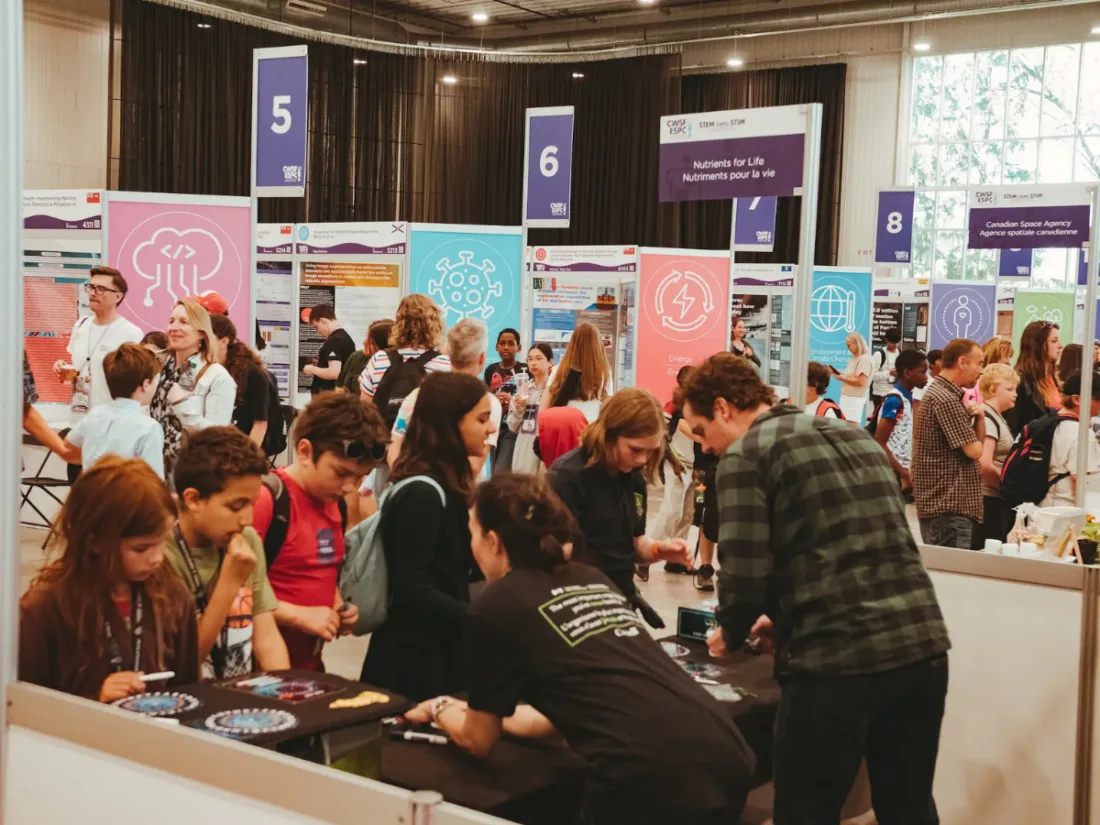
The other regional finalists and I flew out from our hometown on a Porter flight bound for New Brunswick. It was the first time I ever really travelled on my own, the first time I had not been completely accounted for. The plane served Biscoff cookies. I ate one and felt like a superstar. Ditto for when we landed and were greeted by a hallway of cheerleaders, all dressed in the CWSF’s signature purple.
As with all social situations throughout my youth, I felt out of place here. The other finalists wore suits or smart-looking gowns. I wore a sweater and jeans. They were curing the world of all its diseases. I was looking at rocks. Even here, amongst nerds, these other people seemed effortlessly “cool” in that nebulous, undefinable way that I never was. Never could be. But, for this one week, none of that mattered. All that mattered was me. Me and my fossils. It was one of the best weeks of my life.
The presentation hall smelled like Home Depot. For whatever reason, that made it feel all the more prestigious, even though prestige isn’t really the first thing I associate with Home Depot. The ceiling was higher than any I’d ever seen. Our posters weren’t cardboard anymore. No, now they were printed out on huge pieces of paper and taped to industrial-looking display boards. The paper had to be transported in plastic tubes. The fair itself was a week-long affair. There was a talent show night, a celebratory kick-off gala with a buffet dinner and bottomless chocolate pie, a bus tour of the Bay of Fundy, a tour of the University of New Brunswick’s most impressive labs, a private street fair, food trucks, fireworks and an until-11 p.m. finalist lounge that served something called “Purple Cow”—a saccharine neon drink that tasted like a horrifying hybrid of milkshake and grape-flavoured cough medicine. It was intoxicating. The science fair, I mean, though that purple liquid was somehow quite appealing as well. It was a 9-day-long scientific rager that never seemed to end. Until it did.
The final awards ceremony was terrifying, but terrifying in that way that makes you feel alive. Important. As though you have everything to lose. You, who never knew there was anything to lose. You, who thought there would never be anything you could truly excel at. You, who thought your ideas would stay trapped inside your head forever as you wandered around the playground at recess. You, who never knew the world was this big. This wide. This open. You, who thought the four corners of the universe were your home, your school, the park and the strip mall with the grocery store. Now the whole world’s open to you, and it’s never closing again. Things will never be the same.
That year I won a silver medal. I heard the French-Canadian announcer pronounce my name with pride: “Gray’am ‘Opkeenz!” In my mind, I had beaten the “Careers”. The Hunger Games were mine. I, and the 20 or so other finalists who’d achieved this, posed for our group photograph. I clutched that medal tightly. I was grateful, but hungry for more. More of all of this. More of my life. More of these things I do.
I would return to the CWSF a second and final time. Grade 12, my last year of school ever. Until the gilded gates of USask welcomed me, I mean. Go Huskies!
It was just as great as it had been then. I lived that moment again. It was one of those rare seasons of life where things truly feel as though they’re coming full circle. When you get to revisit a long-forgotten moment in time. I didn’t know what was ahead. But for this week, this last, final week, I was going to party again. That first CWSF in 2019, there had been another award I noticed. I didn’t get it. It was an award from the Canadian Museum of Nature for the best natural history-focused project. Sitting there in Fredericton, I thought to myself, “I want to get that someday.” Well, I did. I walked out of the awards hall in 2023 and watched the sunset over the river in Edmonton, medal in hand.
So what’s the takeaway? The takeaway is that I’m a genius and you should all bow down to me! Just kidding. If this science fair saga stroked my ego, then the rest of my high school experience kept me very, very humble. I used to hate that fact. But now, sometimes, I feel something close to gratitude. For all of it. The good and the bad. I hear a little voice silently whisper, “thank you.” It takes me a moment to realize that little voice is mine. I never thought it would be.
All of this is in the past, obviously. But it’s also somehow not. I feel those days everywhere now. I feel that excitement when I’m presenting a poster at a USask student research event. I feel that bittersweet pang of joy whenever I see that specific shade of purple that coloured the CWSF logo. I feel a quiet, implacable longing whenever I see photographs of myself from that time. It’s always there. It’s all around me.
My challenge now is to accept the past and all its heartbreaks and triumphs, while also planning for the future. A future whose stakes and rewards will be so much greater than those adolescent flickers and embers. Those moments that truly meant nothing at all but felt like the entire world was beginning or ending. Those moments that felt life-saving or life-ruining. Those moments that sit around me now like fallen leaves in autumn. These ghosts.
I’m here now, working towards my degree in paleontology. I don’t know what the conclusion is to any of this. To this life we have. I only know what I felt back then. Everything was alive, everything was in motion, everything was joyous. I am dedicating my life to feeling more things like that, experiencing more stories like this.
If I am to succeed, the things I experience will likely be very, very different. But I would guess that they’ll feel very much the same.
Leave a Reply