
THE UNIVERSITY OF SASKATCHEWAN’S MAIN CAMPUS IS SITUATED ON TREATY 6 TERRITORY AND THE HOMELAND OF THE MÉTIS.
THE UNIVERSITY OF SASKATCHEWAN’S MAIN CAMPUS IS SITUATED ON TREATY 6 TERRITORY AND THE HOMELAND OF THE MÉTIS.
Data over a five-year period on where and what type of crimes are committed on campus, and a discussion about improving campus safety with students and the USSU’s Vice-President of Student Affairs
In Statistics Canada’s 2024 Crime Severity Index of metropolitan areas, Saskatoon retained its spot in the top 10 cities in Canada with the highest crime rate, coming in at number six out of 40 cities included in that list.
The Saskatoon Police Service (SPS) provides a daily overview of crimes within Saskatoon at map.saskatoonpolice.ca. In the map’s terms of use, the SPS advises that the locations identified on the map “indicate the general area in which the incident occurred and are not intended to identify the exact incident location,” and that “the data is susceptible to a degree of error due to the complexities involved in compiling and programming” it.
From Oct. 1, 2020, to Oct. 1, 2025, there have been approximately 2,624 Criminal Offences reported in the U of S Management Area, which stretches from College Drive to the Circle Drive North Bridge and includes the main campus, according to the crime map. 292 incidents were recorded in U of S Management Area South, which includes College Quarter residences, over the same five-year period.
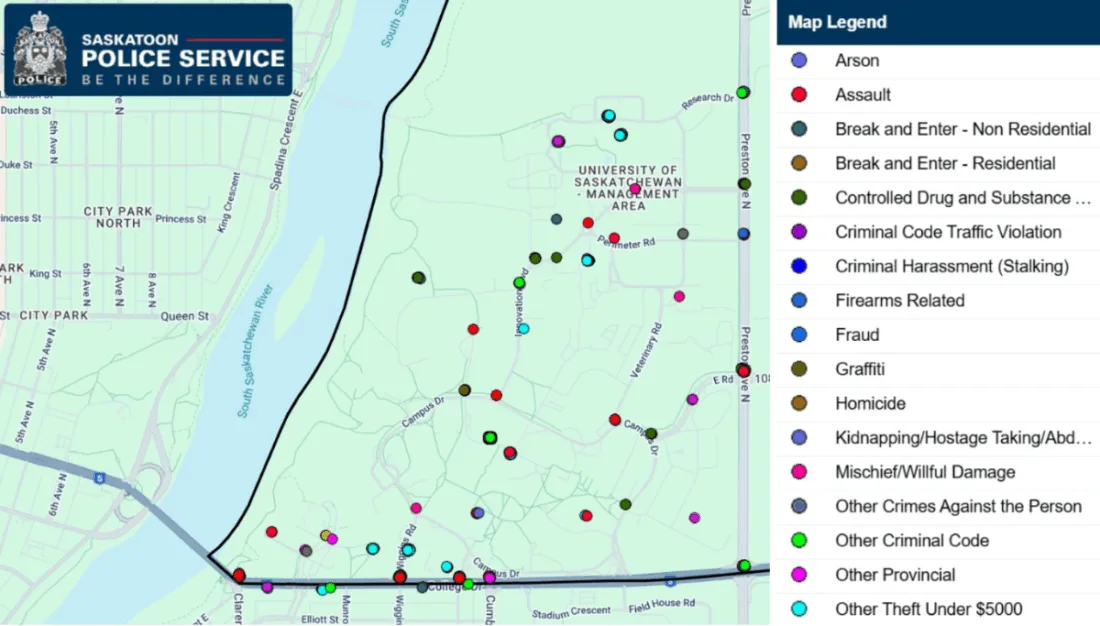
Because the U of S Management Area includes parts of Preston Crossing, a closer approximation of incidents on the main campus (excluding the 1,397 incidents that happened on Preston Avenue) is 1,227 in the past five years.
It’s also worth noting that about half of the total crimes on the main campus are attributed to the Royal University Hospital (RUH) area. The map shows that 651 incidents can be attributed to happening on the 100 block of Hospital Drive. There has been a single homicide in the past five years in the U of S Management Area, which happened inside RUH in 2022.
The most common incidents that occurred on the main campus were 948 incidents of Theft Under $5,000, 334 Provincial Traffic Safety Act violations and 200 incidents of Assault.
A total of 324 incidents located on the main campus were considered Crimes Against the Person—crimes that cause harm directly to individuals that include offences such as Assault, Robbery and Sexual Violation. Only 45 instances of Crimes Against the Person were reported in Management Area South during the same time period.
Of these Crimes Against the Person, a total of 30 incidents of Sexual Violation were reported on the U of S Management Area. According to the University of Saskatchewan Sexual Assault Prevention Policy Procedures Document, “To increase awareness on campus, incidents of sexual assault or sexual misconduct that are reported to Protective Services will be logged and posted on the Protective Services website. This log will be updated on a regular basis.” However, there is no such log that exists anymore.
In a statement to The Sheaf on where this log is, the university responded that: “As part of our proactive approach, the USafe app has replaced traditional website data charts. This user-friendly tool delivers timely, location-specific safety alerts, helping students stay informed and make decisions that support their personal safety. By focusing on relevant, real-time information, USafe avoids unnecessary alarm while enhancing awareness.”
USask states that the misleading information in the procedures document is because the Sexual Assault procedures document has not been updated in over 10 years, but it plans to update the Sexual Assault procedures document this academic year. It also states that it used to have the practice of posting all criminal activity on campus, but has abandoned this approach in favour of only posting real-time alerts.
While the city’s overall crime rate has remained in the top 10 list of Statistics Canada Crime Severity Index for a number of years, The Sheaf sought out what USask students are saying about crime and safety on campus.
10 students who answered a poll were randomly selected for an interview, and each indicated that they generally felt safe on campus and that Protective Services does a good job of addressing crime and safety. The following answers are to the question of: “Do you have any ideas or recommendations on how the university could improve safety on campus?”
Loa, an Anthropology major, suggested that the university ought to “address the stigma when it comes to homeless folks outside.” She says that increasing awareness around addressing stigma in vulnerable and unhoused populations will help people think in a more caring and respectful manner, “instead of operating in a way where you’re on guard and afraid [which] can be disrespectful.”
Multiple students interviewed said that improving lighting in dark areas outside and having an increased security presence in the tunnels at night would improve safety, such as increased patrols or more cameras. Some students interviewed noted that the tunnels connecting the Administration Building are particularly quiet and there aren’t normally many people around, especially at night.
Nadia, a Political Studies major, recommended that the university have more clarity on what constitutes the need to ask for help on campus. “Since it’s a public space, it can be hard to know when you should ask for help, or when it might be good to call Protective Services.”
John, a Master’s Student in Public Health, says that when his friend’s bicycle was stolen on campus, the cameras surveilling the area were not working. “Some [cameras] might be faulty, so I think that [the university should have more] regular maintenance to check if everything is functional.”
Out of 10 students interviewed, two had said that either themselves or someone they know have been victims of a crime on campus. Both said that they were incidents of theft.
Emily Hubick, the Vice-President for Student Affairs for the University of Saskatchewan Students’ Union (USSU), handles safety and security for students on campus. Hubick meets with Protective Services on a regular basis to talk about any prominent or current issues regarding safety that students have concerns about.
When asked about what safety issues are the most prominent on campus, Hubick points to sexual violence remaining a recurring concern. “The ‘Red Zone’ is the six to eight weeks following the start of the fall semester where a staggering amount of sexual violence occurrences happen [compared to] the full school year,” Hubrick says.
To address the Red Zone, Hubrick says that: “The Women’s Center does a lot with that, [like] the fantastic programming when we have Sexual Violence Awareness Week, but we’re looking this year to promote a more proactive approach from the university [such as] increasing some of the supports and educational tools that they have regarding sexual violence, and some of the more environmental barriers to crimes on campus [like] lighting in certain areas.”
Alongside programming from the USSU and the Women’s Centre, Hubrick says that students may also use the USafe App to request a SafeWalk. SafeWalk has been moved under Protective Services and students can request either an in-person SafeWalk, where a member of Protective Services will walk with the student to their destination, a virtual SafeWalk, which provides live location monitoring by Protective Services until the student arrives at their destination or a Friend Walk, which sends a student’s location in real-time to one of their chosen contacts so they can track the student’s location until they reach their destination.
Hubrick also says that on a yearly audit, she and the “Protective Services Manager and potentially another couple departments will go one evening to walk around campus to see what the different potential problem areas are [and] bring that forward to facilities and administration to see what we can do about making those areas a little bit safer.” Hubrick explains that part of this is also coordinating with the Women’s Centre and Pride Centre coordinators and volunteers to locate these potential problem areas on campus.
Hubrick says that students with safety concerns can contact the USSU “because we do have regular meetings with protective services and with different departments that may be able to influence something there,” and suggests that concerned students also reach out to Protective Services.
Hubrick encourages any student who is a victim of a crime on campus to contact Protective Services. If the student would like to remain anonymous in reporting, they can visit the Safe Disclosure Reporting ConfidenceLine, which is available 24/7 and can be reached online at usask.confidenceline.com or by phone. This line is managed by a third party and is for university members to report good-faith concerns or allegations without fear of repercussions or retaliation.

Leave a Reply