
THE UNIVERSITY OF SASKATCHEWAN’S MAIN CAMPUS IS SITUATED ON TREATY 6 TERRITORY AND THE HOMELAND OF THE MÉTIS.
THE UNIVERSITY OF SASKATCHEWAN’S MAIN CAMPUS IS SITUATED ON TREATY 6 TERRITORY AND THE HOMELAND OF THE MÉTIS.
The South Asian Fashion Staple that’s Sweeping Summer Styles
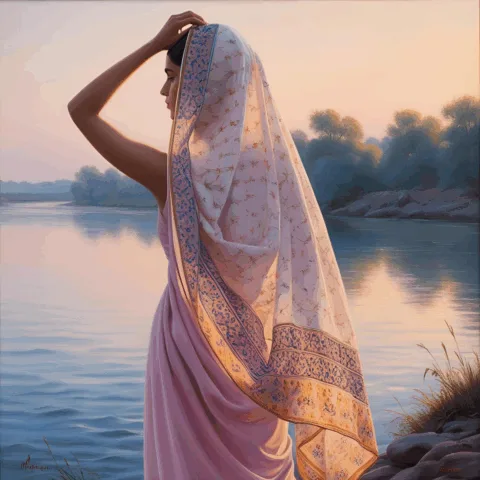
In case you aren’t chronically online like I am, or you’re just not in fashion spaces online, I’ll fill you in on the heated debate millions have been having about scarves this summer. Recently, bigger Western retailers like Oh Polly, Reformation, and Pepper Mayo have unloaded their summer styles upon the masses. People with keen eyes and knowledge about South Asian clothing have noticed that many of the new styles, labeled Scandinavian, Boho chic, and Ibiza fashion have a startling similarity to traditional styles of South Asian formal clothing.
There are two problems in particular that have sparked moral outrage from thousands of South Asians: Firstly, the lack of recognition towards South Asian creators and the colonization of traditional wear, and secondly, the renaming of these styles as European and Western fashion trends.
The biggest offender, that has really sparked the anger of South Asians, is the so-called “Scandinavian scarf.” South Asians around the world have collectively identified this scarf-wearing as a knock-off of the style that has been common in South Asia for several centuries, most widely known as a dupatta.
A dupatta is a long, rectangular scarf draped over the shoulders or head. It can be made from several different materials, and worn on any occasion. Historically, both men and women have worn dupattas, however it has always been more common amongst women. It serves several purposes, acting as a symbol of modesty, a fashion accessory and even as protection against heat and pollution. It is worn as a veil during religious ceremonies, in places of worship, during weddings, as a mark of respect in front of elders and to protect women from unwanted male gaze.
The word dupatta, which is one of many names for the garment, originates from the Sanskrit language and is a combination of the word “du” (meaning two) and “patta” (meaning a strip of cloth). The origin of the dupatta can be traced back all the way to the Indus Valley civilization over 3000 years ago. Paintings and sculptures from the medieval period have shown evidence of its existence in the Indian subcontinent for several centuries.
Before the arrival of the Mughals in the 16th century, dupattas were typically simple and unstitched pieces of fabric used to protect one’s modesty. The garment evolved from the uttariya, a similar veil that’s dated back to the Vedic period, in the 1st century CE. During this time, the way one draped their scarf was more significant than the material or design.
Following the introduction of Mughal culture, the dupatta began to transform from being just a piece of clothing to being a piece of art. During this period the design of the dupatta gradually became more ornate and elaborate featuring rich fabrics, intricate embroidery, and dazzling embellishments. From the 17th to 19th century, during the British colonization of the region, the dupatta’s design underwent further adaptations, with European fabrics and design elements being implemented in newer styles. From there, fashion and design continued to evolve, bringing us to the modern scarf we know today.
Across South Asia, different regions have developed and established their own designs that are unique to the local culture and craftsmanship. From phulkari dupattas in Punjab, to chikankari dupattas in Uttar Pradesh, the variety of modern styles is as vast and diverse as the subcontinent they come from.
Now, I’m not here to enter the debate on whether or not South Asian cultural clothing should be fiercely guarded under lock and key, or shared between the global community. My biggest concern, and the reason I entertain the discourse at all, is the dismissal that South Asians have been receiving from those that they inform. Thousands of comments like “it’s not that deep,” and “it’s just a scarf” have been posted under videos of South Asian women explaining why they’re hurt and bewildered by this bizarre re-branding of their traditions, despite the fact that the discussion and confusion is valid.
Wearing a dupatta is one thing, but adamantly refusing to see and understand that the piece of clothing has deep roots in South Asian culture is outright absurd. To label it Scandinavian when there is no record of Scandinavian people ever wearing scarves in that style at all, and ignoring the Scandinavian people that are outright saying that it isn’t theirs shows that this discourse goes deeper than just scarves.
Why make such bold claims about clothing without doing research? Why deny evidence and history, erasing rich cultural meaning for the sake of false innovation?
While there are a few reasons for this appropriation that come to mind, I’d rather just focus on the significance of the tradition, and the history woven into each and every dupatta.
The practice of adorning a dupatta is something every South Asian woman, both within the subcontinent and in the diaspora, is familiar with. I’ve admired the flowing fabric draped over our shoulders and necks for as long as I can remember. I’ve worn a dupatta on hundreds of occasions throughout my life. I threw one on this morning when I was leaving the house to get groceries, for crying out loud.
Wearing the dupatta isn’t just a fashion trend for South Asian women. It’s a tradition that has been passed down to us from older generations for centuries. It’s a cultural staple and a symbol of our heritage. It’s a familiar and comforting reminder of our grandmothers, mothers, aunts and sisters, and the safety that comes with their presence. It’s a nod to all of the women that came before us, and the artisans that have worked so hard to keep our history alive. No matter the ethnic or national background—Indian, Pakistani, Bangladeshi, Sri Lankan, Nepalese, or Maldivian—South Asians all know what it is, where it came from, and what it represents. It’s something that ties us all together despite all of the differences between our ethnic, national, and religious identities.
While other cultures might not put so much value in their clothing and jewelry, South Asians have always been very proud of everything they’ve created, and for good reason, since the dupatta is still making new waves in the fashion world centuries after it was first introduced.
I’m looking forward to seeing how popular retailers navigate this issue going forward, and seeing more recognition for cultural wear in everyday wardrobes. I hope this discourse brings about new conversations and appreciation for South Asian fashion, and the contributions it’s had on clothing and popular culture worldwide.
But please, from the deepest hollows of my soul, don’t re-brand jhumkas as “European chandelier earrings” next.

Leave a Reply