
THE UNIVERSITY OF SASKATCHEWAN’S MAIN CAMPUS IS SITUATED ON TREATY 6 TERRITORY AND THE HOMELAND OF THE MÉTIS.
THE UNIVERSITY OF SASKATCHEWAN’S MAIN CAMPUS IS SITUATED ON TREATY 6 TERRITORY AND THE HOMELAND OF THE MÉTIS.
ERIC MACFARLANE
Opinions Writer
The idea of a majority Conservative party government should not be as alien to Canadians as it seems to be.
Past Conservative leaders, including Mackenzie Bowell, R.B. Bennet and John Diefenbaker, all attained sizeable majority government status in the House of Commons. In 1984, the Progressive Conservative Party, under the leadership of Brian Mulroney, even won the largest majority government in Canada’s history.
However, a notable difference between past conservative governments and Stephen Harper’s current incarnation is that past conservative governments were formed by coalitions between “blue” and “red” Tories, among other stakeholders. Red Tories, as they are colloquially known, often tabled more progressive welfare and social policies than their blue counterparts. Such red policies allowed the conservative parties of lore to move into the centre of the political spectrum — where a large percentage of Canadians linger and cast their vote.
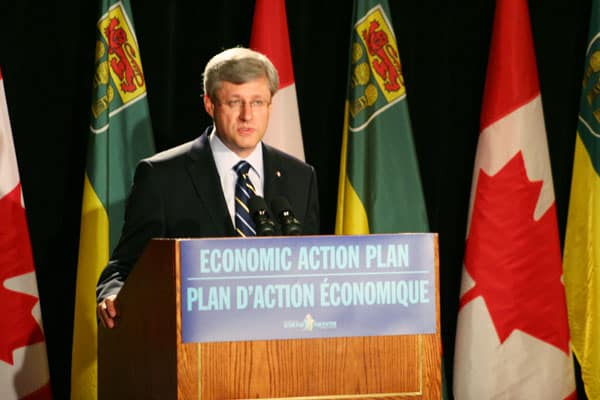
For the average Canadian, Harper’s Conservatives are just too blue to form a majority. Part of this can be attributed to the coalition that built the current conservative machine. In 2003, two right of centre parties — the Canadian Alliance and Progressive Conservatives — banded together to form the Conservative Party of Canada. The newly-formed party’s posturing and election of Harper as its leader provided no doubt that the socially conservative Canadian Alliance faction would dominate the agenda.
By the time Harper formed government in 2006, it was pretty clear that the number of reds in the party had declined or had their voices drowned out. Harper’s overly-centralized authority in the Prime Minister’s Office provided little room for debate or wavering from the thin party line.
In its formative stage, the Conservative party tried to sell itself as a less terrifying, hybridized right-of-centre government. But a number of policy thrusts were indicative of the party’s true colours. Harper proceeded to fulfill his election promise of having a vote in the House of Commons on whether to legalize same-sex marriages. Then, in one fell swoop, the party unwittingly lost Quebec by cutting funding to the arts, in spite of the fact that the government had painstakingly attempted to woo the province by formally recognizing its citizens as a nation. The recent census debacle further indicated that the party’s true blue are drowning out the rest.
Since 2006, successive polls have found the Conservative party to be in the lead in terms of public opinion, but never by enough to form a majority government. This is the case despite Harper’s successful shifting of the Canadian public’s political orientation slightly to the right. Although the Conservative party came close to a majority in the 2008 election, it represented more of a “no” to Stéphane Dion and his carbon tax, than a “yes” to Harper.
I am not suggesting that Harper will never forge a majority government — but a scenario in which it could feasibly happen seems beyond reason at this point. The Liberals already reached their nadir under Dion, Canadians will continue to demand more on the environmental front, and eventually most voters just get sick of incumbent governments anyway.
The sole scenario which might allow a Conservative majority would be a public declaration by both the NDP and Liberals of their intent to form a coalition. This would push the Liberals out of the political spectrum’s centre, opening up a vacuum for the Conservatives to exploit. Although an unlikely development, it is — like all things in politics — entirely possible.
But don’t hold your breath; Harper’s Conservatives will probably erode their political capital before the opportunity presents itself. Canada’s true blue are simply too blue.
– –
Lesley Porter
Leave a Reply