
THE UNIVERSITY OF SASKATCHEWAN’S MAIN CAMPUS IS SITUATED ON TREATY 6 TERRITORY AND THE HOMELAND OF THE MÉTIS.
THE UNIVERSITY OF SASKATCHEWAN’S MAIN CAMPUS IS SITUATED ON TREATY 6 TERRITORY AND THE HOMELAND OF THE MÉTIS.
EMMA GODMERE
CUP Ottawa Bureau Chief
OTTAWA (CUP) — Mike Dunn could make a modest down payment on a house with the amount of money he currently owes in student loans to the Canadian government.
“According to the notice that I got from the student loan people, I owe a total of $28,548 in federal student loans and an additional $3,450 in provincial loans to the credit union here in Charlottetown,” the recent University of Prince Edward Island graduate said in an email.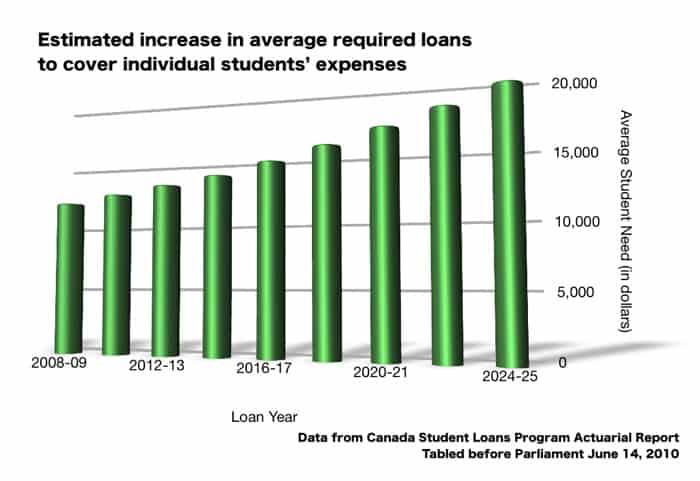
This year, in order to finance an overseas law school education, Dunn has taken out over $16,000 in a combination of 80 per cent loans and 20 per cent grants and scholarships. About half of that total figure has, once again, come from the Canada Student Loans program.
While his debt load — even for this year alone — is a large one to bear, it’s possible the political science and philosophy grad may not have been able to access the federal loans at all this September.
In August, Human Resources and Skills Development Minister Diane Finley realized the government was in danger of breaching its pre-legislated student loan-lending limit of $15 billion. In order to avoid hitting the ceiling and losing the legal authority to dispense loans to Canadian students this September, Finley used an order-in-council — an administrative decision approved by the Governor General — to extend the limit by $2 billion to ensure eligible students received appropriate loans this fall.
According to government documents, some 50,000 students could have been affected and would have had to find other means of financing their education this September.
A Canada Student Loans Program report tabled early this summer estimates the average student will require close to $20,000 in loans to cover general expenses for a year by 2025.
“The economic downturn resulted in a 10 per cent increase in student loan demand, from 2008”“09 to 2009”“10, as more students decided to begin or continue post-secondary education,” an HRSDC spokesperson stated in an email.
Despite those statistics, the department was still only prepared to near the $15-billion limit by 2014”“15, according to an annual report on the Canada Student Loans program, tabled in the House of Commons in June.
Dave Molenhuis, Canadian Federation of Students national chairperson, is concerned with the minister’s decision to extend the national borrowing limit.
“This has essentially sped up the inevitable with the loans-based financial assistance system; we’re here four to five years before the system predicted us to be,” he said.
“We’ve got bad policies that exist out there which are begetting more bad policies … it’s unfortunate that the best solution to this issue that the government can come up with is essentially trying to sweep the problem under the rug.”
Dunn, while appreciative of the fact that he was able to receive his loans this fall, could not decide on whether the government’s decision was a responsible one or not.
“I’m not sure the current funding system for students is the best route overall for Canada to take,” he said.
Molenhuis emphasized that MPs will need to do more to prevent such a situation from occurring again.
“What this shows us is that there will have to be, sooner than we thought, actual legislative changes made to the Student Financial Assistance Act — and it will have to be made in Parliament if we are to continue to rely on a loans-based financial assistance system,” he said.
In the order-in-council documents, HRSDC proposed that a longer-term solution, which could include legislation, would ultimately be required.

Leave a Reply