
THE UNIVERSITY OF SASKATCHEWAN’S MAIN CAMPUS IS SITUATED ON TREATY 6 TERRITORY AND THE HOMELAND OF THE MÉTIS.
THE UNIVERSITY OF SASKATCHEWAN’S MAIN CAMPUS IS SITUATED ON TREATY 6 TERRITORY AND THE HOMELAND OF THE MÉTIS.
SEBASTIEN CADIEUX
The Link (Concordia University)
MONTREAL (CUP) — From growing up, you may not remember seeing Nipper, the adorable tyke who terrorized both neighbours and family in the funny pages alongside Charlie Brown or Dennis the Menace, but that doesn’t mean he isn’t a classic.
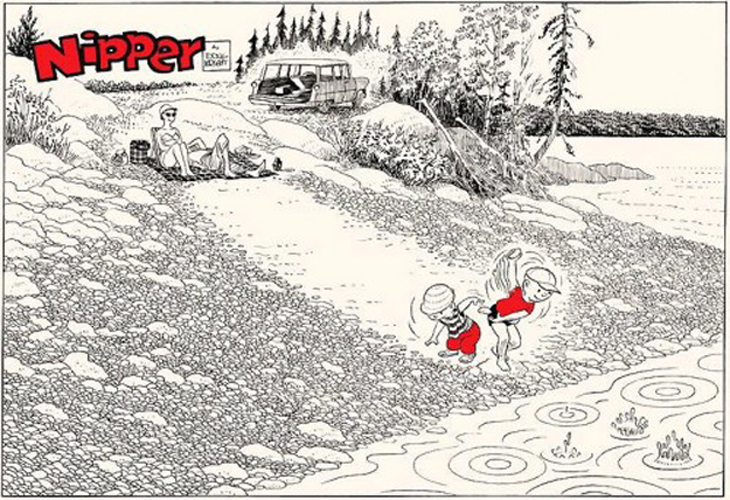
The invention of English-born cartoonist Doug Wright, Nipper has all but faded into the pages of comic history. One of Canada’s most prolific cartoonists in the 1950s and ”˜60s, Wright’s work appeared in the Montreal Standard’s Sunday edition before being serialized across the country.
The Collected Doug Wright: Canada’s Master Cartoonist is the first volume in a planned set showcasing Wright’s life work. This 14-by-nine inch hardcover from Montreal publisher Drawn & Quarterly may be the only fitting way to reprint much of Wright’s work, originally printed as magazine covers and detailed vertical comic strips. The book’s large format also serves to transport the reader back to a time when the Sunday paper’s large comics section was spread out over a bed or kitchen table and studied for hours.
The collection, edited and designed by Canadian cartoonist Seth, is mainly a portfolio of Wright’s published work, but it also includes a number of earlier art and sketches as well as a short but detailed biography of the man and his career.
It starts with the comic strips he drew of fellow servicemen during the Second World War — when he served in the Royal Canadian Air Force — and then moves on to his time as an illustrator for newspapers and magazines, covering Nipper’s decades-long run.
Though the strips started in the late 1940s, the world that the comic characters live in has a distinct local look that even modern readers will recognize.
The strips demonstrate Wright’s tremendous skill as an illustrator, with amazingly detailed depictions of period cars, houses, clothing and the like. More impressive still is his skill as a purely visual cartoonist. In the 13 years’ worth of strips (from 1949 to 1962) in this book’s collection, Wright warms the heart and provides poignant lessons on family along with humour — all without the use of dialogue.
The only words that appear in the strips either come in the form of sound effects or as details woven into the background. Doing away with dialogue not only shows Wright’s skill as a storyteller, but also his business savvy; he expanded his audience by leaping language barriers.
Due to the fact that most of his work was originally syndicated in newspapers, the opportunity to use a full range of colour did not often present itself. Wright used this to his advantage, however, choosing to use only one colour — red — for highlights, to colour key objects like a balloon or a car, or simply to guide the reader’s eye. The effect was amazing.
Wright’s visual storytelling and acute attention to detail elevate his work to the same echelon of comic strip artists as Bill Watterson, Milton Caniff and Charles Schultz, and cement his title as Canada’s master cartoonist.
Though this collection does sport a hefty price tag, it’s well worth the expense to own this nearly-forgotten treasure trove of Canadiana, if only to admire the beautifully-detailed and expressive illustrations.

Leave a Reply