
THE UNIVERSITY OF SASKATCHEWAN’S MAIN CAMPUS IS SITUATED ON TREATY 6 TERRITORY AND THE HOMELAND OF THE MÉTIS.
THE UNIVERSITY OF SASKATCHEWAN’S MAIN CAMPUS IS SITUATED ON TREATY 6 TERRITORY AND THE HOMELAND OF THE MÉTIS.
KAROL KUDYBA
Sports Writer
Eric Lindros. Pat LaFontaine. Keith Primeau — the list of players whose careers prematurely ended due to head injuries is a long one.
Starting last week, the NHL has finally stepped in to stop it from getting any longer.
In what can be seen as the codification of common sense, the NHL has added a rule that adds an automatic league review and possible suspension for any hit to the head from behind or the blind side.
Strictly speaking, the new rule prohibits “a lateral, back-pressure or blind side hit to an opponent where the head is targeted and/or the principal point of contact.”
In laymen’s terms: headhunting.
The new rule takes effect immediately and will remain active throughout the playoffs. After the season, the rule will be re-examined by the league, and almost certainly an on-ice penalty aspect will be added. As it stands there is still no penalty for a frontal hit to the head.
The seriousness of the new rule is evident in the immediacy of its enaction since most rule changes take place in the off-season. However, starting with Patrice Cormier’s elbow to Mikael Tam during a Quebec Major Junior Hockey League game that left Tam seizing on the ice, there has been an outcry for such a rule from around the country.
While there have been many terrifying moments in the past — any hits delivered by Scott Stevens during his career comes to mind — what sparked this immediate rule change is the number of dangerous hits since the beginning of 2010.
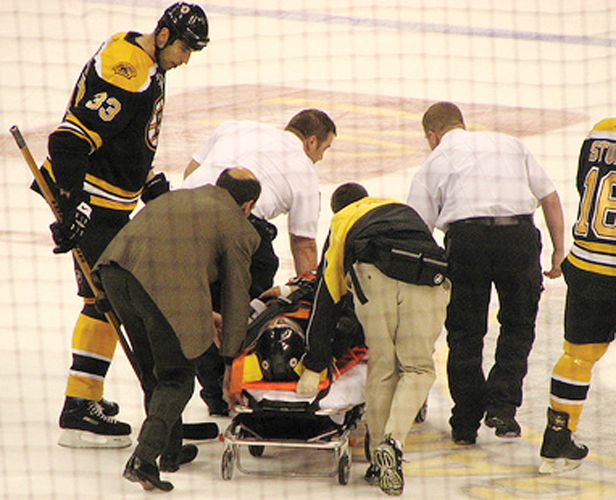
These hits follow a parade of many others that have already occurred this season. Brent Seabrook, Marc Savard and Patrice Bergeron have also missed time with head injuries. The latest recipient of one of these severe hits to the head is Panthers winger David Booth, who suffered his second concussion this season recently. Booth, who scored 31 goals last year has now unfortunately been reduced to a mere 28 games this season.
When players return from such injuries they are rarely the same. Bergeron went from being a potential offensive dynamo to a more defensive forward, less willing to stick his neck out in order to make a big play.
How long any suspension might be is undetermined. Whether the league will stiffen penalties for noted blindside hitters such as Matt Cooke is unknown as of yet.
The message the NHL is trying to send is clear: the goal is to ensure that no more professional athletes wind up in a hospital bed with a serious neurological disorder.
Had the NHL established a rule like this earlier, the what-if scenarios are endless.
The hit that Devils defenceman Stevens laid on Paul Kariya during game six of the 2003 Stanley Cup finals (which left Kariya motionless on the ice for several minutes), potentially had a direct effect on the outcome of the whole series. While Kariya managed to return and score the game-winning goal later in the game, he simply wasn’t the same in the deciding game seven when his Mighty Ducks fell to Stevens’ Devils.
Essentially, a player similar to a Stevens’ might not be able to make today’s NHL.
What does this mean for the future of hockey?
The future of players who bring a more physical presence to their style of play such as Cooke or Steve Downie may soon find themselves on the sidelines like the players they have injured.
At very least, Don Cherry’s next Rock’em Sock’em DVD might have less monstrous hit clips and a few more clips of fantastic saves but if that’s the trade off for saving a talented player’s future, it will be well worth it.

Leave a Reply