
THE UNIVERSITY OF SASKATCHEWAN’S MAIN CAMPUS IS SITUATED ON TREATY 6 TERRITORY AND THE HOMELAND OF THE MÉTIS.
THE UNIVERSITY OF SASKATCHEWAN’S MAIN CAMPUS IS SITUATED ON TREATY 6 TERRITORY AND THE HOMELAND OF THE MÉTIS.
TANNARA YELLAND
Associate News Editor
While many news outlets have spent the last two years examining the recession’s effects on business, employment and the home ownership market, little time has been dedicated to how the recession has affected post-secondary institutions such as the University of Saskatchewan.
As the global recession finally began to impact Saskatchewan in 2009, enrolment at the U of S saw an increase.
Undergraduate enrolment had been declining by about one per cent per year recently, U of S vice-president finance and resources Richard Florizone said. But this year, despite financial stresses from the economic downturn, undergrad admissions saw a modest increase of about one per cent while graduate enrolment went up by about eight per cent.
“Grad enrolment had been increasing by about four to five per cent (per year) already, so it’s a minor boost,” said Florizone.
The provincial government’s Minister for Advanced Education, Labour and Employment, Rob Norris, echoed Florizone’s statement. He said enrolment has gone up at the University of Regina and the Saskatchewan Institute of Applied Sciences and Technologies as well as at the U of S.
Florizone said the increase might be due to the economic uncertainty itself. A degree will — hopefully — offer some level of job security once a student matriculates.
If this trend continues it will place even more stress on the university to come up with its operating budget each year. While any university or college wants more students, in a time of financial insecurity an influx of students can put stress on the institution to come up with money for services.
The university met its budget for 2009-10 by combining its grant from the provincial government, which saw a 7.2 per cent increase, with a tuition increase of approximately three per cent. There was still a significant shortfall last year because the university’s investments saw a drop as the worldwide financial sector took a blow.
Some of the invested money that was lost came from pension funds, causing consternation. If that money continued to not return as much as was invested, it would eventually become difficult to pay former employees’ pensions.
But as global markets begin to settle down the investments are beginning to look more stable.
“The risk on our pension and investments has decreased,” said Florizone, “but what has gone up is the risk on the grant, and that’s something we’re quite conscious of.”
For 2010-11, the U of S has asked for an increase of 5.2 per cent to its provincial grant. Now that the university’s investments are more likely to provide some revenue, people are keenly aware that the government may not be as generous this year as it was last year.
Norris laid out evidence of his government’s dedication to post-secondary education including a $2.2 million addition to student loan enhancements.
“Over all, our government has invested over $1.1 billion in post-secondary education,” Norris said. “That’s a record.”
However, he was vague about what would happen in the next few years when the government is able to focus more on balancing its budget than on keeping institutions afloat, saying the government would “continue to do (its) best” not to cut funding.
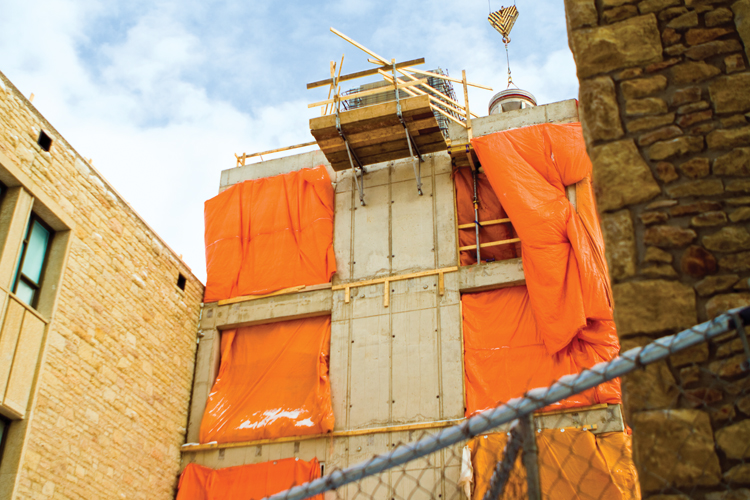
While the university has scaled back its operations budget by $10 million in the last year, the money spent on capital projects has risen significantly, driven by the surge in construction on campus. The projects, except for the Place Riel expansion, are largely funded through provincial and federal government grants.
The Saskatchewan government has committed hundreds of millions of dollars for current construction projects since 2005. This includes $200 million for the Academic Health Sciences project, the E wing of which is responsible for the giant hole on the corner of College Drive and Wiggins Avenue. In 2009, they offered $9.8 million for the International Vaccine Centre, and $15 million for new student residences.
The 2009 federal budget included up to $2 billion in new infrastructure funding for Canada’s universities as part of its stimulus package, but 70 per cent of this is set aside for deferred maintenance and repair projects.
– –
photo: Robby Davis

Leave a Reply